Banner Saga, a Norse-themed tactical RPG trilogy from indie studio Stoic Games, was one of the early titles to ride to prominence on Kickstarter this year. Now Nathan Grayson of Rock, Paper, Shotgun has posted a monster three-part interview/preview, and it’s fascinating stuff — especially the third part, in which the developers explain how the single-player campaign will work (in summary, “it’s a bit like of King of Dragon Pass meets Oregon Trail. It’s King of Dragon Pass on the road.”) While not quite a full branching campaign a la The Witcher 2, the player’s choices will matter, both from a gameplay and a story perspective. Characters will join or leave the party based on their satisfaction with the player; the player will have to juggle the party’s endurance and morale against the need to stay ahead of an all-consuming wall of darkness (this actually put me in mind of FTL), and there will be multiple endings. If that sounds interesting, it’s well worth heading over to check out the full article.
Meanwhile, we’ll get our chance to evaluate the core gameplay next month when a spin-off F2P multiplayer game based around the battle system, Banner Saga: Factions, is due out. This is one project that I’ll keep an eye on.
Sorry for the delay, folks. This week, I have not one, not two, but FOUR songs for you — all are from Sleeping Dogs, since I just praised its soundtrack in my review. Three sound more traditional to my novice ears: “Butterfly Garden” (Ritchie Lo, M. P. Mabel Ki, and Charles Chan), which I linked in the review, is a lovely, relaxing vocal piece, while “Lhasa Groove” and “On Buddha’s Land” (Ritchie Lo) offer something more energetic. The fourth, pop number “Yellow Fever” (note: Vivienne Lu, the artist usually credited, is a character in thegame; the actual composer is Nathan Wang) might not be the best song in the game, but good lord was it hard to get out of my head. Enjoy!
This entry is part 2 of 2 in the series Sleeping Dogs
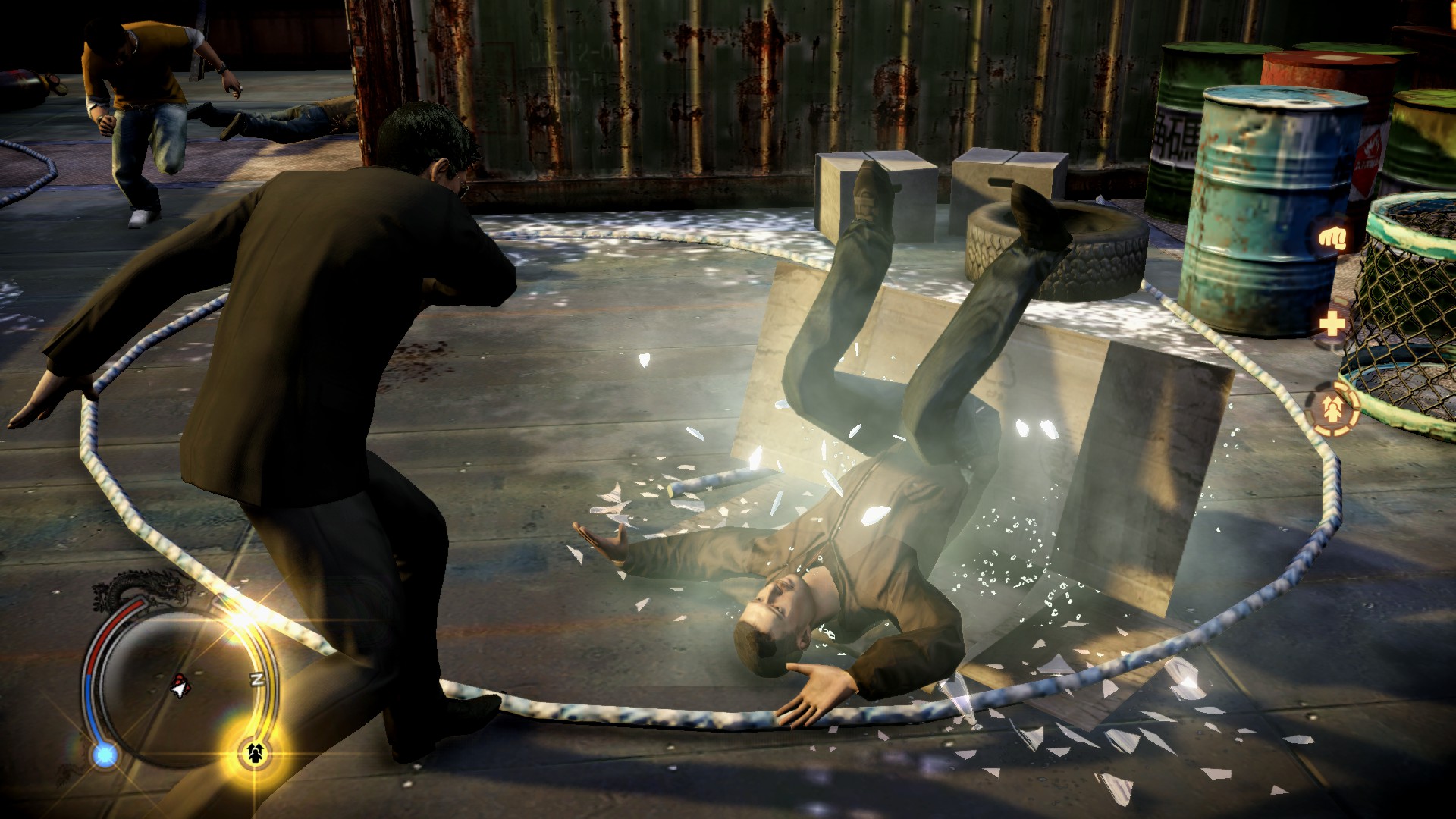
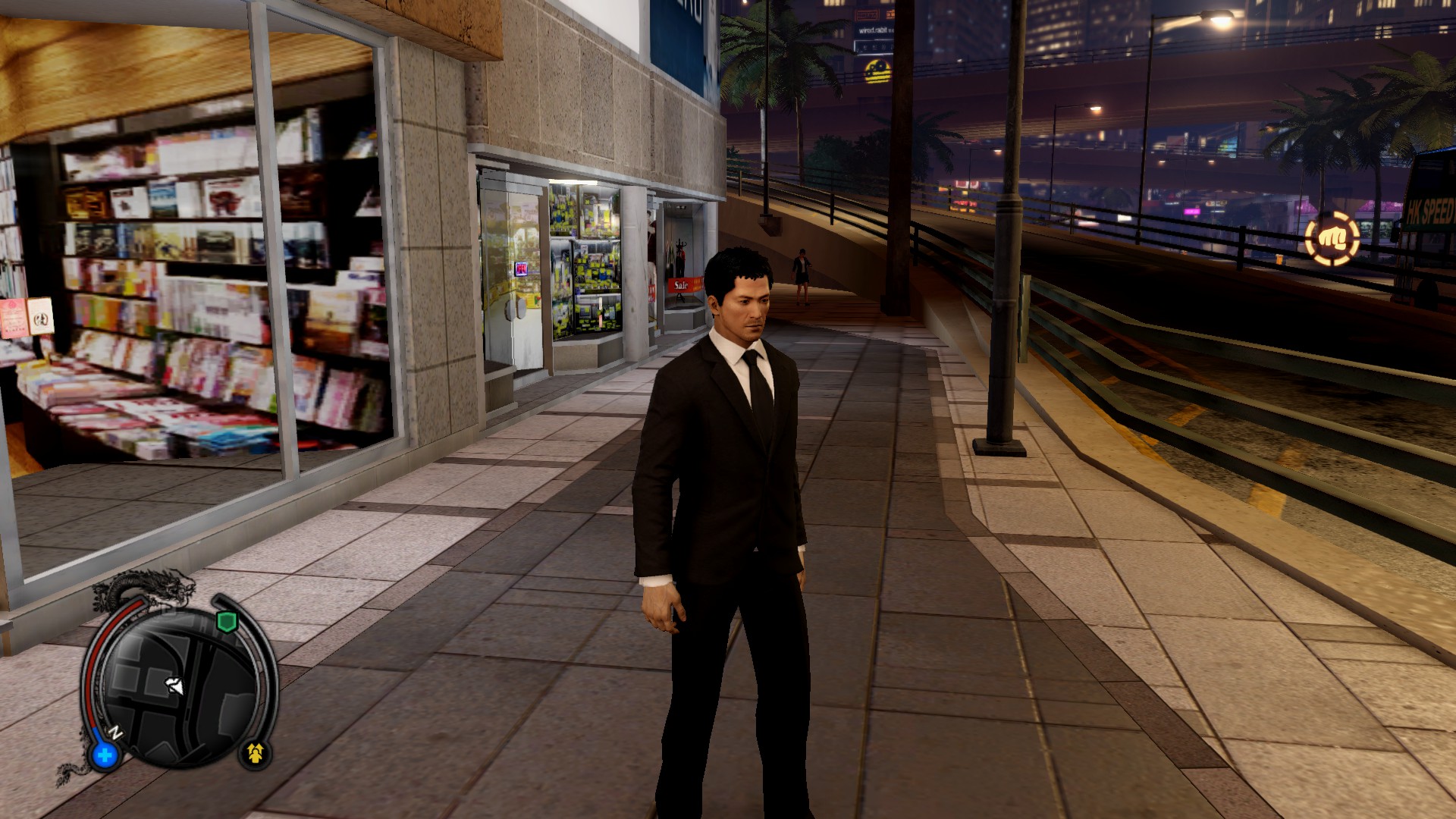
Sleeping Dogs is all about action, whether it be unarmed combat…
I must be one of the few gamers out there not to have played Grand Theft Auto, or any of the other modern-day, open-world, crime-themed games that it spawned. None had premises that appealed to me – until now. Enter Sleeping Dogs, United Front Games’ open-world extravaganza, which casts the player as undercover cop Wei Shen, tasked to infiltrate the most powerful crime syndicate in Hong Kong. This premise has been mined many times before for its dramatic potential, with the most obvious parallel being 2002 Hong Kong thriller Infernal Affairs. However, the key to Sleeping Dogs is that it’s not a homage to thrillers – it’s a homage to action flicks.
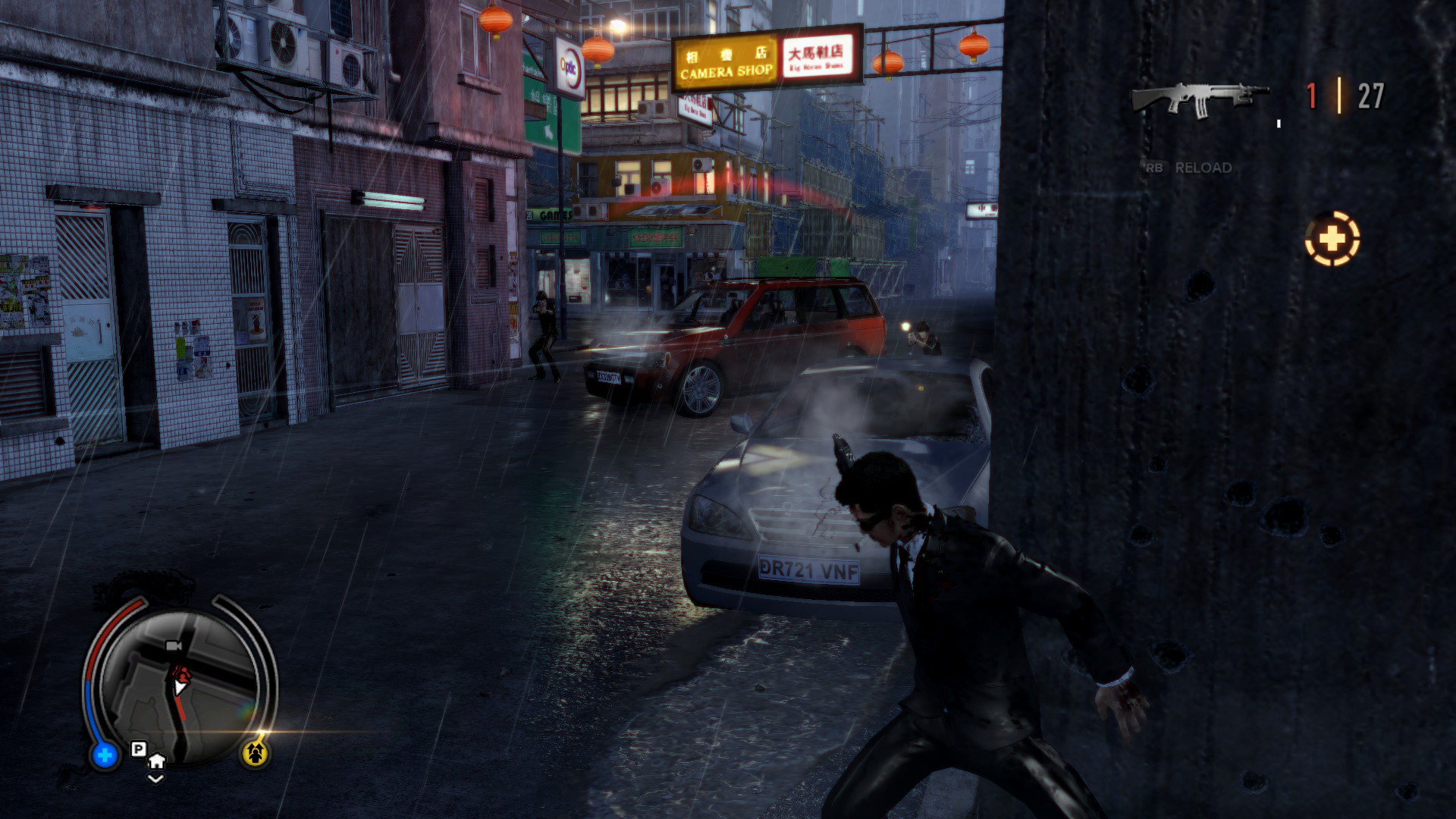
… firing from behind cover (NOTE: shooting without aiming works better with a shotgun)…
Specifically, Sleeping Dogs’ gameplay revolves around two activities: chasing rival mobsters, and pulverising them once you catch up. You chase them on foot (think the opening parkour sequence of Casino Royale) and in cars; you fight with fists, feet, and occasionally, firearms. The typical mission will involve pretty much every variation on these themes: Wei might drive to a target’s lair, disembark to beat up a first wave of guards, grab a gun to deal with a second wave of guards, jump into a car to pursue his escaping quarry, and finally jump from car to car in mid-chase to reach his foe. In between missions, there are other diversions available – special mention goes to a hilarious karaoke minigame (watch Wei during guitar solos, but make sure you don’t have anything in your mouth) – but speed and violence generally dominate the side quests, too.
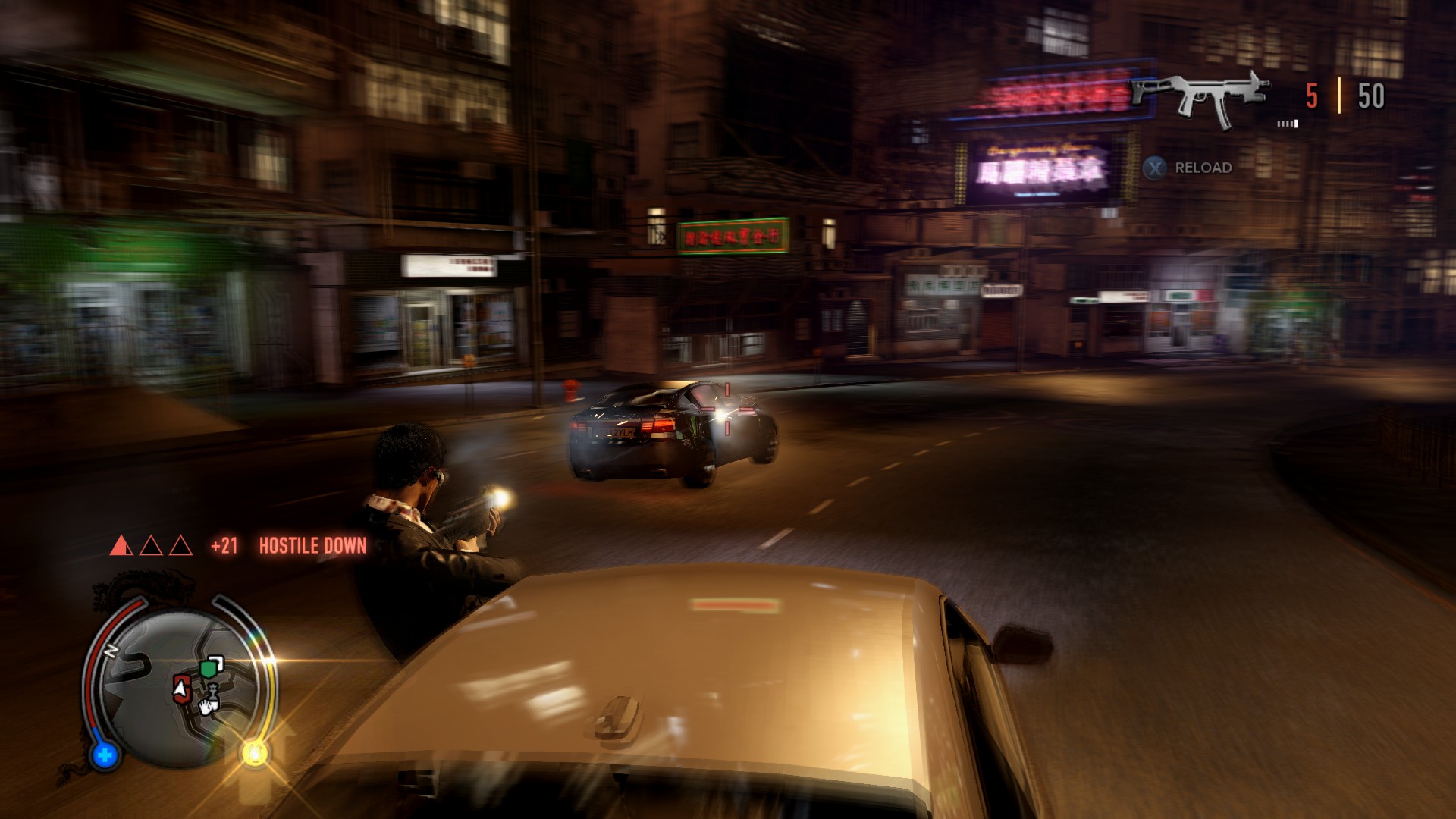
… firing from a car (rail shooting has never been this much fun!)…
This is not a flaw.
What Sleeping Dogs does best is recreate the excitement – and yes, over-the-top destruction – of good action movies. There are deeper dedicated brawlers out there – tapping or holding one button will run Wei through predefined combo moves; tapping a second button will counter enemy attacks; a third will allow Wei to grapple enemies and, often, finish them off with a spectacular use of the environment, such as throwing them into the water, slamming them into fuse boxes, or even impaling them on swordfish. There are deeper shooters out there: Wei’s options largely comprise hiding behind cover, popping up to shoot, or vaulting over an obstacle in order to enter bullet time. And while I’m no expert on racing games, I would be very surprised if there weren’t games with deeper driving models. But while each component is straightforward, the game (and the individual missions) string them together into an overall experience greater than the sum of its parts.
… or taking a brief break from firing, since even Wei Shen needs cover to survive a shootout.
The same holds true for the game’s story. Some sequences are laugh-out-loud funny, though they tend to be merely the comic relief between far darker events. On a deeper level, while the game is a long way from Shakespeare, it understands the importance of theme and character arc. Without them, I doubt I would have seen Sleeping Dogs through to the end – after 28 hours, I was getting a little bored of beating up gangsters and detonating their cars. With them, Wei’s adventures became a coherent, satisfying narrative filled with characters I cared about – characters who acquired depth through their different responses to one of the game’s central ideas, the lure of crime. I wanted to see how their stories would end, and that desire propelled me through an increasingly explosive (in every sense of the word) plot all the way to the credits. Far more ambitious games have done far worse.
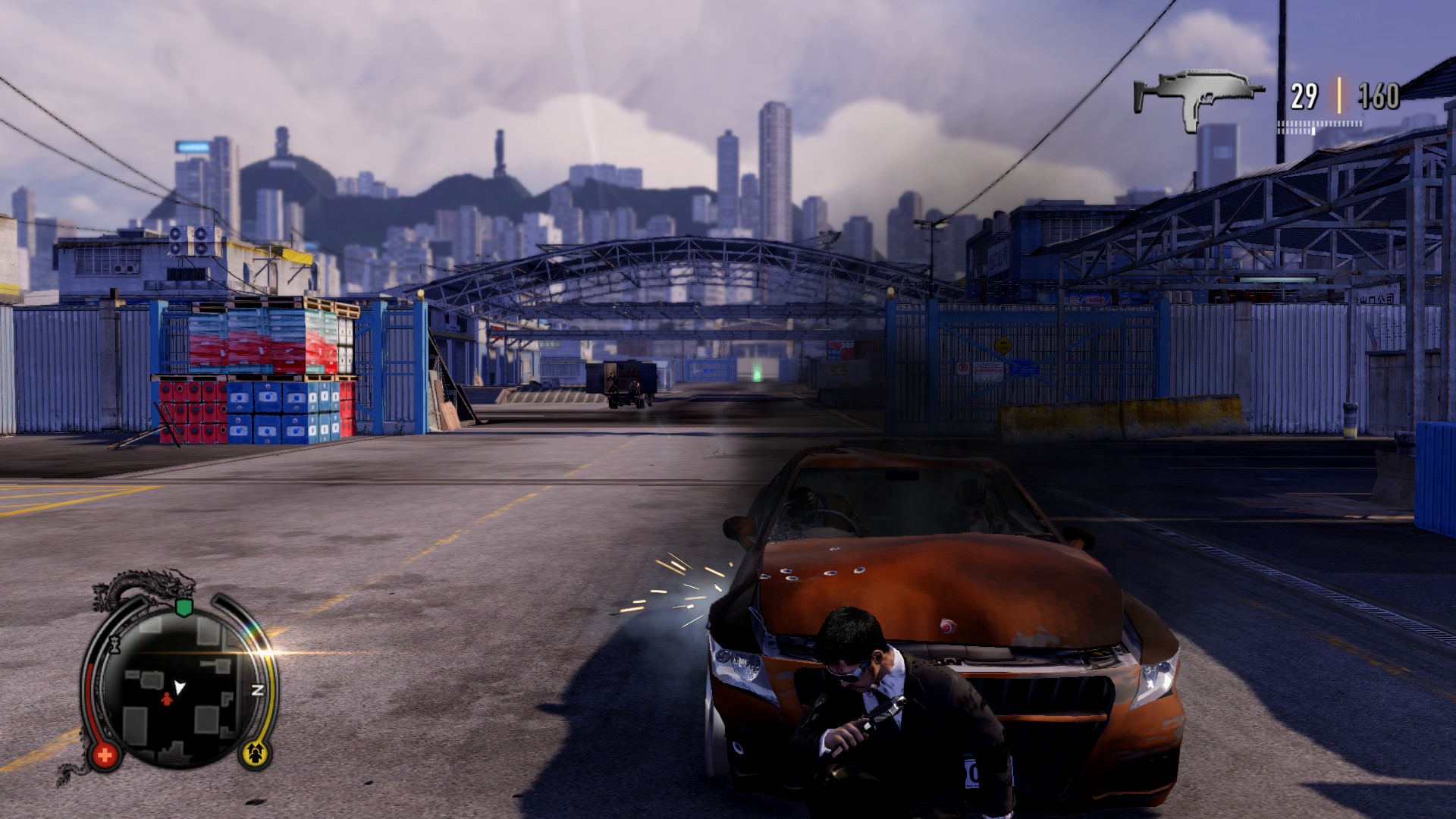
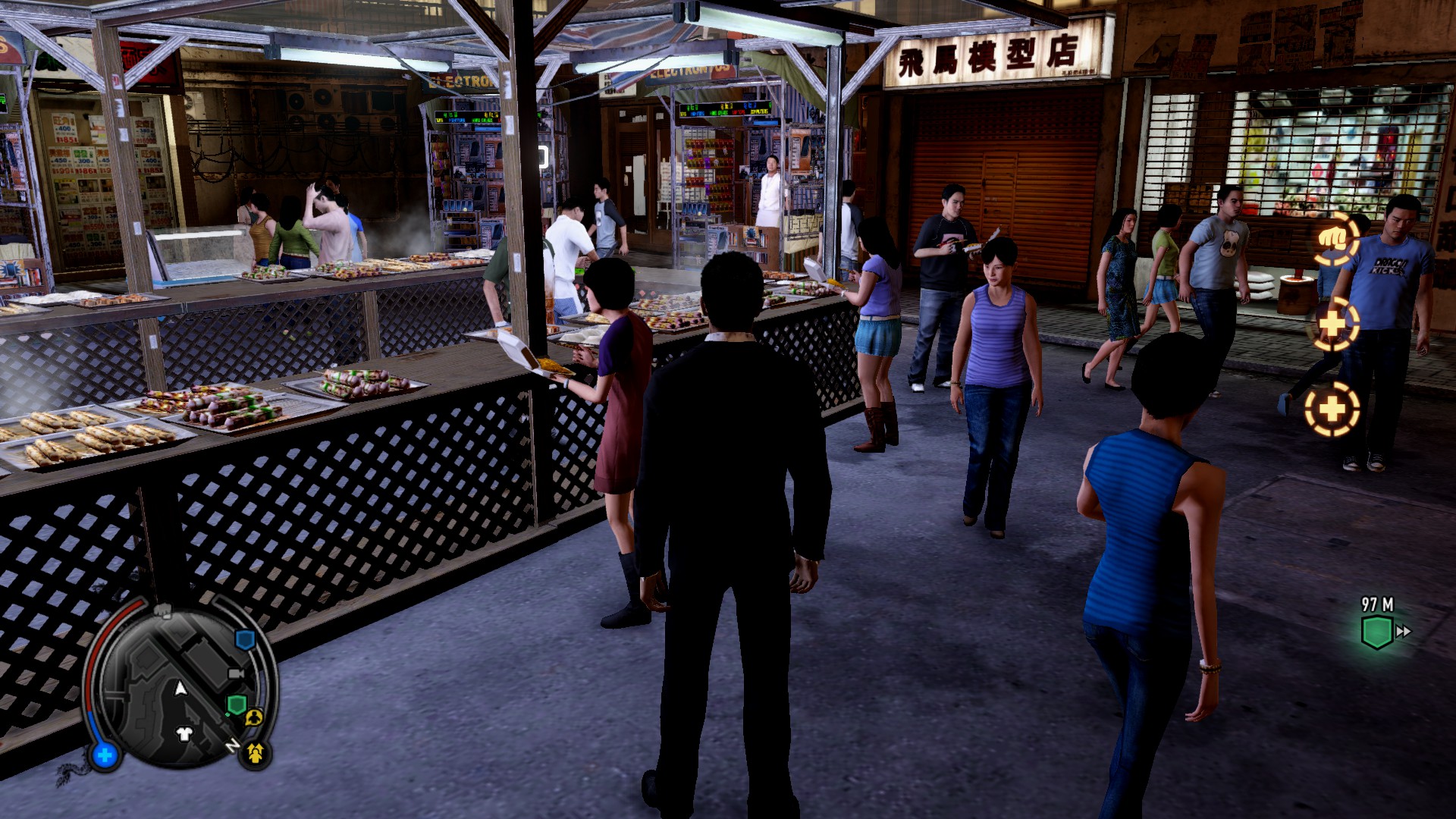
When Wei isn’t fighting for his life, he can take in the sights of Sleeping Dogs’ Hong Kong. Here, he visits the night market.
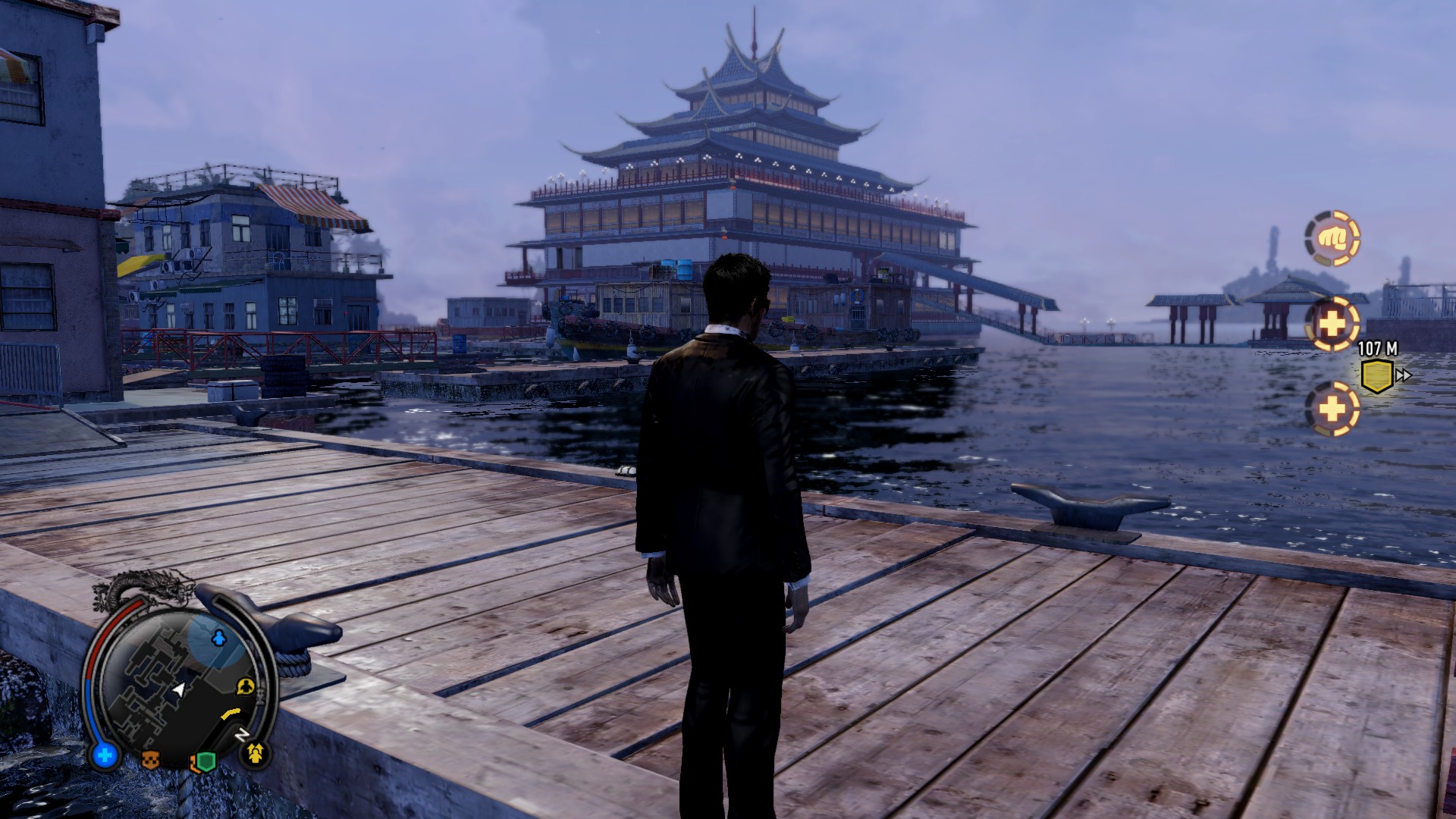
Lastly, I should give a shout-out to the game’s soundtrack, which did so much to convey a sense of place. There are quite a few songs available, but my favourites by far were the (often instrumental) Chinese tracks. Motoring around the game’s version of Hong Kong, with the rain pouring and the car radio pumping this into my ears, wasn’t just atmospheric and relaxing. In its own small way, it was an experience I could not have gotten from another game.
At the end of the day, I couldn’t have asked for a better introduction than this to the modern-day open-world genre. Sometimes hilarious, sometimes horrifying, often exciting, and always entertaining, Sleeping Dogs is a very good game, well worth my money. I look forward to seeing what UFG does next.
We hope you enjoyed this post! To quickly find this post, and our other reviews, click the “reviews” tab at the top of this page.
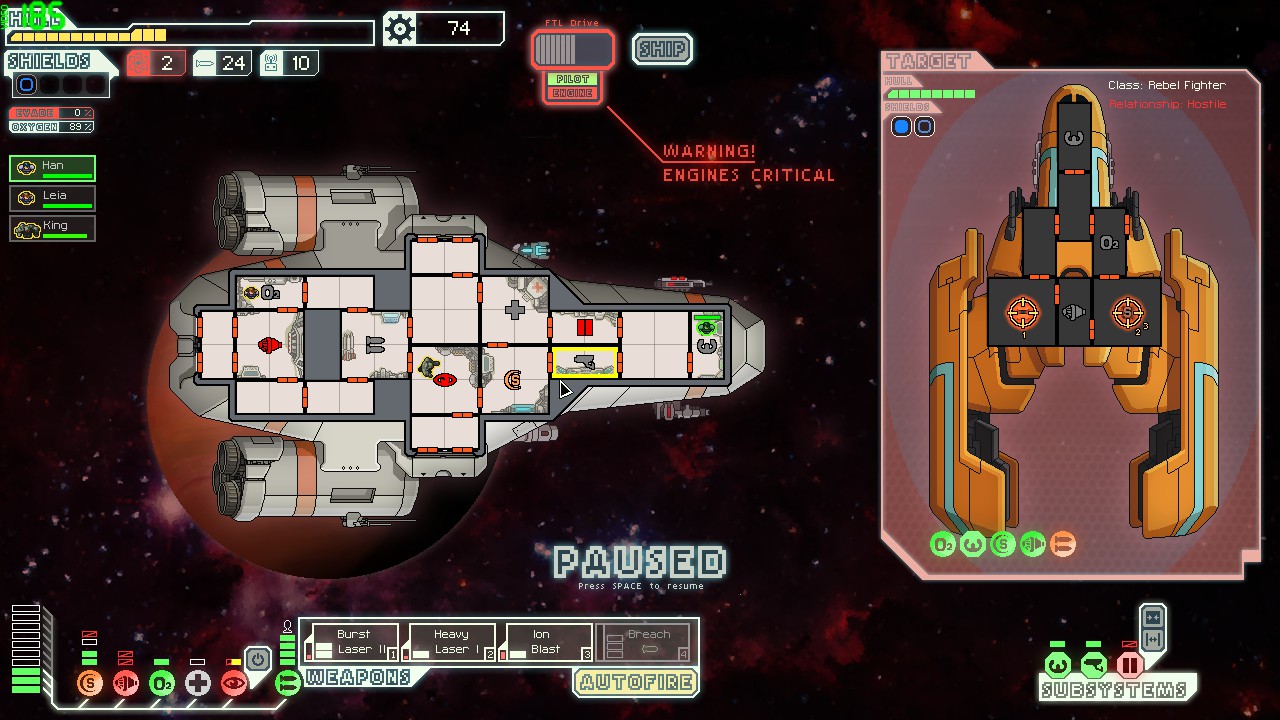
Hull – reduced to confetti. Fuel – almost out. Systems – mostly disabled. This is when FTL shines.
The best way I can describe FTL: Faster than Light, the new indie title from Subset Games, is to say it lives up to the very simple promise on its Kickstarter page (emphasis mine):
FTL is a spaceship simulation roguelike-like. Its aim is to recreate the atmosphere of running a spaceship exploring the galaxy.
To get a sense of how the typical game of FTL plays out, I refer you to my Let’s Play series – linked at the top of this post. In summary, players start at one end of the galaxy, progress through seven increasingly dangerous sectors, and finally take on the final boss at the end of sector eight. Each sector comprises a randomised mix of encounters – shops, text-based, multiple-choice quests (think King Arthur: The Roleplaying Wargame, or maybe a much simpler Space Rangers 2), hazards such as asteroid fields, and most of all, hostile spaceships. Combat is a frenetic homage to movie and TV space battles, as you juggle power between shields and engines and weapons, order your crew to fix hull breaches and extinguish fires, target enemy subsystems, and oh god Mr Chekov will you knock out their missiles before they kill us all?! (Since the game only gives you one save slot, you cannot reload if you die unless you back up your save file, aka “savescumming”.) Afterwards, you use scrap from your enemies’ hulls to upgrade your ship and buy fuel and repairs. Ultimately, you escape to the next sector one step ahead of your foes, and begin the process again. The typical game takes about an hour or two to play, and for most of that time – specifically, for sectors one through seven – it is a delightful roller-coaster of excitement and panic and elation.
Where FTL falls down is its endgame, sector eight, which finally trips over the line between challenge and frustration. The end boss suffers from several related problems:
1) The boss isn’t merely more difficult than anything else in the game. It’s an order of magnitude more difficult.
2) The sheer length of the boss battle. Most battles are in the game are over in 2-3 minutes. However, the boss’ defences are so strong that all up, it took me something like 40 minutes to beat! The game’s combat system is built for short, sharp fights, and it bogs down when it takes that long to get through one opponent.
3) The need for luck to beat the boss. This manifests in two ways. First, since equipment, and shop catalogues are random, it’s possible for a player to reach the boss without the tools needed to win. Second, as my experience in part 4 of the Let’s Play showed, the length and difficulty of the boss fight increase the odds an unlucky hit will scupper all your work.
4) The inability to save/reload, which becomes a liability here. If things go wrong 80% of the way through the boss fight, get ready to replay aaaaaall the way from sector 1.
Net effect: I feel absolutely no shame over savescumming to beat the boss, and while I could replay the game (unlocking and then trying out different spaceships, attempting different builds, etc) – I don’t want to. There are players who feel motivated to defeat that final boss over, and over again. I am not one. And that is a real disincentive for me to spend any more time with FTL.
Still, while FTL lasted, it and I had a wonderful ride. As with 2010’s Recettear, FTL is short, sweet and clever. It’s not perfect, but the core mechanics for 80%-90% of the game are sufficiently strong to outweigh the annoyance and tedium of the remaining 10%-20%. Well worth checking out, and I look forward to seeing what its creators do next.
We hope you enjoyed this post! To quickly find this post, and our other reviews, click the “reviews” tab at the top of this page.
I should preface this with three comments. First, I can’t opine on XCOM‘s maligned keyboard+mouse interface, as I played with an Xbox 360 controller. Second, I edited the game’s configuration files to dial the difficulty up to “Classic” — this is how — so I also can’t comment on the demo’s default difficulty (which was apparently set to the lowest level). Lastly, as the demo only comprises two battles (the tutorial and one “proper” mission), it didn’t give me the chance to assess the game’s strategic layer, or the progression of tactical battles over time.
With that out of the way, I had a great time in the demo. Combat felt tense, fluid and atmospheric. I played slowly and very carefully, and for most of the mission, this worked — I didn’t take a single hit. Then suddenly, it didn’t. The last alien — the last alien! — on the map one-shot-killed my poor support trooper with a lucky critical. As Jake Solomon would say, “that’s XCOM!” Neither did I experience technical problems. Using the 360 controller, I found the UI fine, and after setting the graphics to “medium”, the game ran comfortably on my 2010-vintage notebook (Core i7, 8GB RAM, Mobility Radeon HD 5730).
All in all, what I saw has only heightened my anticipation for the full game — due out in two weeks’ time. Stay tuned for my Let’s Play! Until then, you can watch my gameplay video of the demo mission below:
Half-Minute Hero, a remarkably clever and fun Japanese indie indie-esque (correction: its imaginative concept, general feel, and price tag are all incredibly indie-ish, but I don’t think it meets the technical definition) game, has now landed on Steam!
I played the original Half-Minute Hero on the PSP last year; its conceit is that each level is an entire 8-bit RPG, boiled down to fit a 30-second time limit! In that time, you have to grind, buy better gear, recruit NPC allies, and leave enough time to make it to (and beat!) the boss. (In practice, you have a little longer than that, since you can buy increasingly expensive extensions from the Goddess of Time.)
The original game was a fast-paced, funny homage to the RPGs of yesteryear; I’m not familiar with what may have changed in the PC version apart from the title, which has expanded to Half Minute Hero: Super Mega Neo Climax Ultimate Boy. That moniker should give you a clue as to the game’s mood! However, if the gameplay has remained the same, the Steam version will be well worth $10 (and especially worth the current discounted price of $9).
Yoko Kanno is justly famed for her beautiful anime music (I previously spotlighted one of her compositions, “Inner Universe” from Ghost in the Shell: Stand Alone Complex). Less well known is the lovely music she previously did for KOEI’s strategy franchises, such as Romance of the Three Kingdoms and Nobunaga’s Ambition. I’ve attached an orchestral performance of one song below. Enjoy!
From the blog of Vic Davis, of Armageddon Empires, Solium Infernum and Six-Gun Saga fame:
Ok I’m in the home stretch on The Occult Chronicles. The famous last 10% that feels like the final turn on the 400 meter sprint. The bad news is that I won’t be making the October 31st release date that I had hoped for. Right now I’m shooting for January or February. So I’m having a sale to raise some funds to finish off the art for the project. Kickstarter seems a bit too much for something like this and I’d like to save it for a TBS or maybe a mega expansion pack for this game. I’d like to ask any longtime supporters to spread the sales news around in any way that they can. Tell your forum buddies, post on your blog or get a soap box out and stand on it at a street corner etc. You can get 50% off any games that I sell for the next 10 days. Just enter the coupon code OCCULT when you go to check out. The deal doesn’t apply to the SI & AE bundle but you will get a better price by adding them to the cart separately and then using the code.
When we left off, I was debating which piece of equipment to leave behind in order to pick up a shiny new hull-smasher laser. In the end, I ditch my unused anti-ship drone. I have only limited power available for the drone control unit, and I want to focus on the life-saving defensive drone.
We make it to the end of Sector Seven without incident.
Sector Eight: The Last Stand
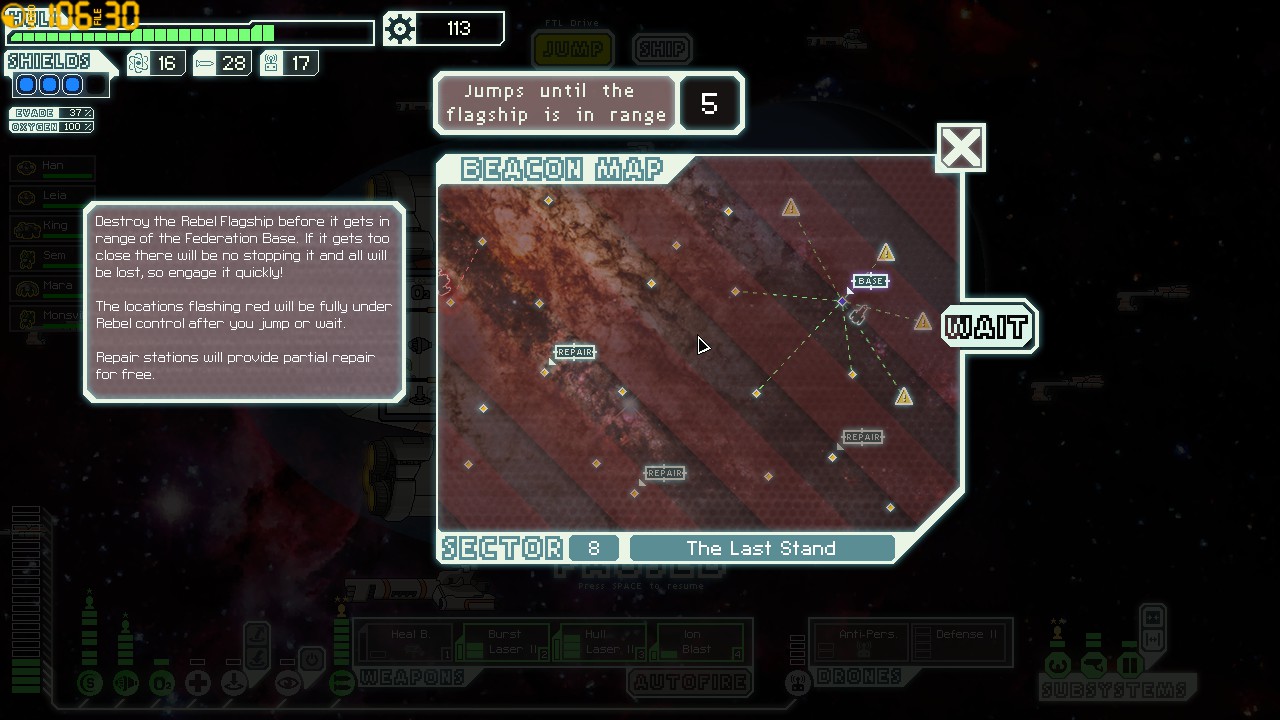
This is it, the cusp of the final showdown. This is what the sector looks like. The Rebel flagship is the ominous red shape just visible at the far left:
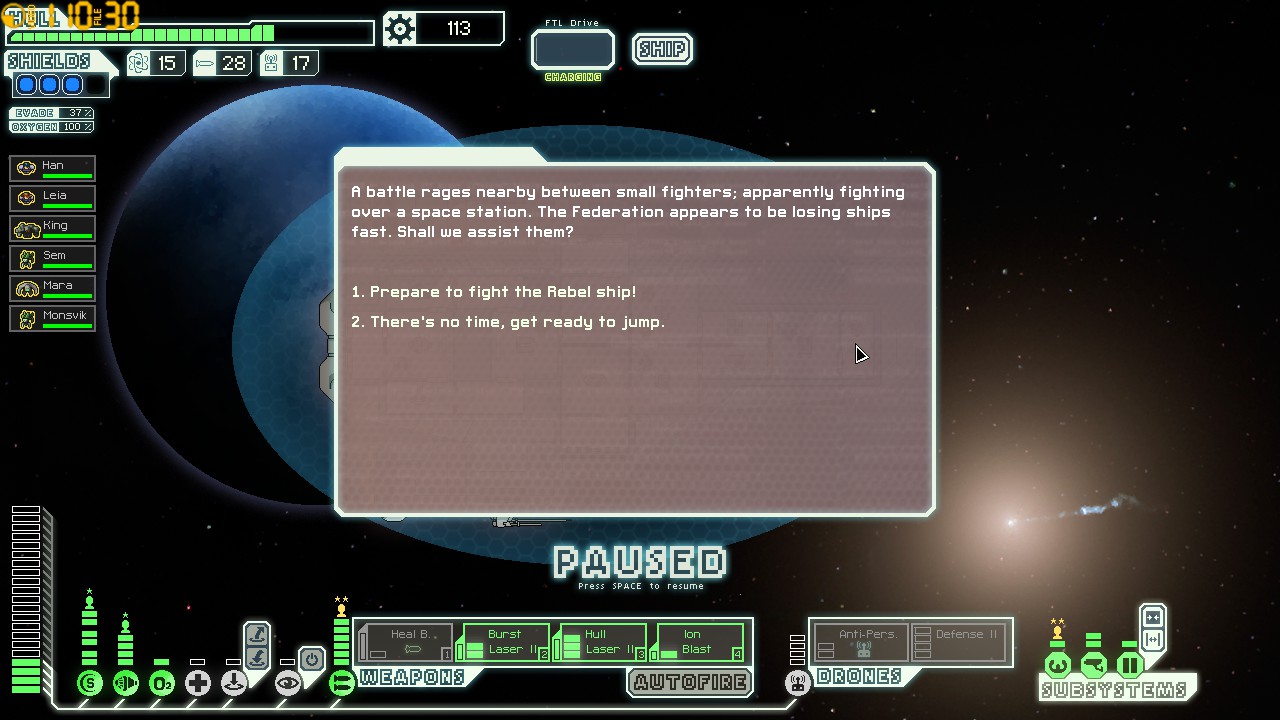
On the way to fight the flagship, we come to the rescue of a beleaguered Federation squadron under attack by the Rebel:
Bring it on! For the Federation!
This time I remember to turn on the defence drone at the start! The Rebel does little damage as a result, and the grateful Federal survivors hand me some supplies. I back up my save again, and carry on. A second Rebel is just a speed bump, and then it’s onto the flagship.
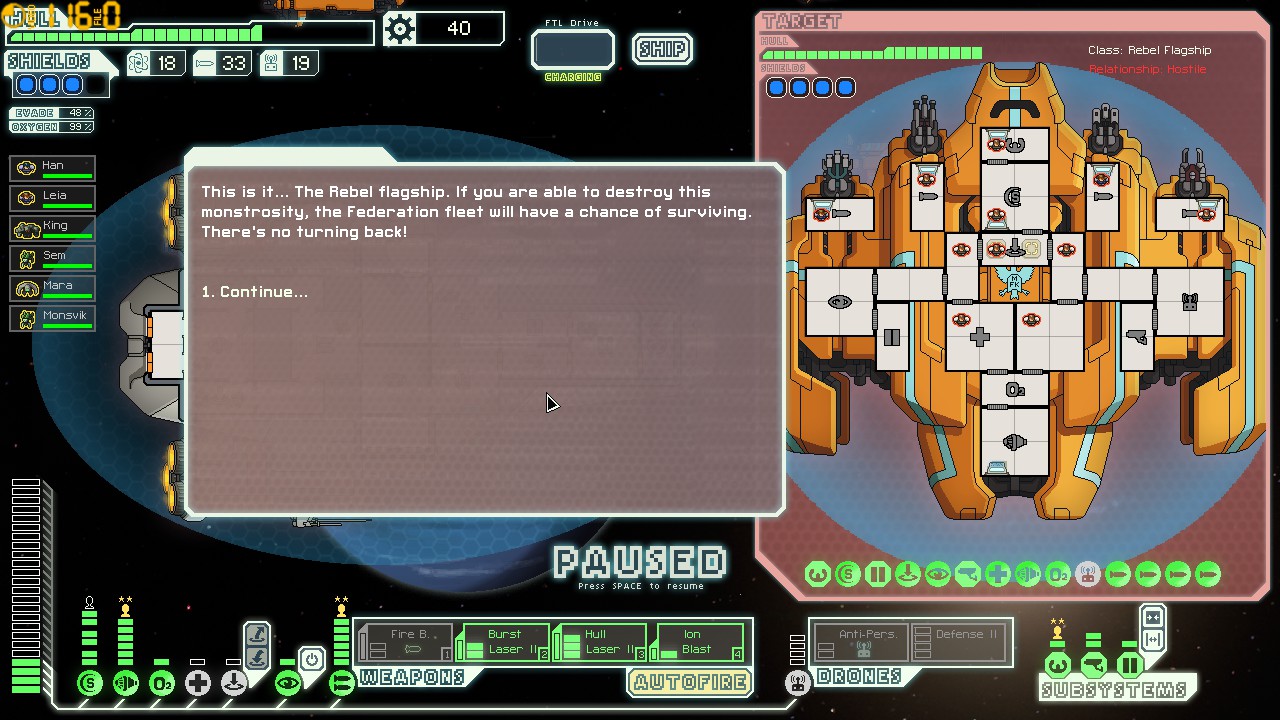
Here we go.
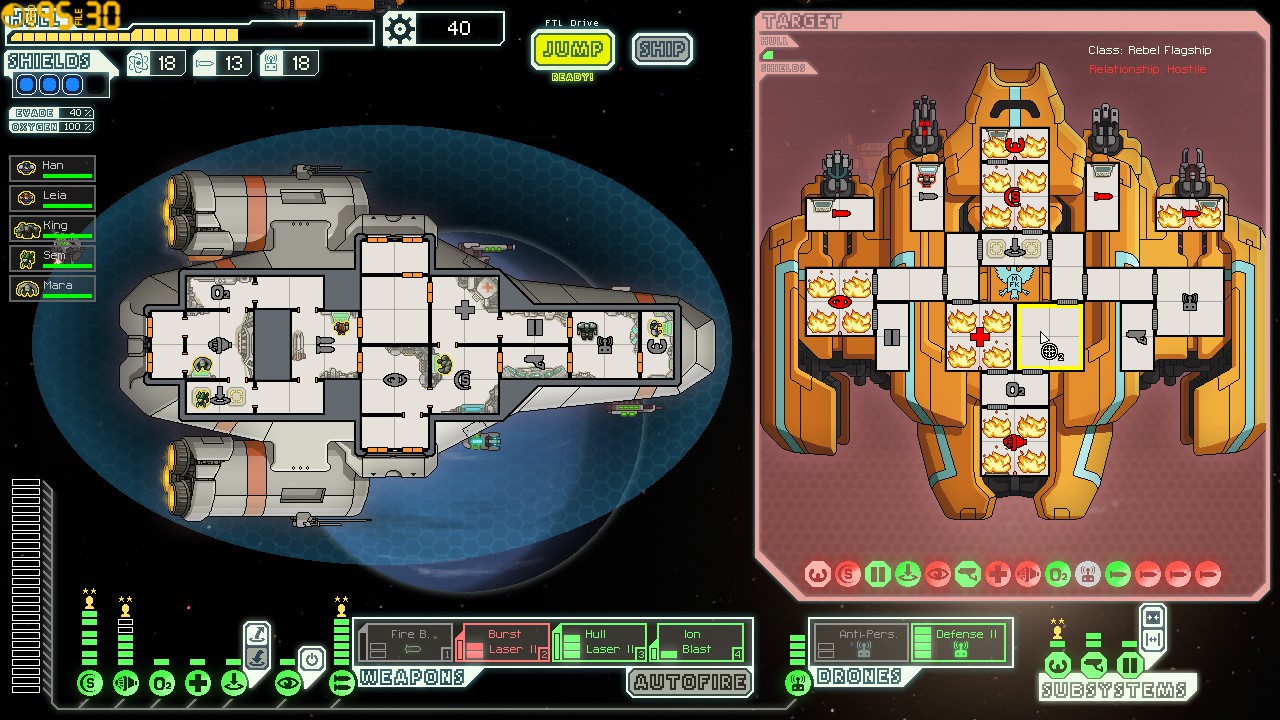
The fight is long (my Dxtory recording comes to over 30 minutes!) and, to be frank, a bit tedious once I’ve destroyed most of the flagship’s weapons. At this point, I just have to wait for my weapons to do enough damage. However, the tipping point comes once I use my Mantis boarders to whittle down the flagship’s crew, at the same time I use the fire bomb I purchased back in sector 6 to set the flagship’s med bay alight. This prevents the crew from simply running away from the Mantes, healing up in the med bay, and running back to pick off my weakened boarders. Even then, it’s chancy – I lose my second crewmember this game, Mansvik the Mantis – but his sacrifice isn’t in vain. Eventually, most of the flagship’s crew is dead, save for one gunner in the forward compartment. Mopping up is easy after that.
The most effective way of taking down the flagship, if you can kill the crew first so they can’t extinguish the fires.
At the end of the fight, the battered flagship jumps away. I back up my save yet again, and prepare to give chase.
… and die horribly when my cloaking device – the key to my survival! – gets knocked out by an unlucky hit. This is why I backed up the save, because I’m not starting this LP (or playing that half-hour flagship battle) again.
Let’s try that one again.
This time it goes much better. A quick barrage of firebombs, and Sem the surviving Mantis, take care of most of the flagship’s remaining weapons. I dust off my anti-boarder drone, and that takes care of the boarding drones the flagship sends my way. The cloaking device stays intact, and I can survive the worst the flagship throws at me. Soon the battle is over. I back up my save once more, spend the last of my scrap, and head off to fight the third and final phase of the flagship.
I have to reload twice – this time, the flagship carries Zoltan shields that prevent me from quickly disabling its most dangerous weapon, a triple missile launcher, with my boarders/firebombs. In the time it takes me to lase the shield down, the flagship pulverises me. Cloaking barely helps, as using the cloak against the missiles meant it wouldn’t be available against the flagship’s special attack, and vice-versa. But on my third attempt, I pull it off! Eventually I bring down the flagship’s shields, and soon after, the missile launcher. Once the launcher is out of commission, it’s smooth sailing.
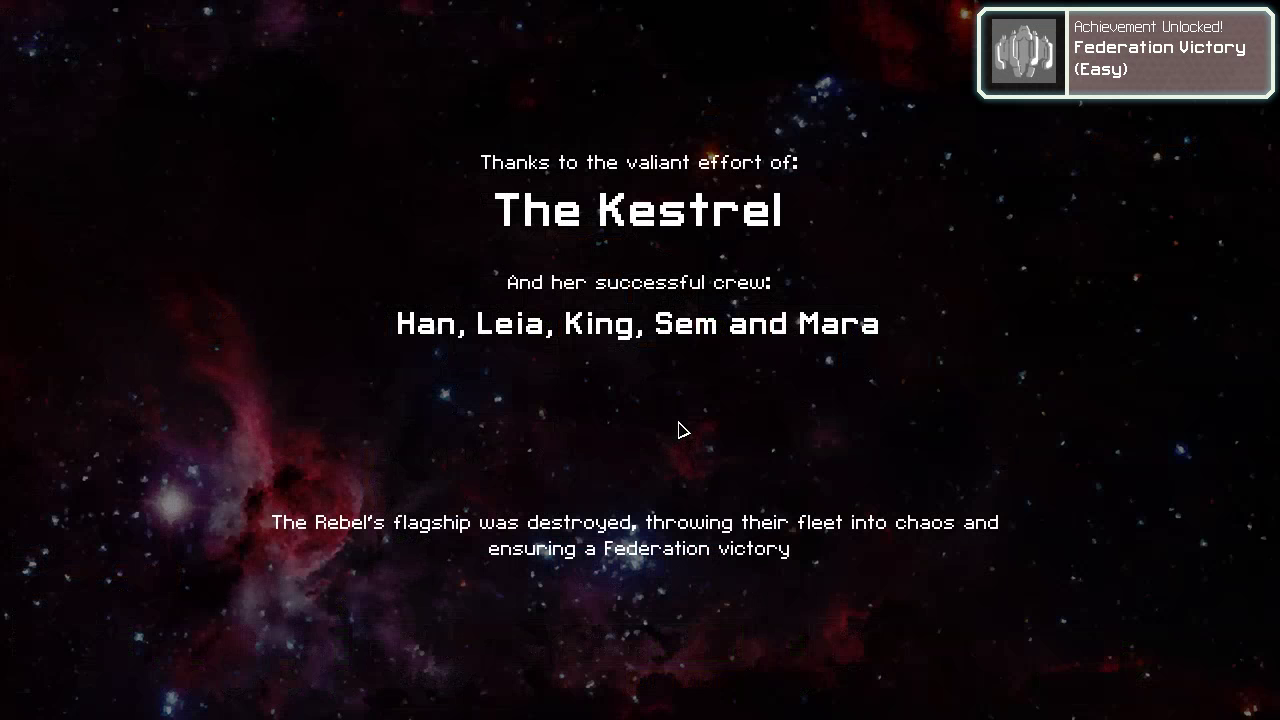
VICTORY!!!!!!
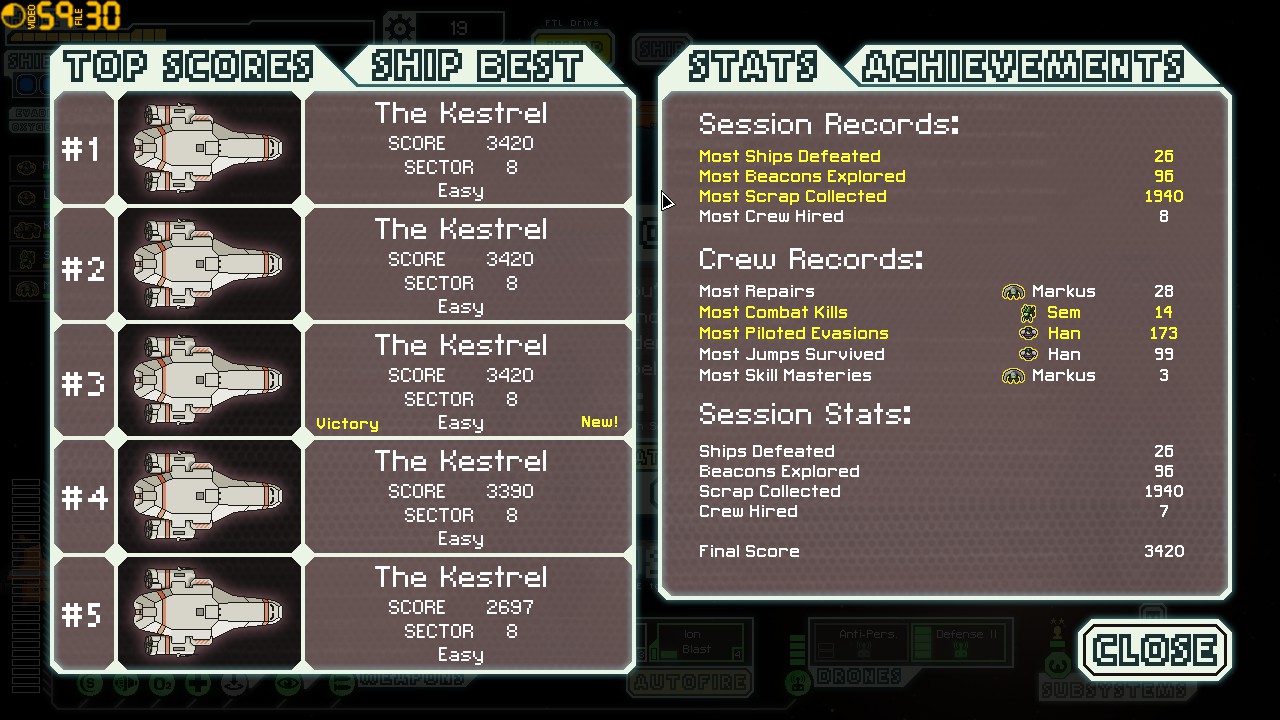
The high score table looks like this. The duplicates are the result of my savescumming (somewhat disappointingly, winning the game doesn’t confer extra points; oh well):
And that’s it for this playthrough! For players who want to try saving the Federation again, beating the flagship unlocks a new ship type, the Federation Cruiser. (There are nine ships, plus variants, in the game – so there is room for completionism.) But for now, I think I can rest on my laurels and proclaim myself done with FTL. Thank you for following along, and I hope you had as much fun as I did!
The Kestrel’s exploration of Sector Four continues, with mixed results.
The good news: beefing up my weapons, and being willing to fire off a missile at the start of combat, have paid off. The next enemy I encounter goes down in flames.
The not quite so good news: the next shop I find is a re-run of the previous one. It has a drone control and crew teleporter for sale, but I don’t have enough scrap to buy anything without selling my spare equipment. This time I grit my teeth, sell a spare missile launcher, and buy the drone control unit. At least I can get some immediate use out of it. Hopefully I’ll find a crew teleporter – and some crew to actually teleport! – later in the game.
I make it to the exit with the Rebel hot on my heels, and head into Sector Five.
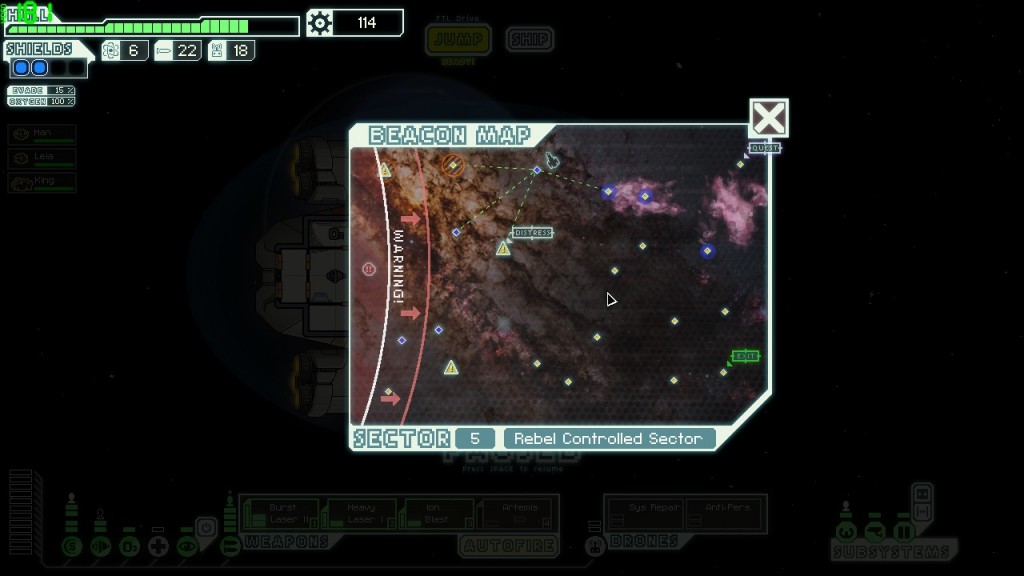
Sector Five: Rebel-Controlled Sector
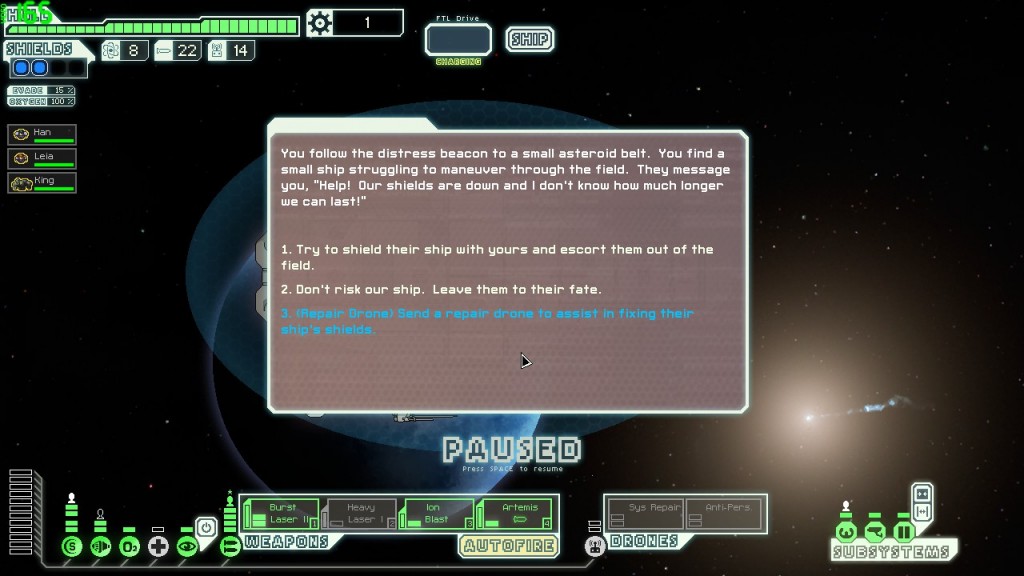
The drone control unit promptly pays off, when I answer a distress beacon:
Glad I bought that drone control unit!
Sending in the drone leads to a little bit of hull damage, but I earn 42 scrap as a reward. At the next beacon, I take on a quest that requires me to travel to the far top-right corner of the sector:
One does not simply shilly-shally to the sector exit!
Along the way, I deal with a Rebel scout before it can jump out to warn the fleet of my presence, fight off a boarding party with a big helping hand from my anti-boarder drone (good thing I bought that control unit!), and find a shop with both a crew teleporter and recruitable crew! I hawk an unused repair drone to pay for the teleporter and a Mantis of my own, name of Sem. Remember, Mantes are the hand-to-hand specialists of the game, so this should give me a big edge in boarding actions.
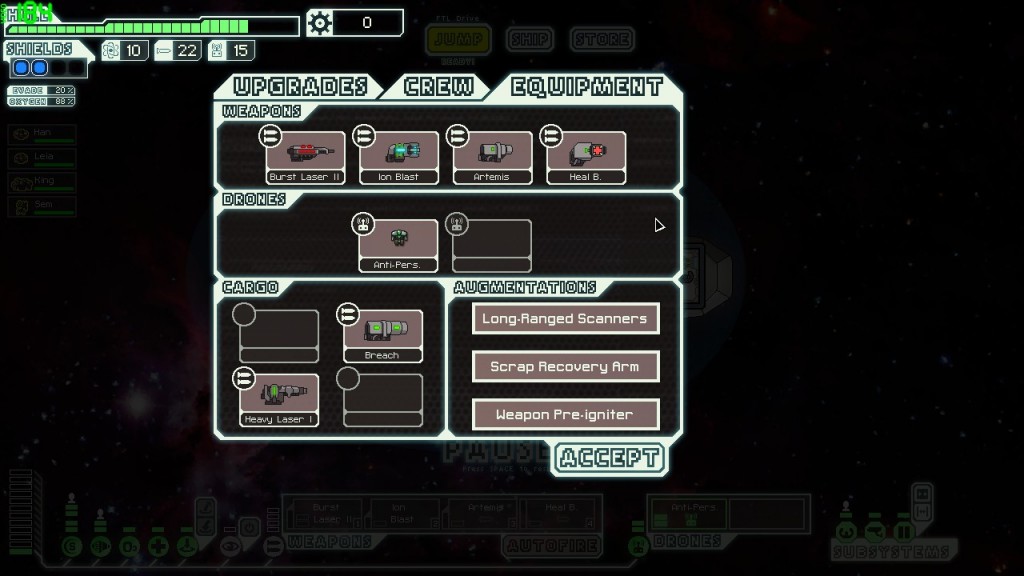
I take the time to play around with the Kestrel’s loadout:
Building up my arsenal.
The weapon on the far right is a healing bomb, which I can deploy (at the cost of 1 missile ammo) to either my own ship or to an enemy ship to heal friendly crew in the vicinity. That means I can send over, say, Sem the Mantis and King the Rockman to slaughter the enemy crew, teleport in healing bombs as necessary to keep Sem and King alive, and then earn more scrap from capturing the enemy ships alive!
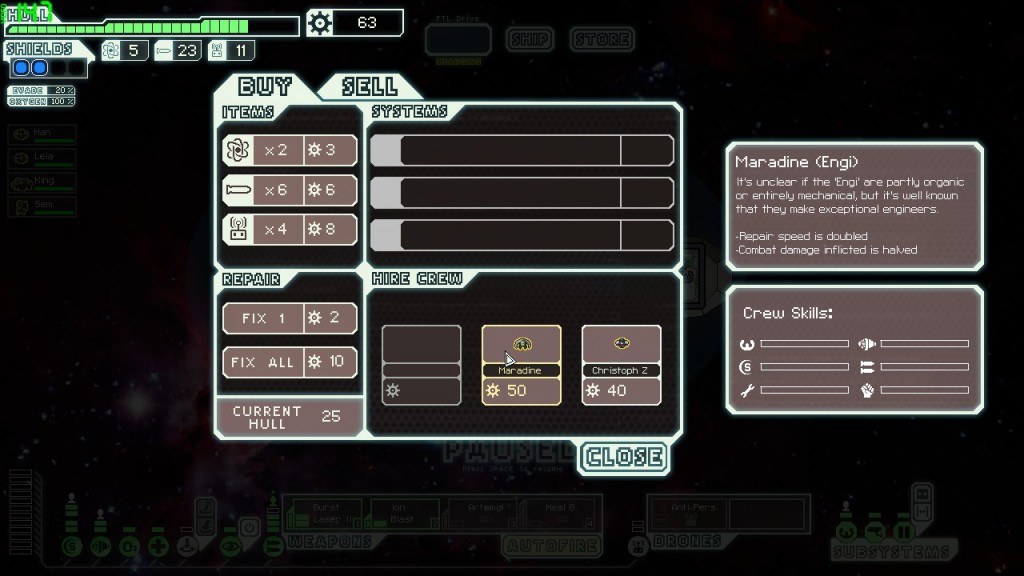
Completing the quest lets me offload some drone parts for scrap, and defeating another Rebel gives me enough scrap to return to the shop and hire an Engi crewman named Maradine:
Fame and fortune await you, Maradine!
On my way to the exit, I run into a Rebel who gives me a taste of my own planned medicine and boards me. Sem, King, and my drone deal with the boarders, then Sem and King head over for some payback.
The first try does not go as planned, thanks to a certain Captain forgetting to actually charge the healing bomb before sending Sem and King over. I quickly teleport the two almost-dead crewmen back, heal them up in the medbay, then send them back. The enemy ship has no medbay, and the enemy crew has had no chance to heal. The second trip goes much better. The scrap I earn from the intact, lifeless Rebel ship (60+) is about double what I’d have previously earned.
I make it to the exit, and onto Sector Six.
Sector Six: Rebel-Controlled Sector (another one)
The first few Rebel ships I encounter are AI-controlled, and hence pointless to board (as well as dangerous; they have no oxygen!). My luck turns when I run into a Rebel whom I can board. Killing the enemy crew (one of whom, I notice, is named Geryk) lets me liberate a Mantis prisoner named Monsvik, who joins my growing team. This is good – it lets me form a dedicated away team of two Mantes, while King the Rockman can stay back and man the Kestrel’s shields.
At the next shop I encounter, I pick up a fire bomb in preparation for a certain battle later in the game. I also sell my venerable heavy laser and pick up a level 1 burst laser instead – the heavy laser does 2 damage to hulls but only 1 to shields, whereas the burst laser fires twice, dealing 1 damage per shot and granting a second chance to hit. The Artemis missile launcher goes into storage:
The new configuration seems to work well, letting me chew through enemy shields while preserving precious missile/bomb ammo. With my newfound love for boarding actions, I upgrade my sensors so I’ll be able to map out the enemy crew. Sector Six ends without incident, as I again just barely beat the Rebel fleet to the exit. I’m getting better at this!
Sector Seven: Zoltan Homeworlds
We’re almost there. Just this, and then the gauntlet in Sector Eight. Stay on target. Stay on target…
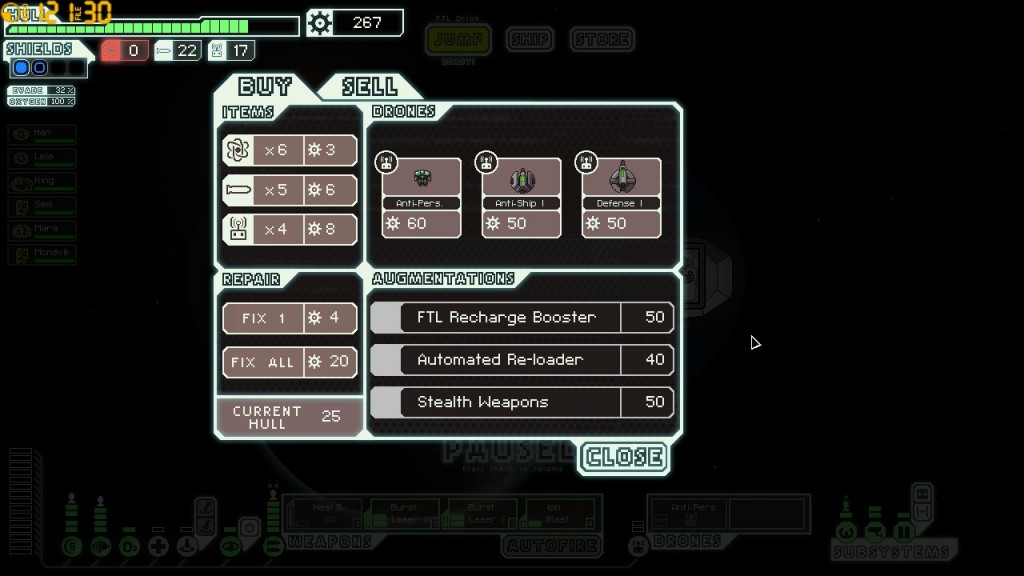
Our first encounter is hostile, as a Zoltan ship shoots first and asks questions later. Luckily, its defences are poor. My pre-ignited lasers make short work of its shields and weapons, and injure the crew. Then, since Zoltan are lousy in boarding actions, my Mantes teleport over to finish the job. When the dust settles, I have more scrap than I’ve ever seen in one place. And luckily, there’s a shop right next door:
Scrap! Scrap! 267 scrap!
I refuel, and buy a level 1 defence – i.e. anti-missile –drone. Seeing another shop right after that, I head over… and see a level 2 defence drone. Oops. The level 2 requires more power, but is also more useful, meaning I wasted the scrap on the level 1 drone. Oh well. I trade it the level 1 and buy the level 2. I then promptly forget to upgrade my drone control unit, leaving me unable to use my new toy.
One battle later, it ceases to matter. After killing the enemy boarders, setting their spaceship on fire, and lasing the surviving crew to death, I’m swimming in scrap again (240 scrap). So much so that when I get the option to pick up a new augment, a “reverse ion field” that gives me a 20% chance to shrug off incoming ion fire, I ditch my scrap recovery arm (+10% to collected scrap). This close to the end, I want maximum survivability.
The next fight chews me up badly – the enemy is strongly shielded and armed to the teeth, with a missile launcher and assorted lasers. My defence drone II would have protected me– had I remembered about it. Eventually I do turn it on, resulting in a much easier fight… only for the enemy to flee before I can administer the coup de grace. No reward.
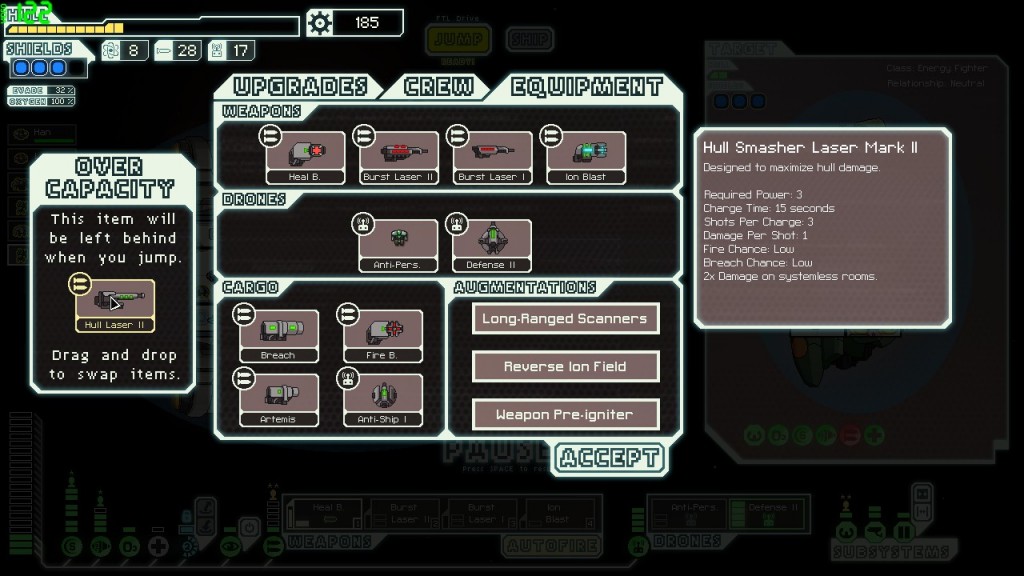
Crushing the next enemy, and harvesting plenty of scrap from a random distress beacon, provide some solace. One jump away from the exit to the final sector, I get into another tough scrap, but walk away with a new piece of loot: a level 2 hull smasher laser, a more powerful, less energy-efficient cousin to my starting burst laser. I’ll have to drop something to pick up the hull smasher laser, but what?
Too many goodies, too little room.
On that note, as I mull which piece of kit would be most useful against the final boss, it’s time for me to wrap up this instalment of the LP. And to hedge my bets, I finish by backing up my saved game (aka save-scumming). This goes against the intent of the designers – FTL only allows you a single, automatically overwritten save slot – but this close to the final boss, I’d like the ability to retry different tactics, and different loadouts, without starting again from scratch.
When we left off, the Kestrel was in good form: decently armed and shielded, with enough fuel and supplies and scrap to last a while. I decide to make the most of it by looking for trouble. It’s time to head into the nebula.
After steeling myself that way, the rest of Sector Two ends up as an anti-climax. I fight off two separate boarding parties in the nebula by the simple expedient of rushing my crew into the med-bay, where they heal faster than the boarders can hurt them. The only hostile ship I meet lacks the firepower to pierce my upgraded shield, resulting in a decidedly one-sided fight. Buying a scrap recovery arm (which gives me +10% to all future scrap income!) rounds off my time in the sector. With the Rebel hot on my heels, I briefly debate looking around a little more, but eventually decide to play it safe. Off to Sector Three we go!
Sector Three: Engi-Controlled Sector
The aptly named Engi are a race of sentient machines, lousy in hand-to-hand combat but great with repairs. They’re also friendly to the Federation, which makes Engi space that much more pleasant to traverse.
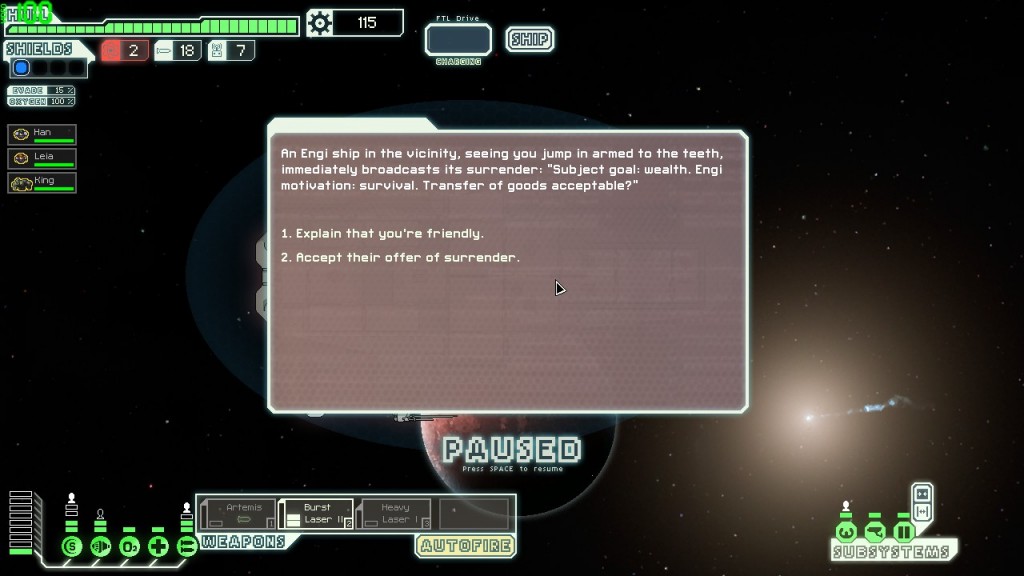
Right off the bat, I hit the jackpot. An Engi ship, thinking I’m a pirate, hastily offers up its cargo of scrap. I demur, telling them I’m friendly:
Do I look that scary?
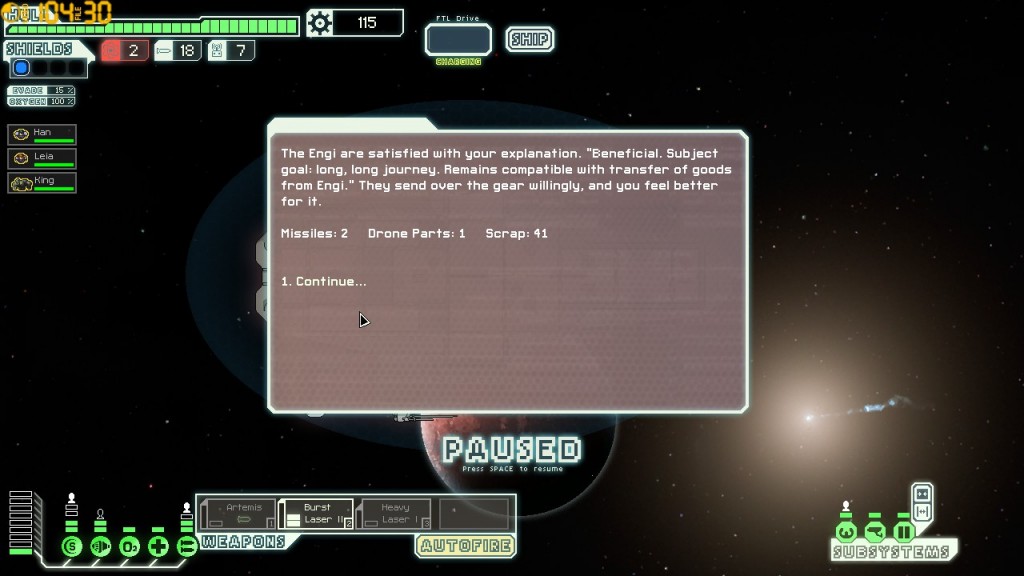
But the Engi go ahead and offer me the scrap anyway, to help me on my long voyage.
Altruism is so rare among FTL’s NPCs, it sticks in the mind when it does occur.
Thanks, Engi! And it’s a good thing, too – I’m perilously low on fuel. The red-highlighted “2” in the top-left means I only have enough fuel for two more jumps! One jump away there’s a shop… and there, I find a cloaking device for sale. I want that cloaking device, but buying it would consume most of my scrap, leaving precious little for fuel.
I roll the dice and buy the cloaking device anyway. And a couple of jumps later, my gamble pays off when I first hoover up some more scrap, then – just as I was about to run out of fuel – find another shop. The whole crew probably heard my sigh of relief!
The rest of the sector proceeds smoothly enough, with the Kestrel able to easily defeat foe after foe. It goes so smoothly, in fact, that I get a bit cocky and end up taking too much time to explore. When I finally make it to the exit, the Rebel is waiting for me. And for the first time during this playthrough, I run from a fight. The Artemis missile launcher comes into play just long enough to disable the Rebel’s weapons, and then once the jump drive is charged, it’s off to Sector Four.
Sector Four: Engi Homeworlds
On my first three runs, I spent scrap as fast as it came in to upgrade the Kestrel. This time I’ve been saving up, and now it pays off. Right off the bat, I find a shop, and this time I hit the jackpot. Specifically, the shop sells a weapon pre-igniter, which will allow me to begin a battle with fully charged weapons, and an ion blaster, which will allow me to efficiently disable enemy systems. Combined with my burst laser, I should be able to start a fight by taking down the enemy shields with my pre-ignited arsenal, then ripping apart the enemy’s weapons. After that, all I should have to do is mop up. Should.
Then the next few enemies I meet teach me about the dangers of assumption:
Specifically, “starting a fight by taking down the enemy shields with my pre-ignited arsenal” only works if I actually have the firepower to take down the enemy shields. But as of Sector Four, the enemy ships are all now sporting 2 points of shields – on a par with my own. With a burst laser 2, a heavy laser, and an ion blaster, I could punch through level 2 shields if I fired every weapon at once, and hit. But at first, I lack the power to actually fire all these weapons, and I can’t count on guaranteed hits! The bottom line: the enemies have more time to hurt me, often with newer and scarier weapons, before I can silence them.
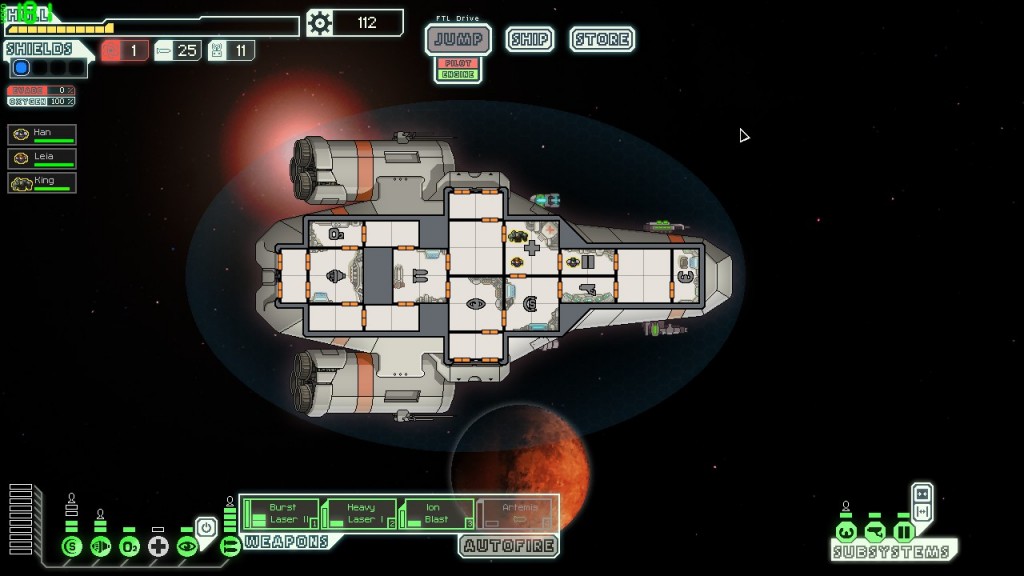
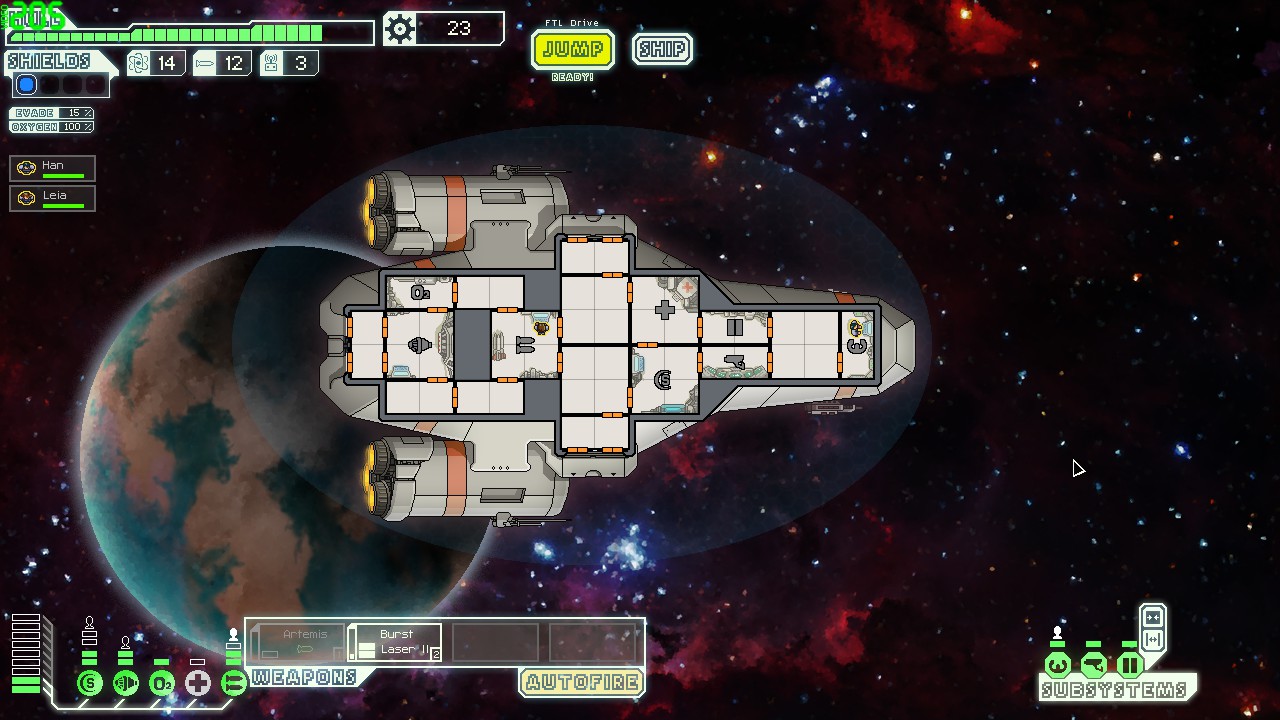
By the time I make it to the next shop, several jumps later, the Kestrel looks like this:
Oww, that hurt…
Not only am I almost out of fuel again, but the “Hull” bar in the top-left is now yellow, less than half-full. If that reaches zero, it’s curtains for the Kestrel. That I owe to a Rebel with a missile launcher, which ignores my precious 2-point shields! It took my own last-ditch missile – not the starting Artemis, but a hulking breach launcher I picked up along the way – to save the day.
With the Kestrel in for some much needed refuelling and repair, this is a good time to ponder battle tactics. I have a whopping 25 missiles – perhaps I should actually use them, say as part of my pre-ignited opening salvo? Buying a couple of new missiles is cheaper, and safer, than fixing a hull that’s been turned into Swiss cheese.
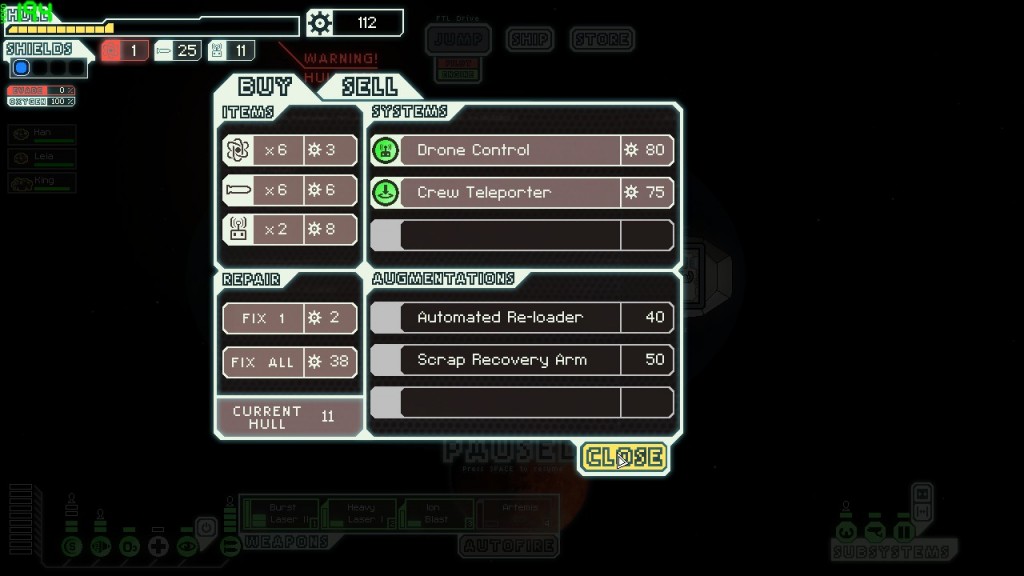
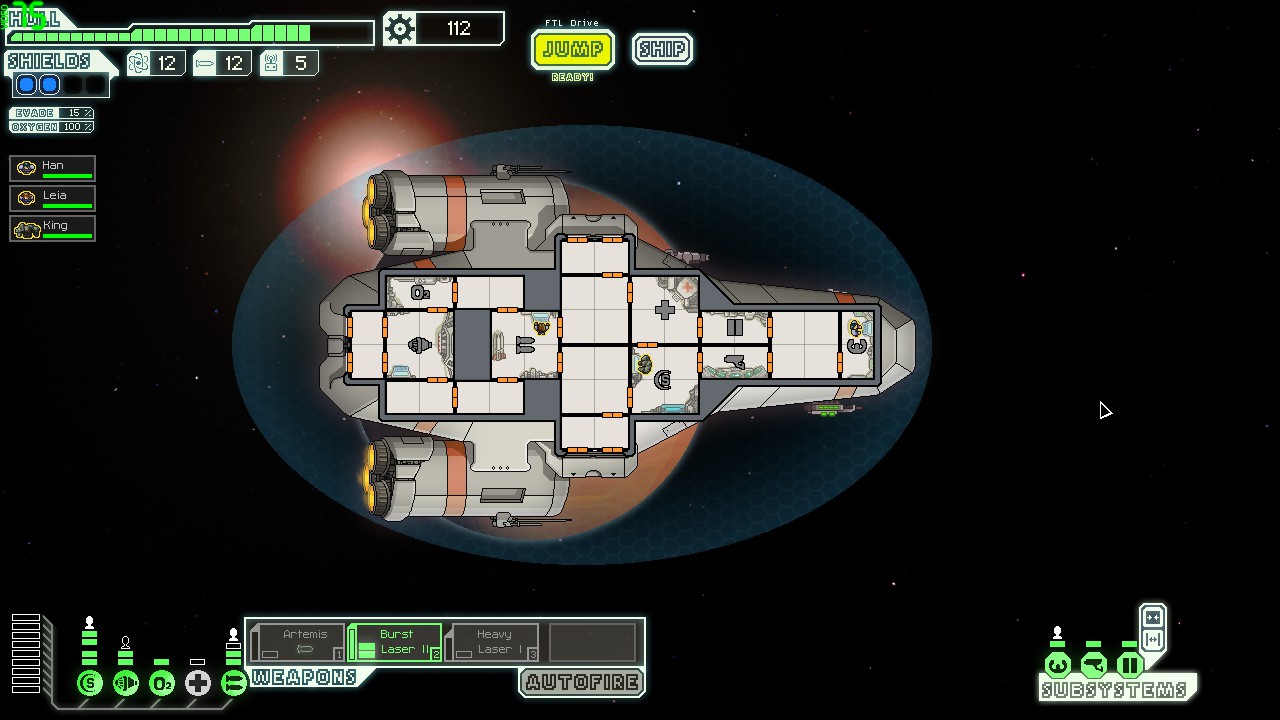
The shop, welcome as it is, also poses its own frustrations. Specifically, I have 112 scrap available. My priorities are repairs (38 scrap) and fuel (I want to buy the station’s whole stock, which will cost 18 scrap), totalling 56 scrap. The shop also stocks a drone control (80 scrap), which would be nice but isn’t essential, and a crew teleporter (75 scrap), which I lack the manpower to use right now, but will be essential later on. I would love to buy the drone control, the teleporter, or both, but – I – don’t – have – the – scrap! I do have some spare equipment – a couple of different missile launchers, a presently unusable anti-boarder drone – I could sell, but I don’t know if I’ll need them in the future.
Without enough scrap to buy what I want, this is the definition of “tantalising”.
With a rueful sigh, I pay for the fuel and repairs. Since I don’t want to sell anything, that leaves me with 56 scrap, enough to upgrade my ship’s reactors in lieu of buying anything else at the shop. Maybe that “first strike” tactic will work if I can throw an even bigger first volley…
With the Kestrel ready to head into the unknown again, this is also probably a good time to wrap up this instalment of the LP. After the relative ease of the first few sectors, things are getting hairy for Han, Leia and King. Will they survive their journey?! Tune in to the next part of the LP to find out!
It is a period of civil war. Rebel spaceships have overrun most of the Galactic Federation. During the battle, Federation spies managed to steal secret plans to the Rebel’s ultimate weapon, the REBEL FLAGSHIP, an armoured behemoth with enough power to obliterate an unwary player. Pursued by the Rebel armada, Captain Peter races home aboard his starship, custodian of the stolen plans that can bring victory in this game…
Captain’s log, starship Kestrel
Stardate 2012.09.20
Introduction
Three times I’ve attempted this journey. Three times I’ve failed, the Kestrel – the game’s starting ship – turned into so much space junk. Now, by the grace of the alien artefact known as the “New Game” button, I can make a fourth attempt.
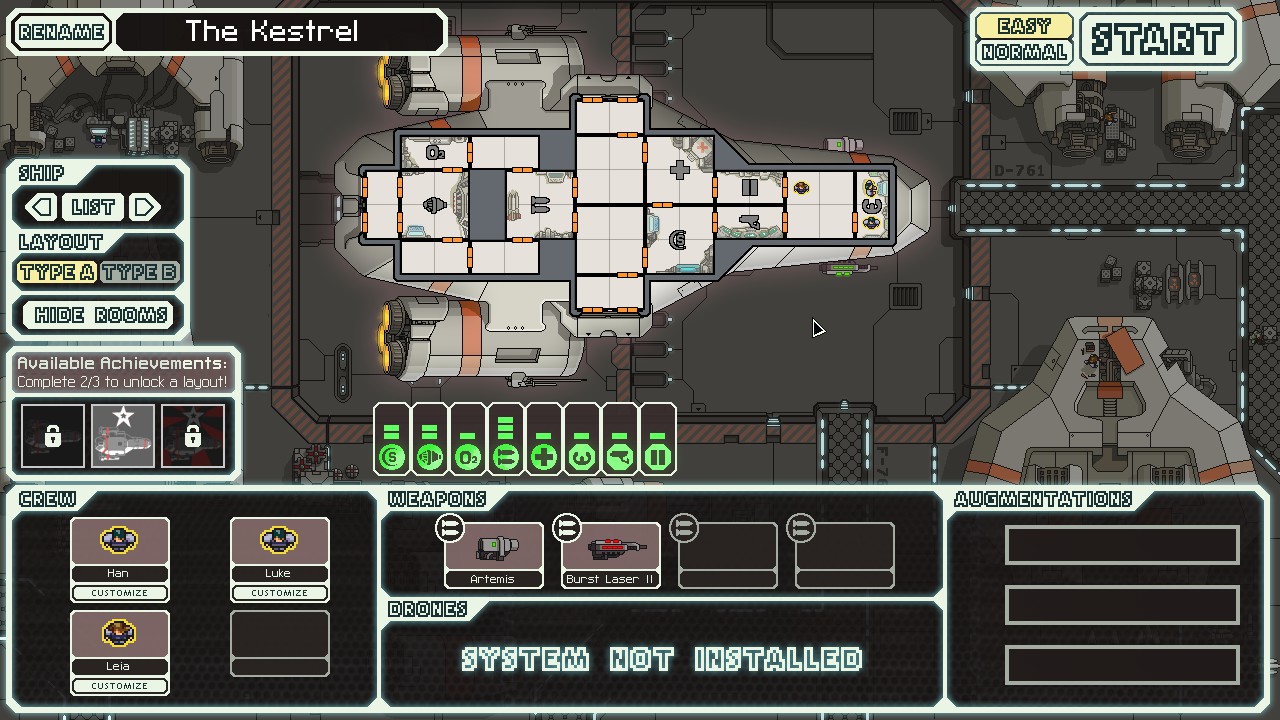
The Kestrel, hopefully the fastest hunk of junk in the galaxy
For this try, I’ll use the Kestrel again. There are other ships available in the game, and I’ve unlocked one (the Torus), but I want to try to see this through with the Kestrel first. The Kestrel packs a well-rounded punch, mounting a powerful burst laser and an ammo-chewing but potentially devastating missile launcher. Once I upgrade its energy shield, it should see me easily through the first few of the game’s eight sectors (each sector is progressively harder). Its starting crew of three is too small, especially when considering there are four systems (helm, engines, weapons, shields) to be manned, but c’est la vie.
After naming my initial crewmembers “Han”, “Luke”, and “Leia”, and ensuring the difficulty is set to “Easy”, it’s time to begin this journey.
Sector One: Civilian Space
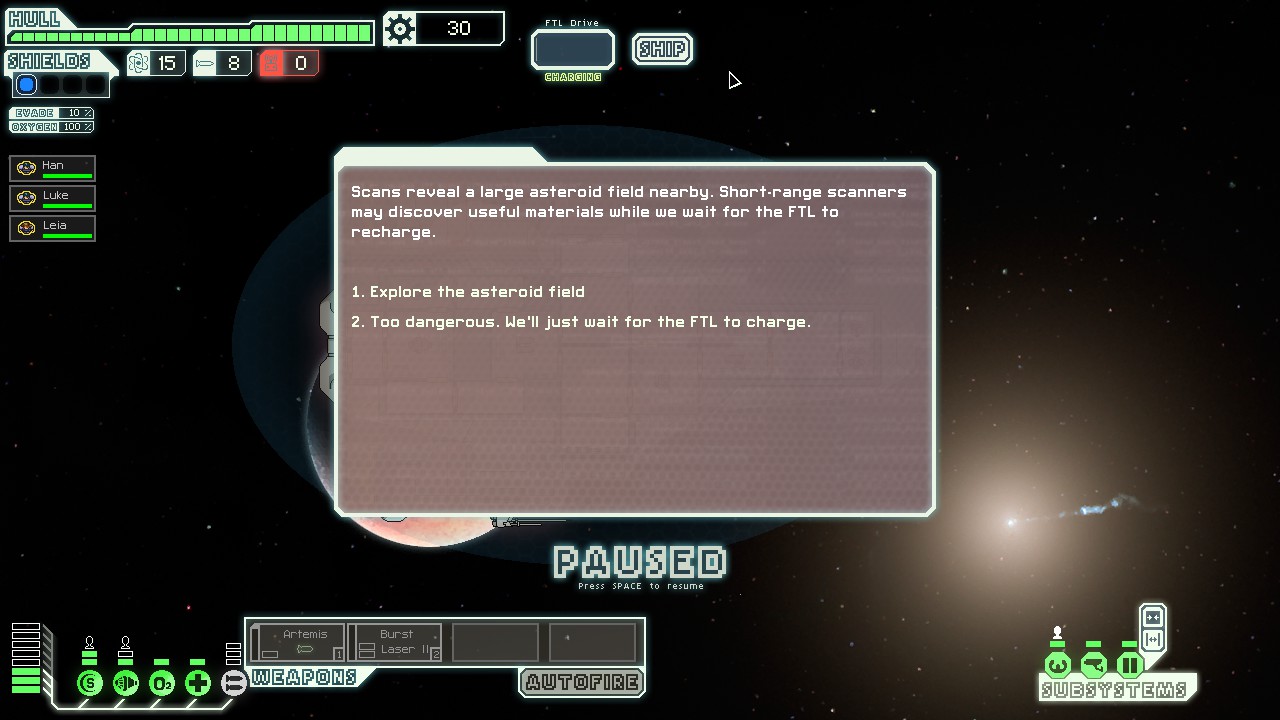
I chose option 2. In this game, discretion is often the better part of valour!
The first sector begins uneventfully. The Kestrel skirts an asteroid field, buys fuel at a space station, and ignores a distress beacon (our mission comes first!). On our fourth jump, we meet our first Rebel.
Several barrages of the burst laser neutralise his weaponry before he can do too much harm, and when he tries to flee, another barrage does the same for his jump drive. Beaten, the Rebel tries to surrender. We refuse. We need the scrap metal from his hull: scrap is the game’s currency, used for purchasing weapons, upgrading components, recruiting crew, and paying for fuel and repairs. Upgrades are life. Scrap is life. And soon enough, we have more of it. The scrap quickly goes into upgrading our shielding system, and onto the next beacon we go.
This time it’s another Rebel, a small transport. I demand surrender. The Rebel refuses, and manages to flee in one piece. I growl, and jump away to the next beacon. Upon consulting the star map, I see the Rebel fleet has now arrived in sector! The Rebel main fleet begins each sector several jumps behind the player, and it’s not a wise idea to let it catch up – running into fleet forces a high-risk, practically zero-return battle. However, I’m still well ahead, giving me the luxury of exploring the sector a bit more. A hidden Federation outpost gives me a bit of scrap and a quest to rescue a Federation base in the next sector, but my luck doesn’t hold up at the next location.
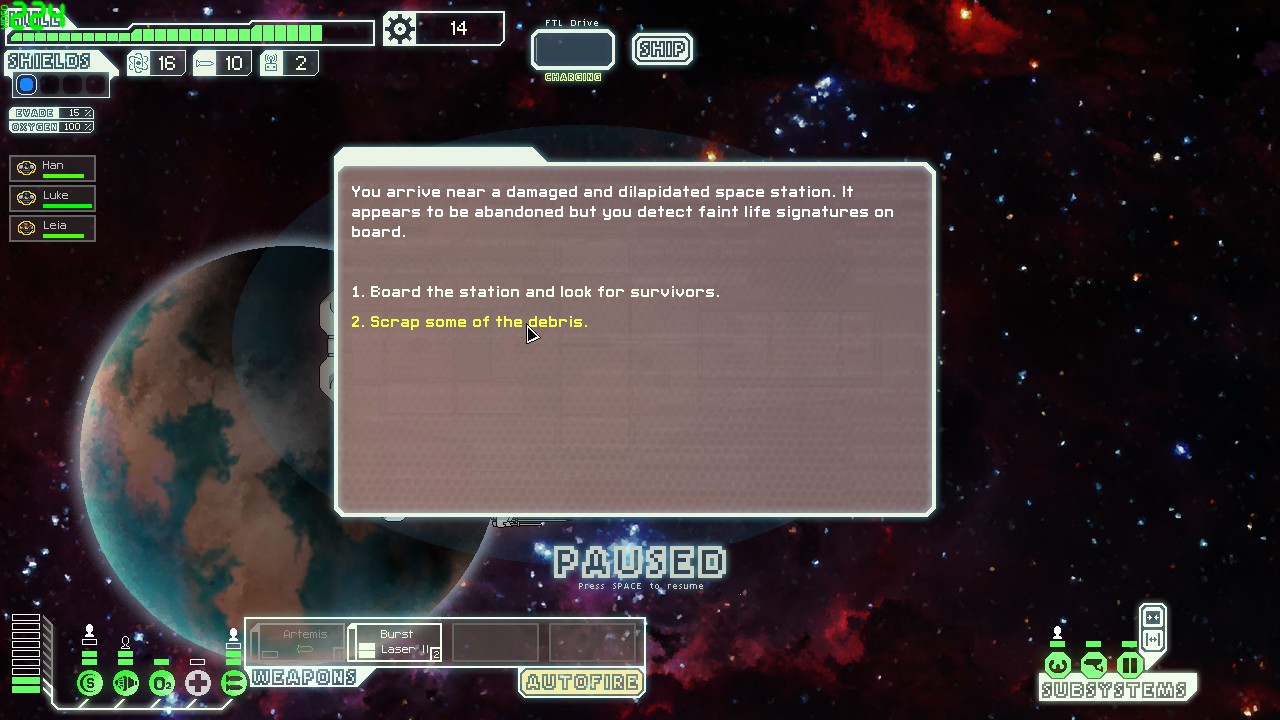
I should have listened to my own advice about “discretion” and “valour”.
While boarding a space station to look for survivors, Luke is struck down by a fatal illness. The measly scrap I pick up seems a lousy compensation for losing one of my scarce crew.
I roll the dice again. One more look around before I head off to the next sector… and what should I run into but an enemy, a Mantis fighter.
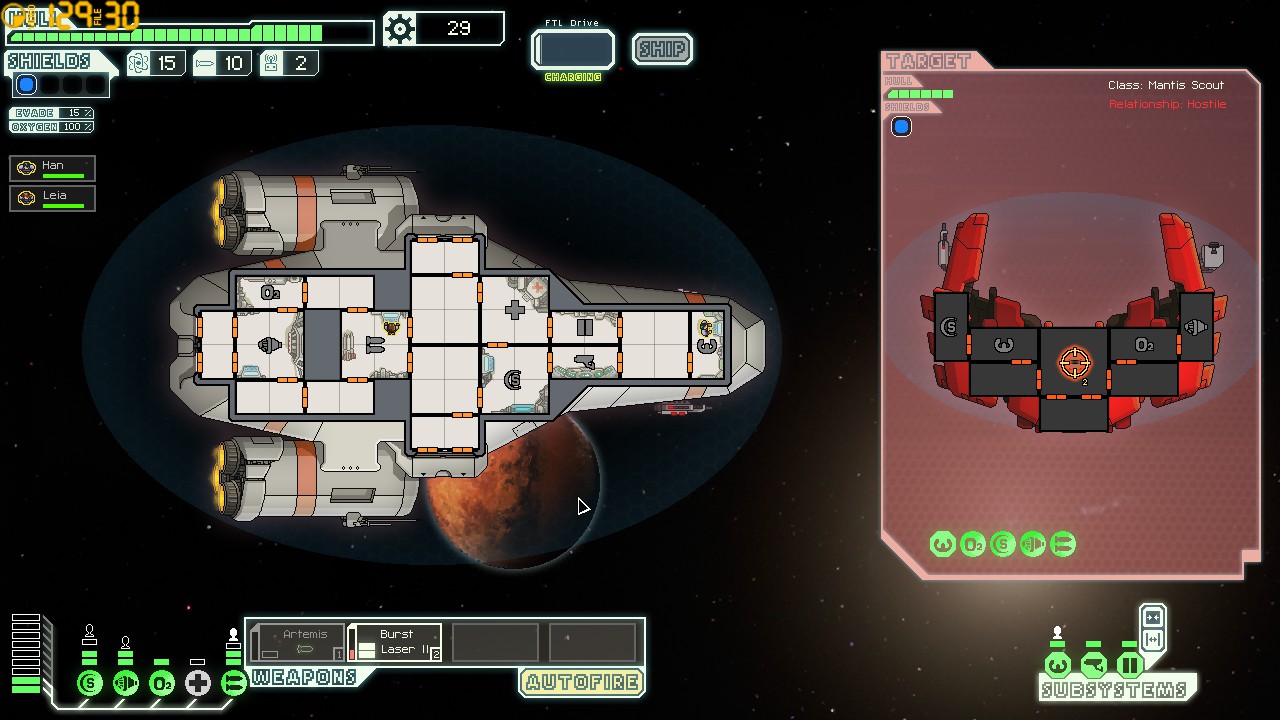
This Mantis bit off more than he could chew.
The Mantes are vicious if they can teleport over to your ship, but luckily for me, the fighter is too small to have a teleporter. I won’t have to worry about Mantes slaughtering my diminished crew in melee! Our first salvo takes out the Mantis weapon battery, our second hits the shields, and the third reduces the Mantis to scrap. I hightail it to the sector exit one step ahead of the Rebels.
For this sector, I had a choice of heading into either pirate or rebel space. The pirates seemed like easier foes, so off that way I went!
Along the way, I stop off to rescue the Federation base I heard about in the last sector. The Rebel ship attacking the base turns out to be just a scout – no match for the Kestrel – and soon I have not only more scrap, but a quest reward! After saving the base, I acquire a new crewman – a Rockman alien named King – and a new weapon, a heavy laser. The laser doesn’t seem too shabby, but the really big prize is the Rockman. Not only was I dangerously short-handed with only Han and Leia left, but Rockmen are great in their own right. They’re tough and immune to fire, which makes them perfect for repairing burning compartments or fighting hand-to-hand.
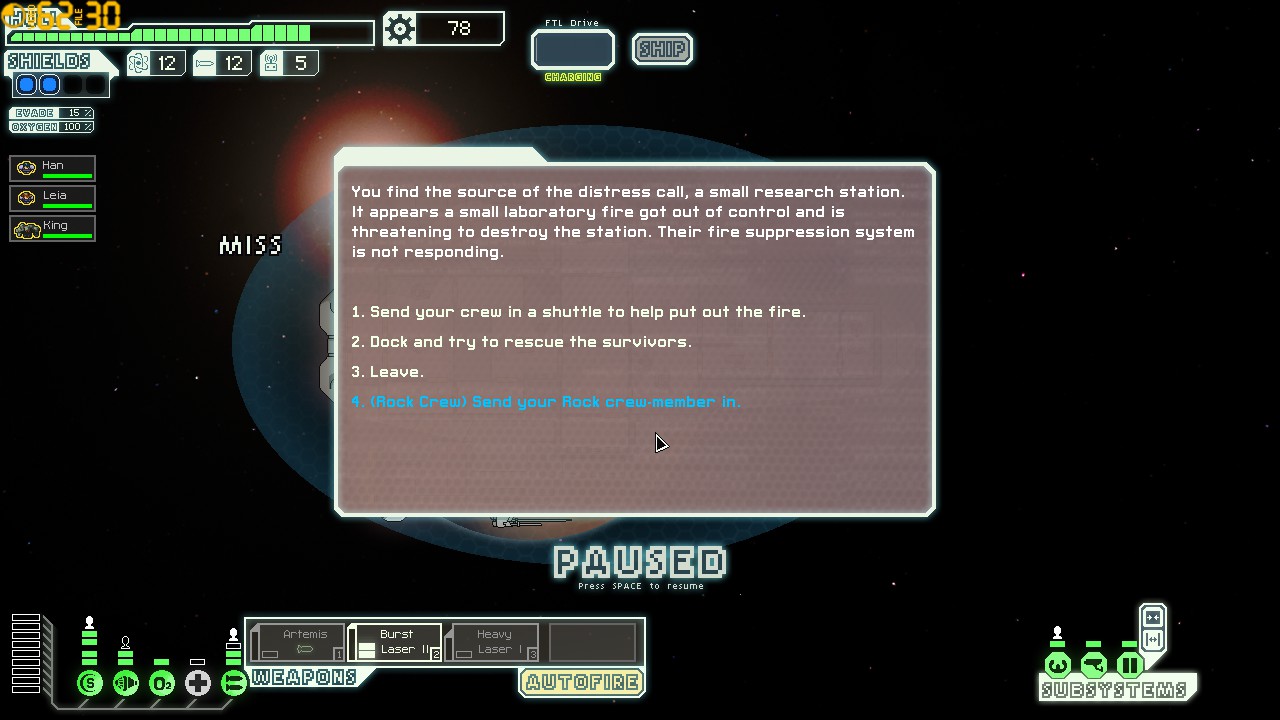
Soon enough, I deal with another Rebel – this one lurking inside an asteroid field – and pour some scrap into upgrading the ship’s power supply, so I can actually use the new laser. Then I investigate another distress beacon, and this time things go my way. It turns out to be a burning space station, and the Rockman promptly earns his pay:
Rock on!
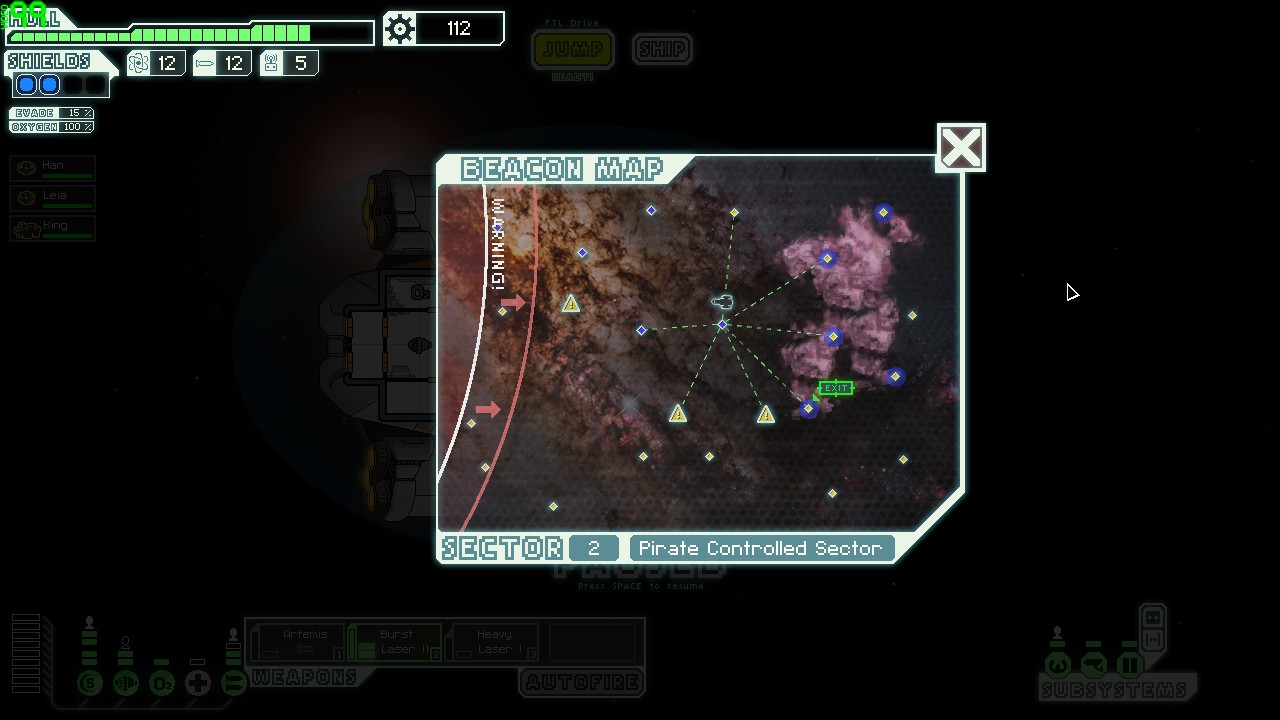
The grateful scientists on board the station give me a new long-range sensor, and I scope out the sector:
The view of Sector Two.
As with Sector One, I have some time before the Rebel (the red line at the left) reaches me, so I should make the most of it. I’m in a decent position: I have an adequately armed and shielded (for the early game) ship, and a nice pool of scrap to play with. Where to next? With the sensor, I can see that the yellow triangles represent spaceships. Jumping to those locations will likely lead to battle, but the rewards (read: scrap) could be worth it. On the other hand, I could simply head into the nebula (the pink blob to the right). In the nebula my sensors would be blinded – carrying its own dangers – but the Rebel’s pursuit would also be slowed. In either case, things could go south in a hurry – or I could stumble across a remarkable find that would turn the Kestrel into a killing machine.
There is a lot of luck in this game, but that’s not necessarily a bad thing . That chanciness helps create a sense of exploration, a sense that I really am a starship captain racing through the unknown. And it often throws up interesting decisions – even if they’re as simple as, “do I roll the dice?” (see: the asteroid belt and space station back in Sector One).
But for now, I’ll have to leave those decisions for another day. “Get out while you’re ahead,” they say, and it looks like a pretty good time for me to close this episode of the LP. Stay tuned for the continuing adventures of the Kestrel, and I’ll see you next time!
This week’s song is another Bethesda opening title theme, this time from post-apocalyptic extravaganza Fallout 3. I’ve linked both the in-game version (ab0ve), which you can also download from the game’s official site, and the orchestral version from the Greatest Video Game Music album. Enjoy!
This entry is part 2 of 2 in the series Jeanne d'Arc
Now that I’ve finished Jeanne d’Arc (PSP, 2007), I can give my verdict!
This post is really an addendum to Monday’s discussion of Jeanne’s gameplay. There’s not much more I can say on that subject! It’s “lighter” – easier, less complex, less time-consuming and grindy – than the typical tactical RPG, but that’s an observation rather than a criticism. From a mechanical perspective, Jeanne is well-designed and largely well-executed (although it does seem a bit laggy compared to its peers), and that forms its main draw.
I do want to talk a bit about story, which is what so often elevates tactical RPGs from “good” to “great”. Unfortunately, it doesn’t do that for Jeanne. The plot is a mishmash of competing and often incoherent plot elements, populated by characters who wander on- and off-stage with little rhyme or reason. What partly redeems it is that, after a slow start, some bits of that mishmash become much better than others. There are some clever twists on history, some very striking individual moments, and one subplot steals the show with its character development (both in the sense that the characters involved change over time, and in the sense that they make painful decisions that reveal their true selves). The net effect is that while the story as a whole is not good, enough of it was for me to stay interested.
At the end of the day, then, Jeanne is a good game rather than a great one. It doesn’t quite match the genre’s two pinnacles, Final Fantasy Tactics and Tactics Ogre, which coupled great gameplay with powerful, meaningful stories. But its gameplay riffs effectively off the greats, and there are enough worthwhile ideas buried in the story to offer a nice bonus on top of that. A worthy “honourable mention” in genre history.
We hope you enjoyed this post! To quickly find this post, and our other reviews, click the “reviews” tab at the top of this page.
This week’s song is another great battle theme from Tactics Ogre, “Fight It Out!” I love the little discordant clash at the start of the song — it makes me envision everyone pulling steel before (at 0:15) the battle is joined. Enjoy!
This entry is part 1 of 2 in the series Jeanne d'Arc
Combat in Jeanne d’Arc
I often praise the PSP as a mecca for turn-based tactical RPGs – Disgaea! Final Fantasy Tactics! Tactics Ogre! – and over the past few months, I’ve pencilled another name onto that list: Jeanne d’Arc, a 2007 title from Level 5 (very!) loosely inspired by the historical Saint Joan. It starts off rather generically, but now that I’m close to the end, I’m glad I gave it a second chance.
By way of introduction, Jeanne plays out like a cross between Fire Emblem and Final Fantasy Tactics. You command a squad of characters, each of whom belongs to a set class and has his or her own strengths and weaknesses. Notably, characters cannot permanently die! Between missions, you assign equipment and special skills (the two work a bit alike; a finite number of skills are available at any one time, and you acquire new skills via crafting and enemy drops). Some skills are class-specific, while others can be assigned at will. For example, Jeanne and her friend Liane both wield swords, so they have access to the same pool of class-specific skills. However, Liane trades off durability in exchange for stronger magic, suggesting players should assign melee boosters to Jeanne and magic spells to Liane. Combat plays out similarly to other tactical RPGs: park sturdier sorts at the front and mages/archers at the back, advance methodically, and heal as needed. So long as the party is adequately levelled, the game is reasonably easy, and since it’s also not very grindy, that’s not a hard condition to meet.
Jeanne’s appeal stems largely from how it gets the basics right.. The levels are creative, both in their layout (the maps are a nice mix of wide, narrow, flat, and steep) and in their objectives: most are simple sweeps, but some require you to make it to an escape point, or defend a key location. One, notably, is an imaginative riff on a certain infamous boss battle from FFT. The pacing is just right: combatants hit hard enough to keep the pace brisk, but (a single annoying escort mission aside) not so hard that the game turns into an exercise in luck-driven one-hit KOs. And while it’s easy in the sense that I’ve rarely seen the game over screen, that doesn’t mean it’s boring: I still reach for the grey matter in every battle.
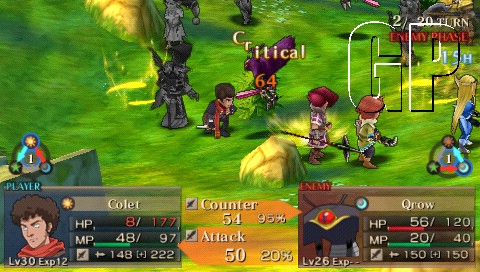
This by itself would be enough to make me recommend Jeanne to genre fans in need of a fix, but on top of that, Jeanne adds several interesting little gameplay mechanics. While they aren’t hugely significant, they do keep the game feeling fresh. One is positioning: keeping characters next to each other gives them a defensive bonus, and the bigger the clump, the bigger the bonus. Striking an enemy will “power up” the tile on the victim’s other side (visible in the above screenshot – note the glowy yellow rings at the upper left and at the far right), but someone standing on the powered-up tile might be away from the group and hence vulnerable. (One tactic I like: run a hard-to-hit character, say the nimble thief Colet, around the back of the enemy line to power up a tile on the front. My slow-moving characters approach the front in a clump, and one stands on the powered-up tile; Colet, meanwhile, can happily look after himself.)
The game’s signature mechanic, however, is that Jeanne and several of her allies wear magic armlets that let them temporarily transform into super-soldiers – and if they kill an enemy while transformed, they get another turn. If they score another kill, they get another turn. And another. And another. The video below (starting at about 1:15) shows this in action:
This has a couple of implications. It changes the ideal tactics: while most games encourage players to focus fire so as to completely eliminate enemies and reduce incoming damage, in Jeanne it’s often preferable to bring a whole host of enemies down to low health (leaving them vulnerable to a single transformation rampage) instead. As with positioning, this isn’t a revolutionary feature in and of itself, but it is a nice point of differentiation relative to Jeanne’s peers.
More importantly, it helps give Jeanne a particular kind of fun. The joy of strategy games lies in reading the situation, crafting a plan, and finally seeing it come together (and generally, the deeper the game, the more profound the delight – anyone who’s played Dominions 3 will know what I mean). The drawback is that it can take a lot of time and effort for that plan to pay off! Puzzle games compress that into a single “aha!” moment and are quicker to play, but typically just have One True Solution. The transformation mechanic gives Jeanne a bit of the best of both worlds. Working out how to bring down a mass of enemies down to low health, then actually doing so, is quick and relatively simple – far simpler than orchestrating victory in Civilization or Dominions! But the basic skills – analysis of a fluid situation, thinking ahead, allocation of scarce resources – are the same. And the moment of triumph, when Jeanne carves her way through four or five enemies in one round, is real.
That, in fact, is almost a metaphor for the gameplay as a whole. By genre standards, Jeanne is relatively short (I’m at 38 hours and could probably finish before 40), simple, and easy. But that doesn’t make it mindless – either on the developers’ part, or on the player’s – or boring. Jeanne’s designers clearly put love and thought into their work, and it shows. This is one title genre fans should check out.
This entry is part 1 of 2 in the series Sleeping Dogs
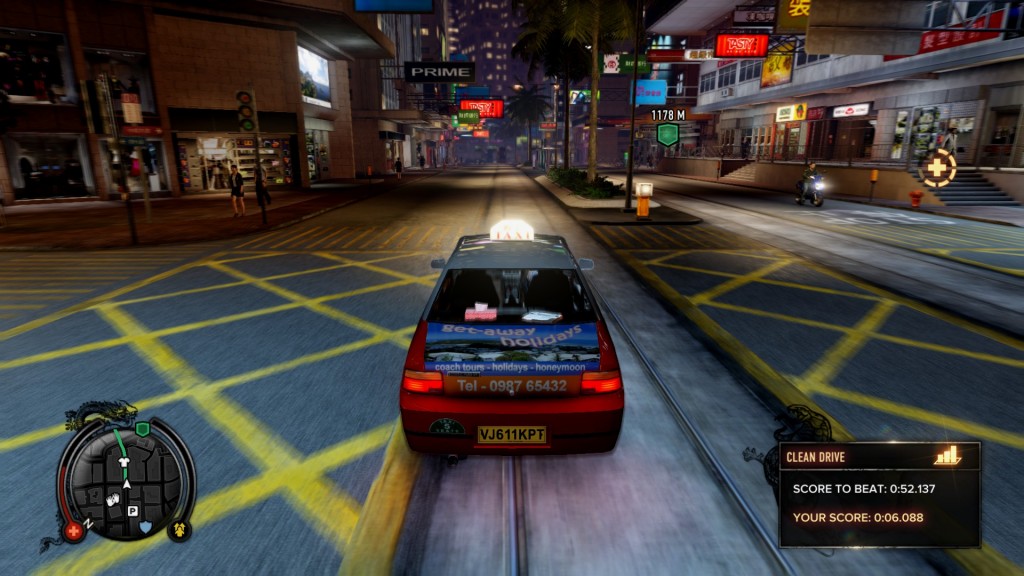
Taaaaaaxi!
Sometimes you can trace when you fall in love with a creative work to a single moment, of joy or wit or creativity. And so it was with Sleeping Dogs, video games’ answer to Hong Kong gangster flicks.
Our story begins with our hero, undercover cop Wei Shen, between missions — quite literally, as his next objective was some ways off. On foot, too far from his motorbike and too far from his destination, it looked like Wei was about to add a touch of verisimilitude — namely, vehicle theft — to his criminal disguise. Then I saw a taxi. Salvation! I sent Wei jogging over. The game popped up a message: “Hold Y to enter the taxi”. Y! Wei opened the door. Threw the driver out. And climbed behind the wheel himself.
Oops. What happened was, I had missed the “hold” part and tapped “Y” instead. So much for “not stealing a vehicle”, but oh well. When life gives you lemons, you make lemonade. When Sleeping Dogs gives you an ill-gotten taxi, you drive off (and luckily for me, there were no police officers nearby to object). But just because I had turned Wei into an unwitting car thief didn’t mean other cars on the road would disappear. In due course I ended up in the queue at a red light, patiently waiting my turn to go. So imagine my surprise when a passerby climbed into the taxi — only to open the door again and run for her life when Wei said, mildly, “Do I look like a cab driver to you?”
That made me laugh. It was the perfectly logical thing to happen in that situation — the taxi was stopped, Wei wasn’t carrying anyone, and there was no way the would-be passenger could have known he was not a real taxi driver. And yet, it was so delightedly unexpected — how often do games obey real-world logic, instead of their own? That bit of clever thinking by the developers sealed the deal for me. I can’t wait to see what else they may have in store.
This week’s tracks are cousins: both are effectively variations on the main musical refrain of Princess Mononoke, one of my favourite movies (animated or otherwise). “Legend of Ashitaka” is the conventionally heroic version, strong but a bit wistful; “Journey to the West” is the more upbeat and adventurous of the two. The versions I’ve attached below are from the “A Night in Fantasia 2004” orchestral concert, which I was fortunate enough to attend. Enjoy!
What can you do when you desperately want to talk about a game, yet cannot do so without spoiling most of what made it such a memorable experience? I have been attempting to find an answer to that question for weeks now. Game of Thrones the RPG is that rare thing: a game with a story which would genuinely be lessened if, when starting, you knew what lay ahead. There are moments of genuine surprise, moments of emotion, moments where the pieces snap together and where I was left in admiration of the storytelling. As much as I would love to link to a youtube video of my favourite speech in the game, I cannot. As much as I’d love to discuss the interplay during a certain rainy scene, I cannot. As much as I am dying to discuss the way a specific relationship is developed, I cannot!
There came a point where, with a good deal of surprise, I realised that I wished I had not read the books by George R R Martin because they were spoiling the game’s plot. Honestly. Hand on heart. When the game laid out certain facts, my mind feverishly examined them, twisted them about to fit them into the ever-expanding plot — and then I realised I knew the rough direction certain aspects must take because of what is — and is not — present in the books. If I hadn’t possessed that book-based knowledge, then particular aspects of the plot would have been all the more effective — but I cannot elaborate without risking indirect spoilers.
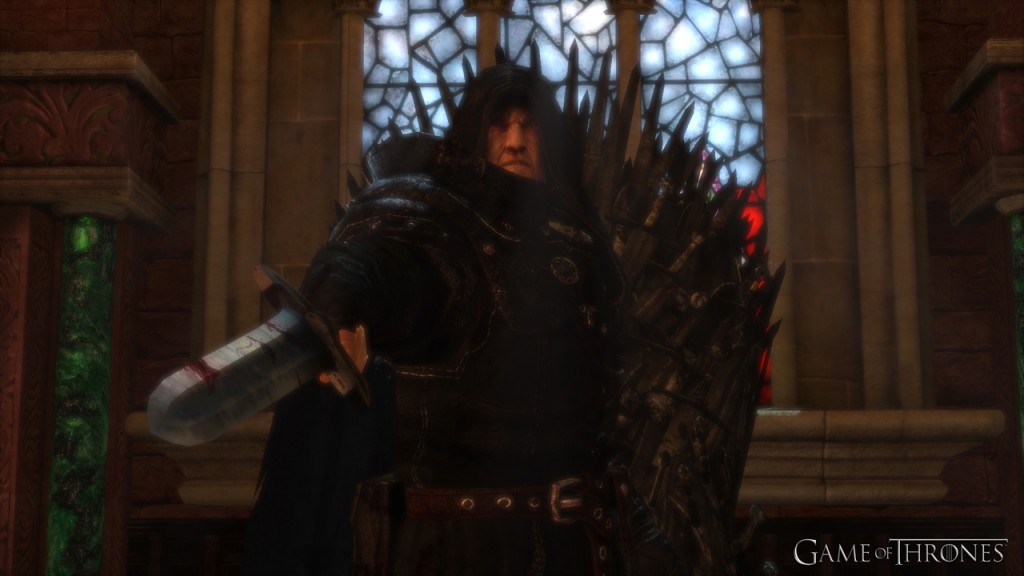
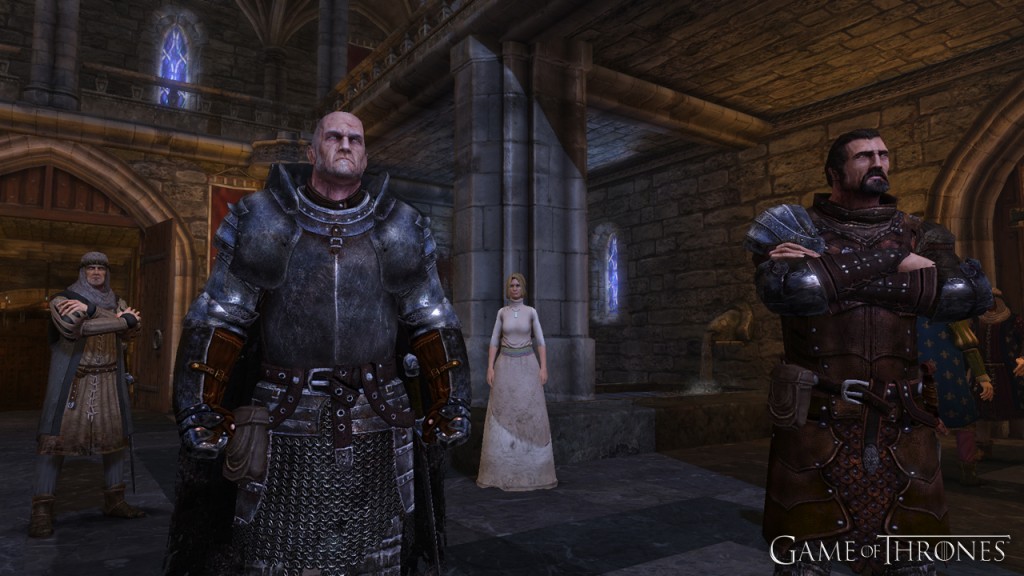
ZOMG! That’s the scene where — argh! I can’t say! If you see the cutscene that image is part of, that’s the scene which I wish I could post a video of. I can’t believe it’s used as a marketing image! I bet the developers chortle every time they see an unsuspecting site post it.
For reader reference, I am not a big fan of the Ice & Fire series. I have read all of the main series, along with two of the Dunk & Egg novellas. I started reading back when book 3 was released in paperback. Whilst I really enjoyed the first three books, I found Feast for the Crows and Dance with Dragons to be deeply disappointing. The novellas were OK, the first being superior to the second in my opinion. Series 1 of the HBO adaptation was generally excellent, but I haven’t yet seen series 2. Thus, I would say you do not need to be a fan in order to enjoy the game. You only need to have the right gaming tastes. Make no mistake: however much I liked it, I do not recommend Game of Thrones the RPG to any but a specific sub-set of gamers. More on that later. First I shall attempt to pick my way through the minefield and explain why I enjoyed the story so much.
To begin with, the game alternates between two protagonists, Mors and Alester. You play chapter 1 as Mors, chapter 2 as Alester, and so on, back and forth, until eventually they meet. At the outset the two stories feel completely disassociated. Mors is up at the Wall doing his duty as a brother of the Night’s Watch; Alester is down south taking up the reins in his family home. Alester’s story begins months prior to Mors’; you’re playing the recent past. Gradually, a tentative link appears between the two strands. It’s at this point the game begins to get interesting. Yes, the game suffers from a slow beginning. I found Mors’ story reasonable from the first, if nothing special or particularly engaging. Alester had some interesting moments, but it took several of his chapters before his half of the tale began to engage me.
When that tentative link appears, Mors’ story started to take a rapid uphill climb. His relationship with a certain character began to develop from typical videogame material to something better, something portrayed with a certain touch of sensitivity — this lent it a humanity frequently lacking from similar relationships in other games. It’s at this point Mors’ voice actor began to improve, as though he’d realised there was more to this script than the typical fantasy game guff. I began to look forward to scenes featuring the two characters, and equally to desire answers to questions which were beginning to form.
Then, Things Happen(TM). Well golly! Yes, I’d seen some of that coming but execution certainly kept my attention riveted — and immediately, freshly hungry for answers, we are snatched away to Alester’s next chapter. It’s a lengthy chapter and slowly, slowly a few pieces of the jigsaw are doled out, fitted together. Right around the point where I felt the chapter was over-long, More Things Happened(TM). And did not stop happening. For the rest of the game. Twists, turns, revelations, shocks, neat snatches of dialogue, and always that hunger to find out what happens next — the story hit its stride and did not falter. Suddenly, those slow opening chapters made a lot more sense when viewed as part of an overall story. They established the cast of characters and the world they inhabit: the type of detailed set-up material so common in books and rare in games. Mors and Alester, in particular, had more to them than typical game characters. Added dimensions and familiarity upped the impact of those aforementioned Things Happening(TM). Events I would have watched dispassionately in another game — have watched dispassionately in other games! — hit me in the gut this time around. Things which feel cheesy or silly in other game plots worked smoothly in this one because the time had been taken to set them up, embroider them into the fabric of the universe. Character motivations made sense as human motivations rather than plot devices. Mors and Alester developed shades of grey, revealing themselves as gloriously human characters. Predictable events often had unpredictable spins to them, happening at the ‘wrong’ time, or with added aspects which were not expected. At the end, the very end, after one final roller-coaster of emotion, I found myself in the happy position of not being able to say which of two conflicting viewpoints was the right one. Honour or duty? A vital, thematic question. The very last scene of the game was one resulting from my choices; it reflected the decisions I had made and left me with a mixture of sorrow, hope, pride, and worry. I believed I had done the right thing by my favourite character, yet I wondered if perhaps the cost would, in the end, prove too high.
My name is Mors. I am distilled awesome.
The game has five different endings. There’s a major choice at the clearly flagged point of no return. This determines which ‘side’ of the ending you will play out. After that, you make another choice on which direction you want the ending to take. The fifth ending is for dying during a certain battle. I reloaded to watch the others — I needed to know! The first ending I saw, the one I regard as my ‘true’ ending, was the most fitting for the path I had taken through the story and I’m glad I arrived at that one naturally.
Yes, “path through the game” and “choices”. Whilst the characters are pre-written and are confined by the limitations of the plot, there’s a reasonable bit of wriggle-room for the player to shape their own versions of Mors and Alester. My Mors was an honourable, upstanding, occasionally downright scary fellow. He could have been a blood-thirsty psychopath, or an unbending, harsh veteran. My Alester tried to strike a balance between the demands of family, honour, religion and crown. In another playthrough he could have been a religious zealot, an oppressor of his people, or a wannabe-liberator. When Mors and Alester unite, the player retains control over both. Conversations will frequently have the option of a response from each character. This ensures there are few personality swerves, and that neither character is relegated to subordinate place. Mors and Alester are equals throughout. The story is theirs: it belongs to both and is told by both. Sub-events can be influenced as well, and the choices you make will often come back in later chapters. To give a spoiler-free example, if you save a certain person in one chapter you can meet him again later and could talk him into assisting you.
Interestingly, Mors and Alester are both older men. Mors is completely grey, Alester heading that way. One could pithily sum this up with “Mature characters for a mature story”. Life imparts experience, and both characters are richer for having decades of life behind them. They reference, and draw upon, this experience throughout the game.
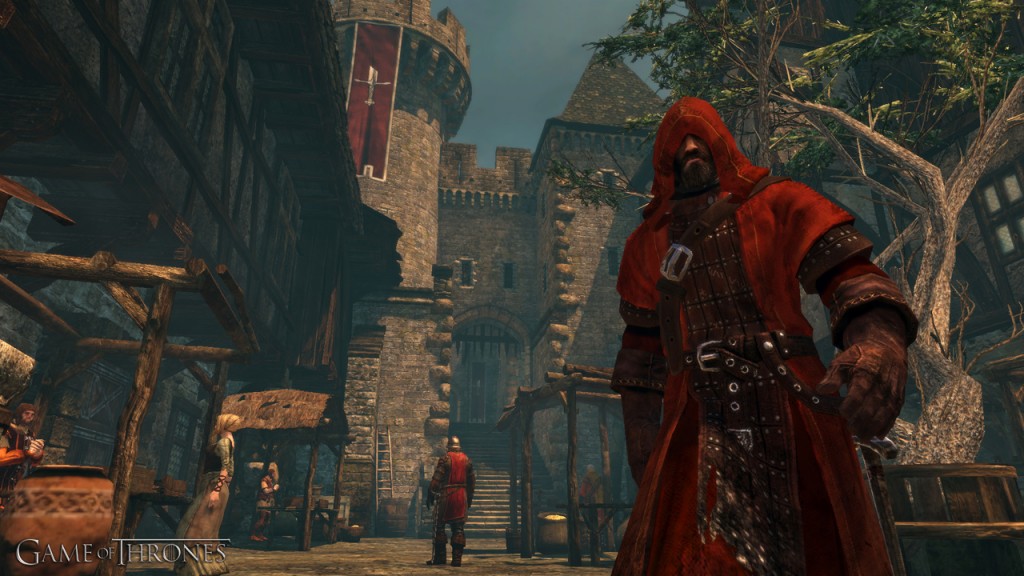
Alester. Is he wearing the hood because he’s a Red Priest, or because he’s sensitive about his greying temples?
So why wouldn’t I recommend the game to all RPG gamers? It’s very simple: the gameplay and the production values. This is a game which relies very heavily on its plot, and so gamers who prize gameplay above all else will struggle to see much attraction.
In terms of production values, Game of Thrones the RPG is clearly not a triple-A title with a many-millions budget; it is unfair to demand it match a Bioware or Bethesda game in that department. The game cannot compete on those grounds and there is no point in trying to claim otherwise.
Game of Thrones the RPG is not a pretty game. I’d say that it’s not as ugly as some critics have made out; it’s about on a par with Dragon Age: Origins’ console versions. If Dragon Age has occasionally better texture work, Game of Thrones has better character models with nary a spindly-twig-arm in sight. Locations are easy to recognise by sight, and character models have a good range of variety. Whilst there’s plenty of unrealistic fantasy armour, there’s also a higher than typical amount of armour based on real historical designs. Generally, I felt that the common foot soldiers had the best ‘outfits’. The game’s major set-back in presentation occurs in larger areas, King’s Landing in particular. The game engine (and doubtless budget) cannot host large, complex areas filled with plenty of active NPCs. Thus, the two bustling urban areas felt decidedly boxy and emptier than they aught. There’s also a strange obsession with closing off the easiest route from A to B in King’s Landing, meaning that the player is forced to take the long route around outside of specific set-pieces which temporarily open up the doors. Castle Black fares better due to being a quieter and more straightforward location; however, the sense of scale is missing from the wall. It’s the old graphics versus gameplay versus experience debate – some people are better able to overlook shortcomings like this, others find they unacceptably damage the atmosphere of the game. That’s a decision best made by the individual gamer.
The game fares similarly in the audio department. The TV series’ theme music is used for the title screen. Other than that, the music is original, and unfortunately quite forgettable. The sound effect selection does the job, although without a huge range of variety. I did find that the howl of wind added a lot of atmosphere to the chapters taking place at the Wall, and contributed more to the feeling of chill than the snow and ice effects. The voice acting is a very mixed affair. Mors improves as the game progresses, starting as a gruff, growly half-hearted sort, and ending the game as a gruff, growly fellow who produced lines with such emotion I was mesmerised through a certain scene. Alester, by contrast, is voiced with consistency throughout, though sadly he never reaches the same highs even if he does avoid the initial lows. The two main characters have a lot of dialogue between them, and fortunately, even at their worst, I never found them to be less than tolerable. All of the characters who appear in the HBO series are voiced by their respective actors, including Lord Mormont, Varys and Cersei. The remainder of the cast range from acceptable to “Is something wrong with her nose?”
Some gamers associate mid-budget games with bugs and technical failings, sometimes with good reason. Game of Thrones the RPG has few such issues, at least in its Xbox 360 incarnation. The frame rate was stable and fluid, and I only encountered two bugs in my entire 30+ hour playthrough. Both were in the final chapter, and both necessitated reversion to an earlier save as they made progress impossible. In one instance I could not initiate conversation with a critical NPC, in the other I could not walk through a doorway due to an invisible wall. That’s actually fewer bugs per hour than I’ve encountered in some recent triple-A RPG titles :cough Mass Effect 3, Skyrim :cough: but it was still immensely aggravating, and cast a cloud over the game’s final hour. The standard RPG maxim should be followed: save early, save often, and save in multiple slots!
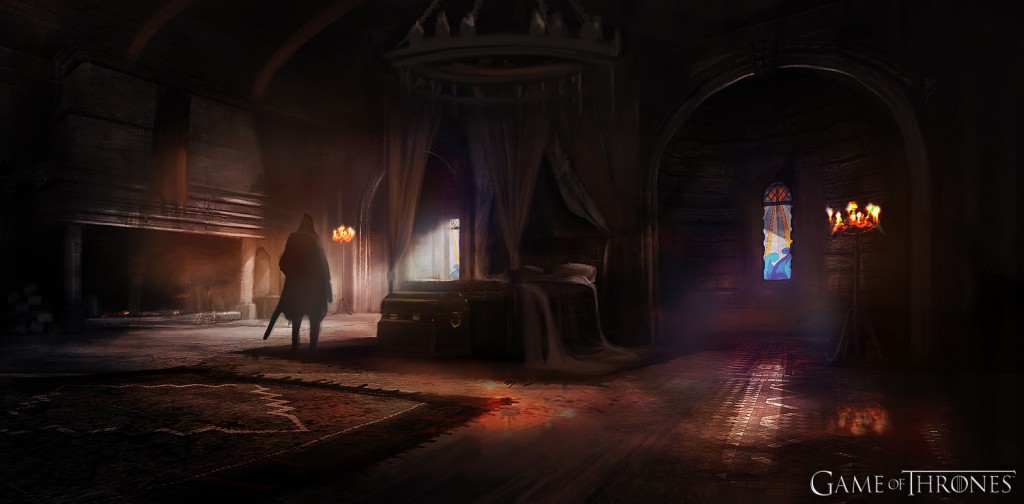
This is the concept art for the room where — er, various things happen. Yes. Various things. Some of which are more variously spoileriffic than others.
Gameplay is roughly a 40/40/20 split between conversation/plot, exploration/travel, and combat. Yes, combat is very much in the minority! Battles are less frequent than is the genre norm, and the stakes are much higher. Active player participation is required — there is no mashing X to win in this game. Difficulty is adjustable at any time, yet, as in Witcher 2, easy mode is more comparable to most games’ normal mode. You must use your characters’ skills wisely, both to set enemies up for extra damage and to prevent them from using their own skills. Using a skill costs stamina; a character can temporarily go into guard mode to catch their breath and restore most of their stamina gauge. There is a cooldown on this, however, so it cannot be spammed. Characters can apply poisons and wildfire to their weapons for extra effects, and can drink potions for bonuses. During tough battles, both will be essential. Each level gained feels precious, each upgrade to your equipment significant, because an extra 10 points of damage have a tangible effect in combat. Personally, I preferred this approach. Combat quality over combat quantity. Orders are issued in real-time and combat cannot be paused. Instead, you pull up a skill wheel and the game goes into slow motion. Queue up your commands, swap between characters and targets as necessary, then close the skill window. The game will resume normal speed and the actions play out. While there’s an element of pressure, I never felt overly harassed by the inability to pause, and I confess to being something of a pause-baby in any RPG which will let me. Conversation, exploration and travel all function as you’d expect, following genre conventions like dialogue choices and fast travel.
The game does feature the occasional stealth section. Mors is a skinchanger and can take command of his dog. Mors being Mors, the dog is called Dog and looks about as grizzled as his master. These sections are short and quite widely interspersed throughout the game. Dog will not give Solid Snake any competition-based fears as his stealth is markedly simpler than that of the serpent. You control Dog from a first-person viewpoint. You walk up behind guards and pounce on them, tearing their throat out with the aid of a simple button-bashing minigame. Done, you abandon the corpse and skulk off to locate the next hapless fellow. If the guards spot you then they will attempt to kick Dog. Should they land a blow, Mors is jolted out of Dog’s mind. It’s a mild penalty; you can immediately dive right back in and run back to the guard who foiled you to try again.
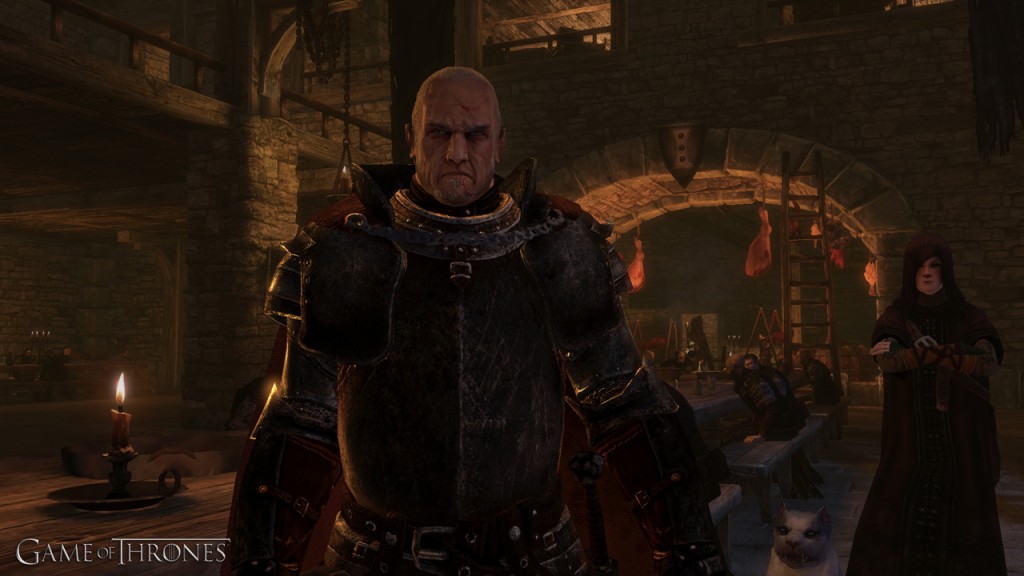
Mors and Alester anxiously await the verdict on their adventure.
I’m hesitant to call this a review. I don’t want to write a review, although that’s what it has ended up being. I want to discuss the rain scene, and the ending, and the relationships, and all those other spoilerific aspects. I want to talk about why this story would make a decent book — note decent, not great literature or throw-away pulp reading. I want to compare it to the other games and talk about why the story worked for me where others fell flat. It is a repeat of my Divinity II dilemma. You see, I loved the original ending of Divinity II. I can’t tell anyone why without ruining the ending and thus robbing my audience of the necessary experience to fully enjoy it. Some things require a build-up, context, and immersion in order to work.
If you are interested in strong characters and plotting in video games, then you probably aught to play this game. It manages to get so many things right in those areas! Wait for a sale if you feel more comfortable with lower expenditure and hence, lower risk. Play until you reach the scene in the rain around the halfway mark. If you aren’t caught by that point, then I doubt you ever will be. Just remember: it’s a slow starter.
The basis of my … gibbering:
Time spent with the game: Somewhere around 35 hours. The storyline was completed, as were all side quests and achievements. I also saw three different endings.
The review is based on the Xbox 360 version of the game. It was purchased by myself.
The images used in this piece all come from the official website at http://www.gameofthrones-rpg.com.
We’re back into game soundtracks with this week’s song, the “Main Theme” to the PS3 tactical RPG Valkyria Chronicles. It was composed by Hitoshi Sakimoto, of Tactics Ogre/FFT/FFXII fame, and it lives up to that pedigree. Enjoy!
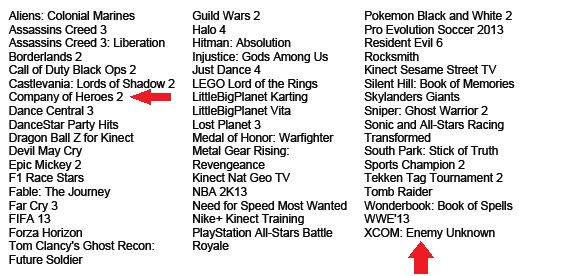
Compared to our Northern Hemisphere friends, Australia is relatively short on video game (and anime, and science fiction, and geek…) events — hence why I haven’t been able to talk about conventions on this blog. No longer! In a little over a month’s time, I’ll attend the EB Expo (Sydney Showground, 5 to 7 October) as a member of the press. I’ve copied and pasted the list of games to be exhibited below:
That selection is rather console/action-heavy, but that’s fine — I’ll still be interested in taking a look at the two prominent strategy games on the list, XCOM (just a few days before it unlocks…) and Company of Heroes 2. As someone who’s gotten a lotofvalue out of his PSP, I’ll also be very interested in an up-close look at the Vita — that’s one platform I intend to buy once it acquires a decent stable of RPGs (squad-based or otherwise). And there’s bound to be other titles of interest, so I’ll be sure to keep my eyes open!
To answer this question, I think it helps to split up what G&K offers into two categories. In one bucket, we can place the headline-grabbing features wholly new to V: new scenarios, espionage, and religion. Simply put, these are nice, but they’re not worth US$30 (let alone US$50, if you happen to suffer from regional pricing). In the other bucket, we can place the tweaks G&K makes to the core game: AI, diplomacy, units and technologies, and so on. These are the real draw.
Starting with espionage and religion, these two features are similar in that they both offer a handy set of bonuses, without reaching so far as to be game-defining. Espionage begins in the mid-game. When a civilisation begins a new technological era, starting with the Renaissance, it receives one spy who can be sent to a rival player’s city, sent to a city-state, or left at home for counterintelligence. Sent to another player’s city, a spy will provide line of sight and early warning about planned attacks, and every X turns, steal a technology (unless he/she is killed by a counterintelligence agent!). Sent to a city-state, the spy will gradually increase relations over time, and can be used to attempt a coup (a roll of the dice that will leave you with either a new city-state ally, or a dead spy). Simple, hands-off (none of the “fiddly agent” problem common to strategy games), elegant, but not decisive.
A la carte: religious bonuses in G&K
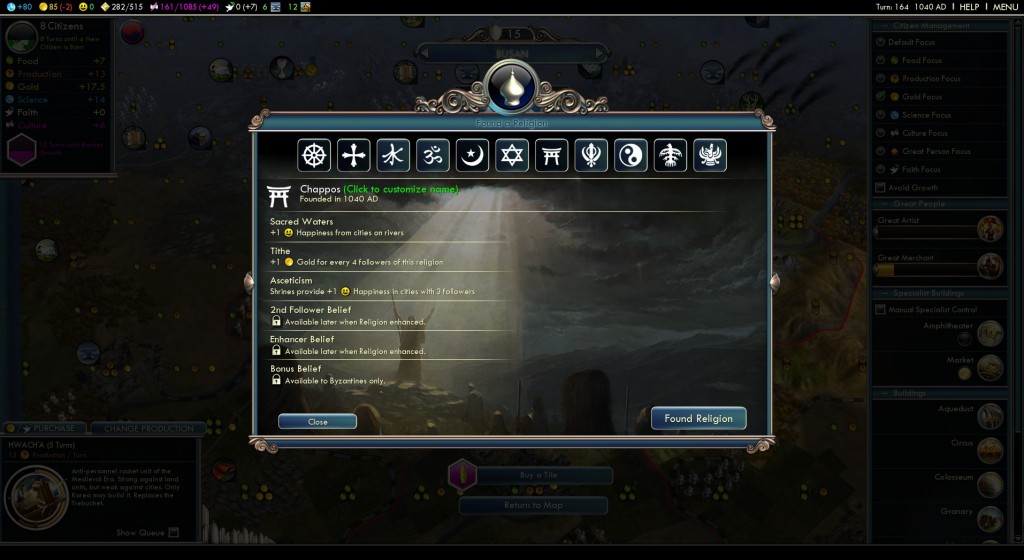
Religion, meanwhile, works off “faith points” which are primarily generated from buildings such as shrines/temples. The more faith points you accumulate, the more missionaries (spread your religion), inquisitors (quash other religions), and Great Prophets (do all the above, and also needed to found the religion!) you can deploy. Founding a religion allows you to pick and choose from a set of bonuses, some of which will apply only to you, some of which will apply to cities of any nationality that follow that particular faith. As only one civilisation per game can choose any given bonus, prioritising faith – and hence, that first Great Prophet – will allow the early bird to catch the worm. I think the importance of religion will depend on play style: I never found it that central, but I can see someone reaping dividends by taking a religion-centric civilisation (such as the Celts, who earn faith from forest tiles), then picking bonuses that allow, say, the purchase of pre-industrial units with faith.
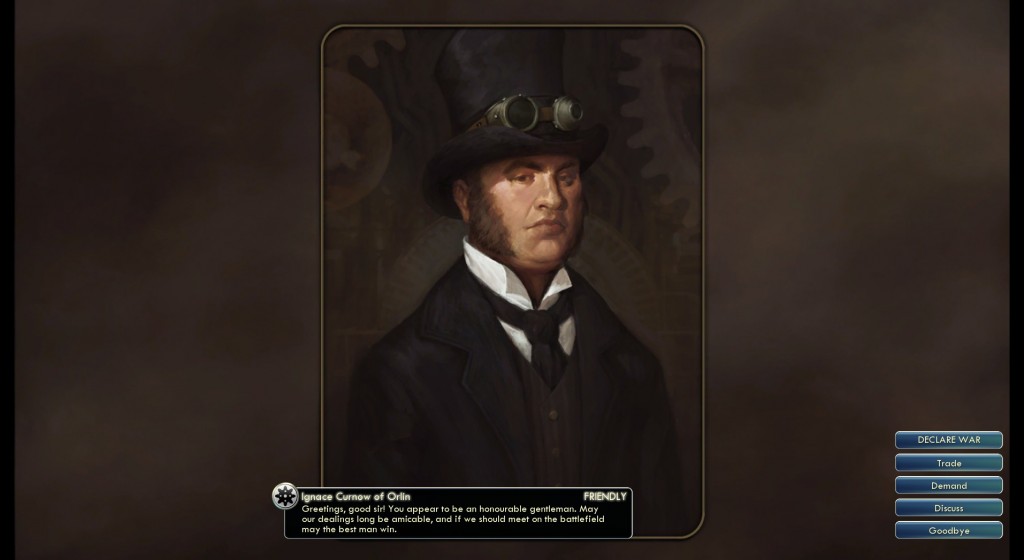
Meanwhile, the two scenarios I tried (out of three* that shipped with the expansion) were a mixed bag. Steampunk scenario “Empires of the Smoky Skies”, despite its name, is a breath of fresh air. It’s quick to play: I finished in a single evening. Its mechanics are distinct; in particular, zippy research and construction, plus unique victory conditions, make it a builder’s paradise. And it has a sense of place, of steampunkish whimsy: it’s impossible not to grin when bartering anti-gravity ore with a goggled, top-hatted man named “Ignace Curnow”. In contrast, the “Fall of Rome” scenario was a disappointment. A purely military scenario with no diplomacy, no research, and no religion, it runs headlong into the “Civilization is not a wargame” problem that has dogged scenarios since Civ II.
We hope the skies are as friendly as they are smoky
Those are G&K’s most visible features. However, iceberg-like, its real significance is what lies below. Here are a few examples:
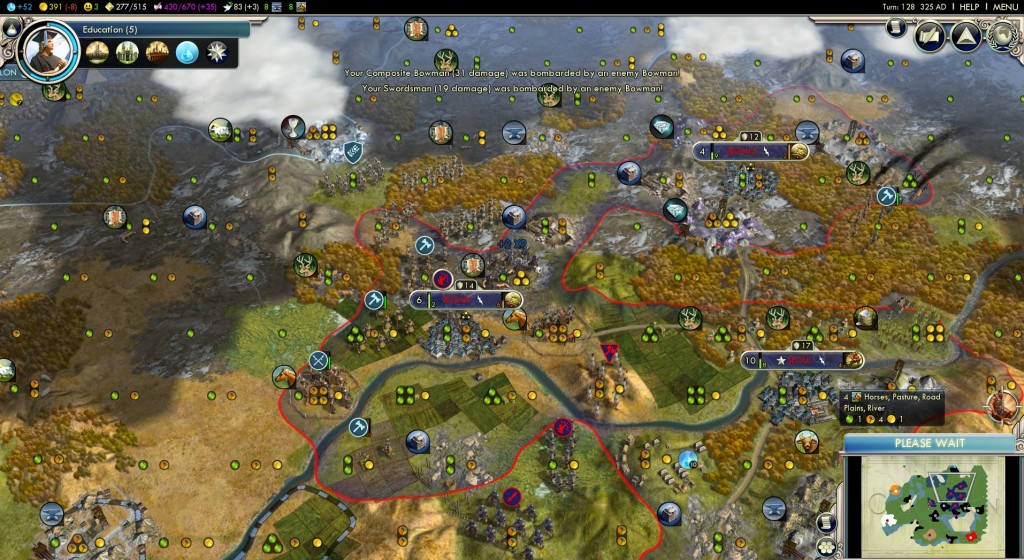
1) The computer player is cleverer (at least on land maps). Time after time, I’ve had to fight for my life – usually against early-game rushes, once against a late-game attempt to snatch up a diplomatic victory. In general, the AI hits the sweet spot where it can offer a thrilling game without actually making me lose. It did drop the ball in one game in which (a) the computer players all ignored the New World (this was a Terra map), and (b) the #1 player declared war on my horribly unprepared self… only to not lift a finger, not even posting a single soldier to our border! (The resulting war ended up one-sided, all right, but not the way I’d feared.) However, this match was very much the exception to a usually positive rule.
Heeeeeere they come! Babylonian forces (in teal) attempt an early-game rush.
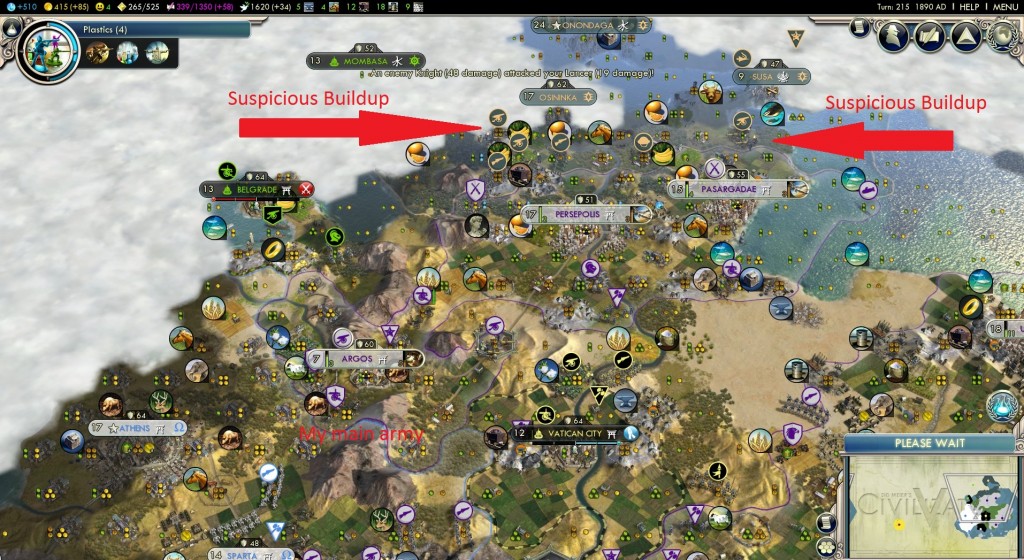
2) Diplomacy, though still not up to the heights the series reached in Civ IV, has improved to the point where the computer feels rational now. That’s more than most strategy games can say! The computer will ask for a cease-fire when it’s weary and throw in the towel (but without the ridiculously abject capitulations of pre-G&K) when it’s beaten. Even more importantly, it generally will not go to war without a sensible reason, such as border tension, and it can be deterred by a suitable show of force – in one game, the computer massed troops on our border while I was busy fighting another war, only to back down once I rushed an army home! Not only is this good strategy on the computer’s part, it does a lot to aid my suspension of disbelief and hence, my enjoyment.
3) The tech tree, the available units, and their upgrades are better designed. Remember the abortive archer upgrade path, or the ease of beelining for mechanised infantry (which made tanks redundant)? Gone. Games ending before I got a chance to play with aircraft and other late-game units? Well, now that G&K has added Great War-era aircraft, I have story after story to tell about how airpower transformed my campaigns. The effect was almost as steampunkish, and certainly as cool, as anything in Empires of the Smoky Skies! It’s not perfect – the devastating Gatling guns unlock a little too early – but it’s much better than what we had before.
The Iroquois mass along my northern border while my main army fights Greece in the southwest.
I could list more incremental improvements.Refinements to one of Civ V’s best new features, city-state diplomacy. Notably faster performance on my computer. But the gist, I think, would be the same. The best reason to buy G&K isn’t to see spies, or prophets, or steampunk airships. The best reason to buy G&K is to see how it enables Civ V to realise its potential, and I think it’s telling that the more I played G&K, the more I liked it.
At the end of the day, my recommendation is straightforward. If you hated the base game, Gods and Kings will do nothing to change your mind. If you liked the base game, however, Gods and Kings is worth your cash. It offers subtle but real enhancements, and irons out several of the flaws that previously marred CivV. Its more visible additions – espionage, religion, scenarios – are merely icing on the cake. A good expansion.
* Despite its historical setting, the third scenario, “Into the Renaissance” starts players with just one city and a settler! This didn’t quite appeal to me, though I may revisit the scenario in the future.
We hope you enjoyed this post! To quickly find this post, and our other reviews, click the “reviews” tab at the top of this page.
What I played: One game on King as Austria (aborted). One game on Prince as Austria (won via the science victory). One game on Prince as Carthage (won, science). Two games on King as Korea (a pre-G&K civilisation) (won, science). One attempt at the Fall of Rome scenario (aborted). One attempt at the Empires of the Smoky Skies scenario on Emperor (lost). These were mostly on land-heavy maps: Continents, Terra, and Europe.
What I didn’t play: The “Into the Renaissance” scenario. The remaining difficulty settings and civilisations. Archipelago and similar maps.
Calling all readers, aspiring alien-hunters, and Guile-haired jumpsuit-wearers! With XCOM: Enemy Unknown‘s release just a month and a half away, Earth needs a few* brave** men and women. As in the original X-Com, players will be able to rename their soldiers at will, and for the XCOM game diary I’m planning, I’d love to name my troopers after you guys. Though I have nothing to offer but blood, toil, tears, and incoming plasma, it’ll be exciting while it lasts! Who’s with me?! Do you want to live forever?!
Ahem. If you’re interested, leave a comment below and I’ll add your name to the bottom of this post. Once the game is out, I’ll probably either create a new post with all the custom-named soldiers and their current status, or just expand on this post. So check back in a couple months’ time!
* at least
** or “foolhardy”
The roll call thus far
“Beefeater”
“Froggy”
“Josh” (wants to be first into battle)
“LeSquide”
“Kat”
“Talorc” (who wants a rocket launcher)
“Veloxi” (wants a sniper rifle)
“Hikaru Usada” (wants… to be last out of the dropship)
“Riztro” (great psi bait)
“Rebecca W”
“Wolfox”
“Farnsworth” (wants to hang back and lob the odd grenade)
This week’s song is the opening theme to John Adams, the very nice 2008 HBO miniseries. Below, I’ve linked both the full-length version and the shortened version that plays over the gorgeous credits sequence. Enjoy!
Hot on the heels of Paradox’s announcement of Europa Universalis IV, studio boss Johan Anderson has presented the first gameplay video! Courtesy of Gamespot:
That video’s highlight, for me, is the new trade system (which starts at 3:54). Placing trade routes on the map (linking the old EU “centres of trade”) appears to been inspired by Empire: Total War‘s excellent but horribly underappreciated system. However, it appears Paradox is adding its own flair. This Destructoid interview explains:
“So what we’ve done is added in a system of static trade routes, so the trade flows along from the world into Europe, and your job is to dip money out of them as they go by. The way you do this… firstly you have your trusty merchant that you can send to various points along the routes to convince them to suck more wealth down to you rather than have the locals cream off the profits.
The second part of your trade empire is territory. If you take the Portuguese empire you’ll see strings of bases along their trade routes, so if you do the same thing you’ll be able to suck more trade home to Portugal and make yourself wealthier.
The third part is the fleet which will help you control trade in areas. We’re going to make small ships trade ships and big ships combat ships. So the small ships, you can send them off to, say, the Arabian Sea where the trade will split between going around to Africa and going up to Eastern Europe, and if you increase your power there you can steer the trade to where you want to.”
Trade ceases to be a merchant placement mini-game, and looks set to become far more connected to conquest, colonization, exploration, and diplomacy. No longer do you have to conquer entire countries to get a gold mine in a specific province, you can use your fleet and strategic bases to control the flow of trade on your own terms. Previously the system was very automated “and the moment you start talking about automation, the feature has a problem.”
As the above video highlights at 6:18, trade routes will also shift over the course of the game (away from the Mediterranean and towards the Atlantic, once the routes around the Cape of Good Hope and to the Americas open up).
The net effect, hopefully, will be to strengthen one of EU3‘s weaker aspects: the naval game. Not only were individual naval battles not very satisfying (they tended to boil down to “who brought the most ships?”), but EU3 only modelled one of the uses of seapower (being able to land troops on the enemy coast), while neglecting the need to protect overseas trade routes. Based on what we know so far, it sounds as though EU4‘s naval game will be much more interesting, which should benefit maritime powers such as Portugal, the Netherlands, and England->Great Britain. I look forward to seeing how this works in the final game — and to seeing what else Paradox has in store for us.
This week’s song is another SNES-era RPG world map theme: “Time Circuits” (aka “Corridors of Time”), which plays in one of the most wondrous areas of Chrono Trigger. Enjoy!
#3 – 18 August 2012: Some details out from Gamescom, if you can read French! The highlights, according to Google Translate, include a co-op campaign and confirmation Sweden and Canada will be in the game.
#2 – 14 August 2012: . In response on a question I asked on the official forum about AirLand Battle‘s “dynamic campaign”, an Eugen team member stated:
Dynamic means fully dynamic -so much more than in W:EE
That sounds promising to me!
#1 – 12 August 2012: Eugen Systems and publisher Focus Home have announced Wargame: AirLand Battle, the upcoming (2013) sequel to European Escalation! I’ve quoted the full press release at the bottom of this post. The highlights are as follows:
1) The new game still takes place in the 1975-1985 time period, and the protagonists are still NATO and the Warsaw Pact; however, the action has shifted north to Scandinavia.
2) Fixed-wing aircraft will be in the game! This is a change from EE, where the only aircraft are helicopters.
3) There will be four new countries in the game. The developers have all but confirmed one of them will be Canada, with the other three being chosen from amongst Denmark, Norway, Sweden and Finland.
4) The number of units has increased to 750 (more than double the 361 in EE!), of which 150 are planes.
5) Edited in due to my bad memory: AirLand Battle will have a “dynamic campaign”! This is the feature that has me most excited, as I felt the campaign was the weakest part of the original game.
6) You can view the first teaser trailer below:
I’ll update this post as news about ALB emerges, so stay tuned!
PARIS- Aug. 10, 2012 – Released in early 2012, Wargame: European Escalation by Eugen Systems became the new benchmark in real-time strategy games, praised by critics and players alike.
Today, its sequel, Wargame: AirLand Battle, has been unveiled for the first time in this teaser video. Planned for released in 2013, Wargame: AirLand Battle will bring the series to a brand new dimension. Today’s video gives a glimpse of the spectacular new features to come!
Wargame: AirLand Battle will be presented for the first time at Gamescom 2012 in Cologne next week at the Focus booth in the business area (Hall 4.2, Stand I-050a) and at Koch Media’s booth in the public area (Hall 7.1, stand B051 – B041)!
While the first Wargame made a splash with its powerful engine, Wargame: AirLand Battle will be the series’ leap forward by bringing a level of detail never before seen in a real-time strategy game. The new version of the IRISZOOM Engine™ will display spectacular graphics with a wide variety of units, scenery, and impressive topography reproduced from satellite maps, all of which are visible in today’s teaser.
Just like its predecessor, Wagame: AirLand Battle takes players through a series of conflicts commanding NATO and Warsaw Pact troops between 1975 & 1985 at a turning point of the Cold War. In this episode, war rages in Northern Europe, notably Scandinavia, whose architecture and magnificent landscapes are faithfully recreated in the game.
Wargame: AirLand Battle allows players to command all military resources of the Cold War era from tanks to planes. A total of 150 planes strengthen the playable arsenal of the game, from fighters to bombers to electronic warfare planes. Four new nations and their vehicles join the original eight from the first installment, making a total of over 750 vehicles and combat units rendered in realistic detail! Wargame: AirLand Battle also brings authenticity to the next level thanks to a new weapons system, better handling of fire effects, and a new Urban Combat Interface (UCI) allowing for battle inside cities.
The solo campaign is composed of several new dynamic campaigns, during which players manage all aspects of battle by leading each squad of the Theater of Operation and making good use of reinforcements and strategic support. Wargame: AirLand Battle still allows customization of armies in solo and multiplayer modes thanks to the ‘Deck’ system, which is now being enhanced with an integrated ‘viewer’. Ultimately, each decision made will have an impact on the tactical outcome of battles and evolution of the global conflict! Prepare to re-enter the Cold War in 2013!
Criminal lords who control everything not controlled by the ultra-rich;
Police whose only principle of operation is maintenance of the status quo;
Hordes of poor people starving in the streets;
Absolutely no middle class whatsoever.
Nonetheless, the society manages to remain at a high technological level.
– The Grand List of Overused Science Fiction Clichés
At first glance, one might think that Deus Ex: Human Revolution, last year’s cyberpunk action-RPG from Square Enix, falls into the above trap. A walk around its first hub area (which I’ve just completed), the Detroit of 2027, appears to tick every box. The game’s first act takes place over a single evening, so the sky is black and forbidding. The streets are filthy. Graffiti is everywhere. The beat cops all wear riot gear. The outside world appears no better: newspapers refer to an ongoing “Australian civil war”. At times, the exaggerated dystopia shades into silliness: why are middle-class characters living in the same garbage-ridden slum as the local arms dealer?
The grrrritty future: Detroit in 2027, from Deus Ex: Human Revolution
But dig deeper, and you’ll find more to Human Revolution than Generic Science-Fiction Dystopia. This is a world defined, above all, by one social issue, one conflict – transhumanism, in the form of cybernetic augmentation. This raises several questions. First, there’s the usual debate about the morality of humans “playing God”, evident in conversations with other characters, in product blurbs from cybernetics manufacturer Sarif Industries and in radio broadcasts from anti-augmentation terrorists Purity First. It’s done well, it’s done plausibly – the pro/anti-augmentation slogans would fit right into today’s culture wars – but it’s also what we’d expect from a work that tackles the topic. In other words, well-executed but par for the course. If you are already familiar with this debate, from other works of science fiction, then Human Revolution won’t do much to sway your mind.
The game’s real strength isn’t what it has to say about transhumanism in general – it’s what it has to say about transhumanism in this particular world, with this particular technology and set of trade-offs. The advantages to cybernetic augmentation are obvious – you get to play with them. Want to jump like an Olympian’s dream, fling dumpsters and vending machines as if they were tissue-paper, see through walls, turn yourself temporarily invisible? These are merely some of the enhancements available to hero Adam Jensen, and making use of them is what Human Revolution’s gameplay is all about. More prosaically, cybernetics also fill the role of real-world prosthetics – allowing people who’ve been injured or maimed to live better lives. These positives are real.
The glittering future: the Sarif Industries lobby
But there is a heavy price. Cyborgs don’t lose their souls. They don’t become evil or insane or deranged. They don’t go on homicidal rampages. The game is not so crude as that. They do become dependent on an expensive drug, “neuropozyne”, to prevent tissue rejection and eventual agonising death. What happens when a cyborg runs out of neuropozyne, from the hints we’re given (and from this live-action trailer, in the form of a Purity First propaganda video) is not pretty – and there are “people” in Human Revolution, such as pimps looking for leverage over their girls, who’ll take advantage of that. This trade-off isn’t metaphysical, or moral, or airy-fairy and abstracted. This trade-off is grimly practical. Would you make it? Human Revolution’s appeal lies in its ability to make us ponder that question – and sympathise with those characters who didn’t get a choice.
Perhaps my single favourite visual in Human Revolution is a billboard advertising a new opera, “Il Metamorfoso” (see the bottom-left of the screenshot below). The game conveys so much meaning with that one simple little image. What is the “metamorphosis”? We don’t know, but given context and the curved, circuitry-like lines just visible in the ad, we can guess it’s augmentation. What is the opera’s take on it? The “Metamorfoso’s” demonic leer, and the way his hair flows into the sinister red background of the ad, speak volumes. Augmentation, the ad seems to tell us, is a deal with the devil. Revel in its power, but know it has consequences.
The commercial future: Detroit billboards in Human Revolution
It’s that kind of clever touch that draws me to Human Revolution. This is no exercise in mindless nihilism. It’s a game whose creators put real thought into its bleak future, into art and aesthetic and concept – and then, as good science fiction writers should do, extrapolated the resulting possibilities, vile or otherwise. It’s a game that respects my intelligence, and I look forward to playing more.
In my review of Tactics Ogre last year, I praised its music as a “labour of love”, and now it’s time to highlight it. I had a hard time choosing a track for this week, but I eventually settled on “Blasphemous Experiment”, the theme that plays whenever you fight a certain powerful necromancer. Enjoy!
This week, I have two songs for you: “Omoi Haruka”, the soft, gentle theme from the 2007 anime Moribito: Guardian of the Spirit, and its vocal version, “Nahji no Uta”. Excellent but criminally overlooked, Moribito brings its low-fantasy world to life with such verisimilitude, I could almost think it’s really historical fiction. Composer Kenji Kawai’s (Ghost in the Shell, Fate/stay night) music, particularly the folk song-esque “Nahji no Uta”, is a key part of that appeal. Enjoy!
Details
Track: “Omoi Haruka” & “Nahji no Uta”.
Source: Moribito: Guardian of the Spirit – OST #1.