This week’s song is the theme of Terra, the heroine of Final Fantasy VI, and also the game’s first overworld track. Melancholy, wistful, yet with a strain of hope, it is one of the most beautiful songs I’ve heard despite being composed for the SNES sound chip. Here it is:
Deservedly, it also features in pretty much every Final Fantasy remix collection there is: I’ve listened to piano, vocal, and multiple orchestral versions of the song. However, while the orchestral versions are grand and glorious and good (I’ve linked one below, from the “Distant Worlds II” collection), I can’t help but think that they miss the sweet sadness that made the original so special. The vocal version, “Wanderer of Time” (linked, bottom), comes a bit closer to the original. Still, they’re all well worth a listen.
Details
Track: “Terra”.
Source: Final Fantasy VI original soundtrack.
Composer: Nobuo Uematsu. “Wanderer of Time” version sung by Risa Ohki.
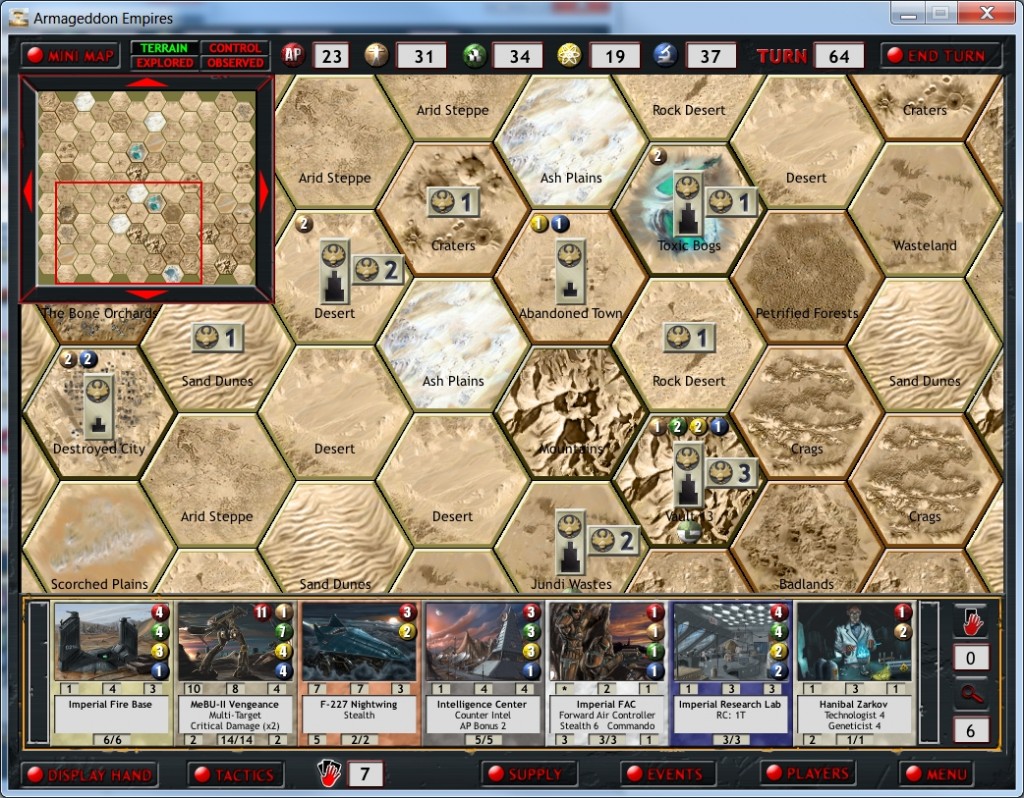
The main map of Armageddon Empires. My hand of cards is visible at the bottom.
Two high-profile strategy games came out recently, Civilization V: Gods and Kings and Sins of a Solar Empire: Rebellion, and I might as well spoil my forthcoming reviews by saying I like both of them. Each offers incremental but tangible improvements over its predecessor; each is a worthy addition to its franchise. However, for sheer enjoyment, they might just be trumped by a third title I discovered around the same time: Armageddon Empires, the 2007 board/collectible card game-inspired, turn-based strategy title from Vic Davis and his one-man studio Cryptic Comet.
By way of background, AE takes place on a future Earth devastated by a four-way war between humans, mutants, and two invading alien armies. Players explore a randomly generated map, gather resources, amass armies and heroes, research better equipment, and ultimately crush their opponents. In other words, AE is a 4X (explore, expand, exploit, exterminate) game, the post-apocalypse’s answer to Civilization. However, whereas conventional 4X games allow players to build anything they have researched and can afford, AE represents available units and structures as cards – players are limited to building what they have in their hand at any one time. Certain card types can be created and added to a hand in mid-match, but the basic building blocks of gameplay – tanks, troops, fortresses, heroes – must be included in a deck before a match (hence the board game/CCG element)*.
That’s the waiter’s description – so what are the chef’s secrets?
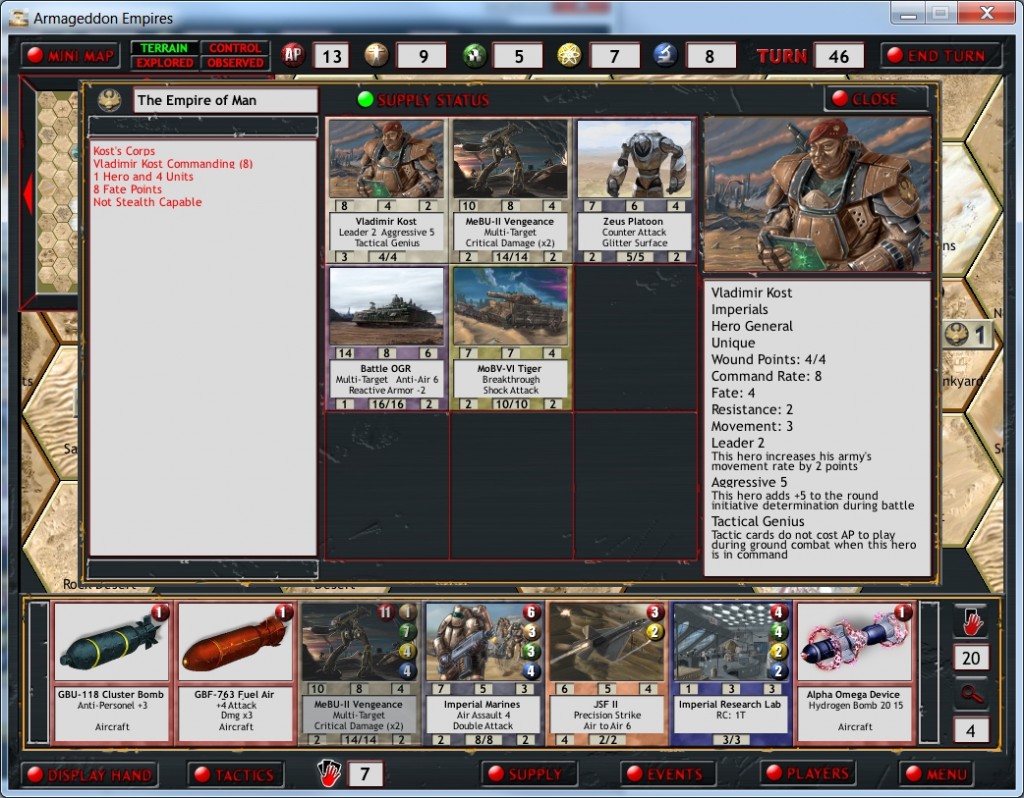
My invincible endgame army.
The first thing that makes AE special is its twist on the genre formula: most strategy games are built around sprawl, but AE is built around scarcity. Most of the wasteland is just that, useless and barren, save for a few resource-gathering sites. Armies are finite, limited by deck size. New units are produced from one source (the player’s hand of cards – though they can then be deployed to any friendly base), so no juggling multiple cities, factories, or build queues. This has several implications. First, as Kieron Gillen pointed out, it’s consistent with the game’s post-apocalyptic theme: it stands to reason that in this world, there just is not that much to go around. Second, it does away with the usual bane of the strategy genre, the “I have to babysit all this?!” syndrome. Last of all, when players can form a stack of doom out of four units (see the screenshot above) and (at least on the default settings) there are no more than two or three main armies to manage, this doesn’t just affect the gameplay mechanics (“fewer, but more interesting decisions”) – it also makes every stack more distinct, and hence easier to identify, easier to grow attached to. (This is a topic to which I’ll return.)
AE’s second distinctive feature is that, like Distant Worlds and Conquest of Elysium 3, it gets exploration right. Every game map is bound to contain a few special locations (the number can be tweaked at startup), and these run the gamut. Named, especially juicy resource-gathering sites: the Camps (+3 manpower, whoo!), the Slave Pit and its overseers, the cannibal-infested Destroyed City. Abandoned strongholds: the White Base**, the Crashed Mothership, the Mecha Design Lab. Hidden goodies: a desiccated corpse still clutching a suitcase nuke. This works from a mechanical perspective: it encourages early-game exploration, rewards players for investing in recon units, and offers a trade-off: do I muster troops to take out a defended site, or do I use them to hit one of the other players? But crucially, it also adds to the theme. Scavenging is part and parcel of any post-apocalyptic world, and AE’s specific choice of locations adds further flavour. What do the slave pits and cannibal ruins tell us about the catastrophe that befell the world? What does the gaudy casino defended by gangsters tell us about how some survivors have managed to make their living? And just who was that poor devil with the suitcase nuke?
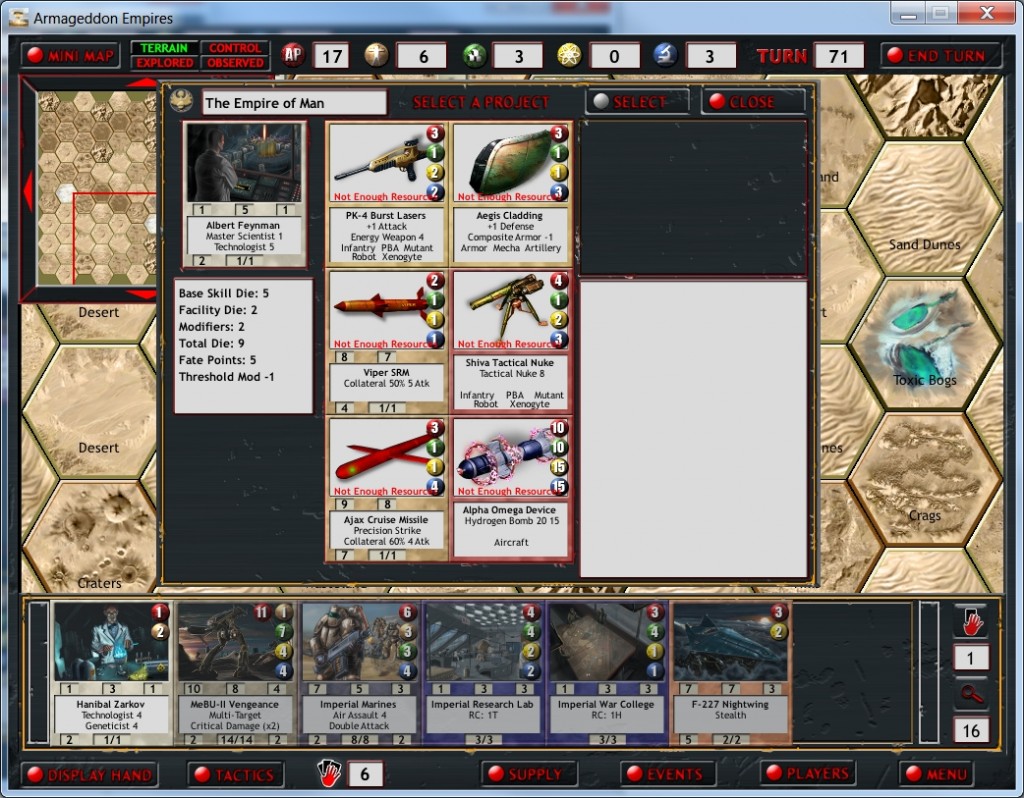
New inventions that my scientist can cook up.
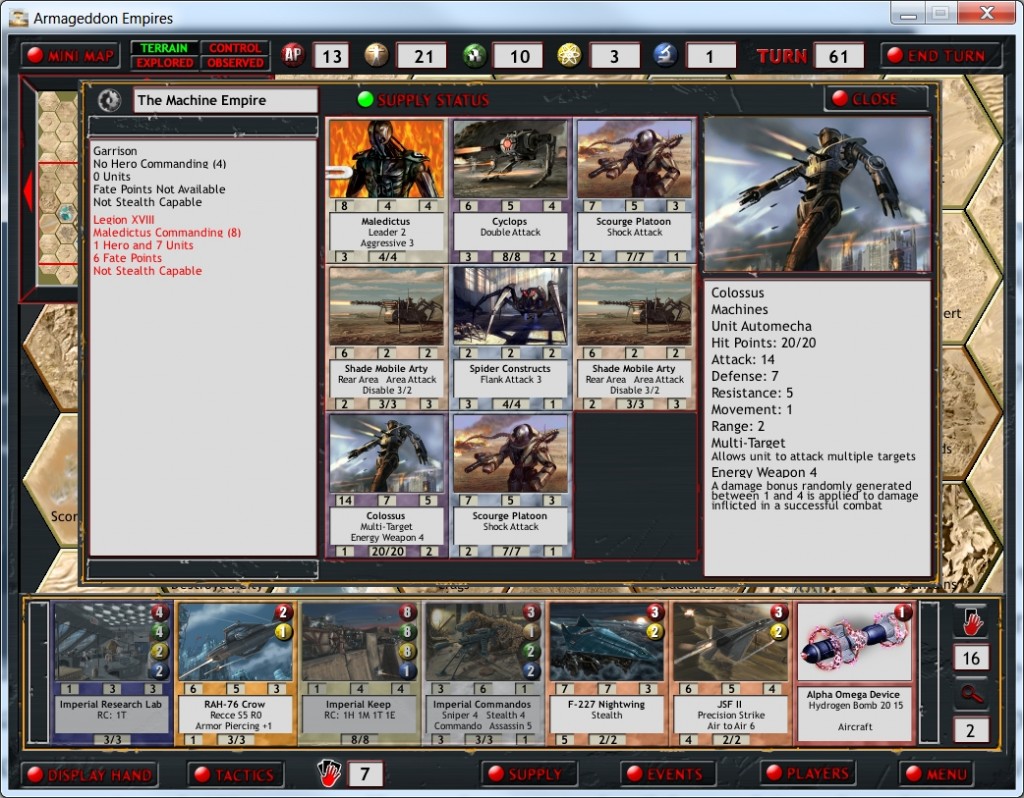
The third element that makes AE special is the broadest and most intangible of the three, but also possibly the most important: this game is evocative. For me, every single-player video game is at least partly an exercise in imagination, in temporarily convincing me that I’m not just making pixels blink on a screen – I’m building a city, piloting a spaceship, saving the world. And this is where AE shines. Partly, this is thanks to the factors I discussed above. Exploration brings the game’s world alive, and the relative scarcity of pieces in play means that (a little like a squad-based game or tactical RPG) it’s easy to construct narratives about the Vengeance mech you always sent where the fighting was fiercest, or the plucky marines who seized the alien HQ with a surprise landing. Partly, this is due to the way so many game mechanics revolve around hero units, giving AE a human face. New inventions (see the above screenshot – better vehicle armour, man-portable laser cannon, tactical and strategic nukes…) don’t spring from a well of “science points” – they come from scientist heroes, who have to roll dice against their skills. That suitcase nuke won’t magically walk to another player’s base – a saboteur hero, such as the humans’ Valentine Kusanagi**, has to infiltrate the hex and make a successful roll. Partly, this is due to inspired card art. The Colossus mech is one of the scariest units in the game, and to see why, look at the screenshot below. That thing has to be the size of a skyscraper! Partly, it’s due to the way different game mechanics interact in clear and intuitive ways: my scouts found a nest of survivors in a destroyed city, which let me call in a tactician and some Imperial Marines, who secured a forward outpost, which I used as an airbase to launch a nuclear strike and win the game. Partly, it’s due to… I could go on, but the point is AE is so much more than the sum of its parts. I walk away from every match feeling like I enacted a heroic story, and that’s one of the best things I can say about a game.
The fruits of science. The Machine Empire’s Colossus is not something I want to face in battle… which is why I have its name written on a hydrogen bomb, bottom right.
One might wonder why, if AE is so good and has been around for five years, it isn’t also better known. To be sure, it’s not perfect. There’s no in-game tutorial, and while it’s a rare game whose controls I can’t figure out just by messing around, AE’s are sufficiently unintuitive to require reading the manual or a how-to-play guide (I recommend Bill Harris’). Its interface leaves something to be desired, even by indie strategy game standards, and so does its coding – I’ve had to abandon a couple of matches due to glitches. But I don’t think the problem is the rough edges – none of them seriously hurts the gameplay. I think the problem is precisely that AE has been around for five years. It was very much ahead of its time: despite its glowing critical reception, it was not only a TBS, but an indie TBS for the PC, in the days before iPads, hip indie bundles, and the recent renaissance of small/mid-market games.
And that really is a shame, because five years on, AE doesn’t just “hold up” – it shines as an example of what this genre can do. More than a very good game, more than a possibly great game, AE is a unique game, packed with lessons in design. This is one game I think every strategy aficionado, and certainly every strategy designer, should play.
* There are a couple of exceptions, but this holds true as a general rule.
** I also like the shout-outs that Vic Davis scattered throughout the game!
This week’s song is neither an opening nor a closing theme — it is, effectively, Okami‘s overworld theme. It’s the background music for the Shinshuu Fields, the “hub” area for the game’s first act, and much like the Morrowind theme from two weeks ago, its lilting, upbeat tones are the perfect thing to send you off on an adventure. Enjoy!
Details
Track: “Shinshu Plains 1” & “Shinshu Plains 2” (spliced together in this video and in the in-game music player)
Hi everyone — I’ve just added a new way to follow the site. For those of you on Facebook, you can keep an eye on the Matchsticks for my Eyes Facebook page (which reprints links to everything that goes up on the mothership), and feel free to drop a “like” or two!
In other site news, it’s been a couple of weeks since the last major update — I’ve been tardy, I know! However, I’ve spent some of that time with a couple of big new strategy releases, Sins of a Solar Empire: Rebellion and Civilization V: Gods and Kings, so I should be able to give my thoughts on one or both of them soon. Also, stay tuned for a piece on the lessons designers can learn from Armageddon Empires, a 2007 indie game that blends strategy game and CCG influences, and a write-up of the anime series Ghost in the Shell: Stand Alone Complex, one of the best creative works (in any medium) I’ve encountered. Hope to see you round for those posts!
I’ve featured opening themes for the first two weeks of Musical Monday, but this week I have an ending theme to share with you — “You Were There”, the perfect song to close out the lovely Ico. Enjoy!
Track: “ICO -You Were There-”
Source: Ico: Melody in the Mist soundtrack.
Credits: Composed by Michiru Oshima and sung by Steven Geraghty.
From an opinion piece in last Monday (25 June’s) edition of the Australian Financial Review, page 43. The author, Mark Lawson, mockingly lists ways for politicians to waste their time:
Playing computer games. After a period with Civilization V (the game title uses the American spelling), I’ve switched back to Civilization IV as the game play is generally more exciting. But for long periods I’ve been into Medieval II, Victoria II, and Darkest Hour (a fan remake of the classic Hearts of Iron II game).
But if Julia Gillard wants real detail in her games, she could try the very complex Hearts of Iron III…
… For those who want a more active experience, the zombie shoot ’em up Left For Dead my son sometimes plays on the internet seems like fun. For those not into conquest or zombie stomps, my daughter recommends The Sims III.
Total War, Paradox, and Civ — I certainly can’t quarrel with Mr Lawson’s taste in historical strategy.
Update – 5 July 2012: It’s a mystery no longer: details of Conquest are now on Steam. It’s a territorial victory mode:
’CONQUEST’’ for Wargame: European Escalation brings brand new exciting content to extend the conflict.
Defy commanders worldwide in the brand new multiplayer mode: CONQUEST. To be victorious in this mode, in addition to the classic Command Points, you will have to control Victory Sectors (VS) located on the map, until the victory conditions are fully satisfied. In this mode there’s no Scoring System related to the destruction of your adversary’s units, only controlling territories will grant you victory. 7 maps have been adapted or created to fit this new mode, where you can either challenge players or AI.
Update – 4 July 2012: Patch notes are out! It’s a long list, but the highlights include a new gameplay mode (“Conquest”) and continued balance tweaks. I have to say, I’m very happy with Eugen’s post-release support for this game. Developers, this is how you treat your customers!
Original post: Back in April, Eugen Systems patched a new game mode into Wargame: European Escalation, and now the game’s Facebook page has this to say:
Second free DLC coming in July !
Get ready to confront your opponents in new multiplayer mode!
There are no additional details for now, but I’ll keep you posted as more emerge.
Good news — my computer is back from the service centre, and even more importantly, my backup restored just fine! It’s business as usual again, so stay tuned, over coming weeks, for write-ups of Sins of a Solar Empire: Rebellion and Civilization V: Gods and Kings. I’ll see you ’round!
From Soren Johnson’s Designer Notes (itself a reprint of an article in Game Developer magazine):
Ever since OnLive’s dramatic public unveiling at GDC 2009, the games industry has been watching and wondering about cloud gaming, at times skeptically, at times hopefully. The technology holds the potential to revolutionize the business, perhaps forever destroying the triangle that connects consumers with hardware manufacturers and software retailers…
… Most importantly for consumers, cloud gaming should change the economics of pricing. By removing the traditional retail middlemen, not to mention secondary drags on the system like rental and used-game sales, a developer could easily make as much money selling a game for $30 via the cloud as they could selling it for $60 via a traditional retailer. The industry could finally approach a mainstream price point, with games priced comparably to movies, books, and music – instead of the $60 price point (for a $300 console) which is absurdly out of reach of the average consumer.
Indeed, the economics could change for developers too. If entirely new business models emerge, with consumers paying for a game daily, weekly, or monthly – or perhaps with a single subscription to all available games (a la Netflix) – the design incentives change. Cloud gaming could reward developers for depth of gameplay over ornate, scripted sequences; infinitely replayable dynamic games like Left4Dead or StarCraft might suddenly be more profitable than hand-crafted semi-movies like Call of Duty or Uncharted…
.. However, cloud gaming’s potential is much, much greater than changing the economics of the industry; in fact, it could revolutionized the very way games are made…
… Perhaps the group which has the most to gain from this new model would be small, independent developers, for whom the idea of building an indie MMO seems laughable given their tiny resources. One can’t help wonder what Mojang could do with a cloud-based version of Minecraft, seamlessly updated, playable from any device or browser, that connects every world end-to-end. So far, the big question for cloud gaming is when will it be feasible, but ultimately, the more important question is what will it enable.
Definitely worth a look (and while you’re there, check out some of the older posts — in particular, the two about theme vs mechanics are some of my favourite pieces of games writing.)
It’s Musical Monday again, folks! This week’s song, composed by Jeremy Soule, goes by several names — “Call of Magic”, “Nerevar Rising”, “Morrowind Title” or just “the Morrowind theme”. Of all these titles, I like “Call of Magic” the best: it’s a hopeful song, filled with the spirit of adventure. Just the thing to see you off on your journey:
This is a good time to be a fan – as Iam – of games that mix squad-level strategy and RPG mechanics. Last year saw the PSP release of the excellent Tactics Ogre: Let Us Cling Together, a labour of love that blended fine-crafted gameplay, a mature story, and gorgeous production values. This year won’t lack in quantity: it’s already seen a Jagged Alliance remake for PC and the recent PSP launch of Gungnir. Two more titles are due out in a few months (Firaxis’ XCOM: Enemy Unknown for PC, and Atlus’ Growlanser: Wayfarer of Timefor PSP) and we may well see a third soon, Goldhawk’s Xenonauts (PC).
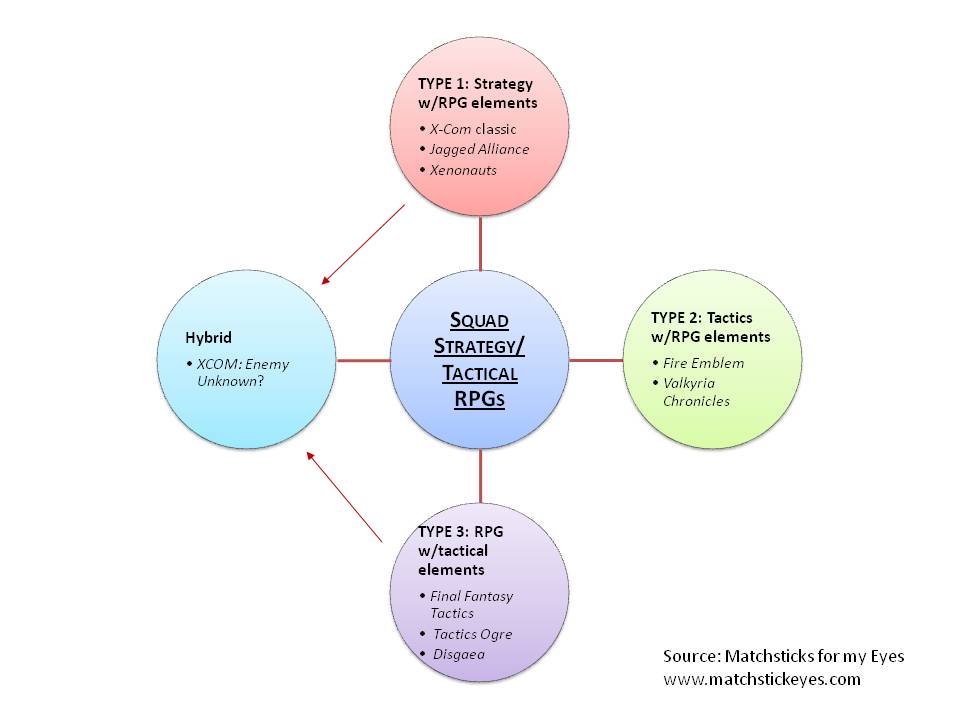
The above names suggest this is a pretty broad genre, and in fact, I don’t think there is a single squad-level strategy/RPG genre so much as there are several distinct subgenres, spread across PCs and home and portable consoles. As such, this is also a good time to review each subgenre – which games it contains, what makes it distinctive, how it compares to the others, and how it’s faring.
Type 1: the “squad-based strategy game with RPG elements”
Typified by the Jagged Alliance series and the first three X-Com games, this subgenre is largely PC-based (notwithstanding the odd console port) and driven by Western developers. These games share two overarching attributes. First, they emphasise the “strategy” part of “strategy/RPG”, and second, they’re closer to the “realistic” than to the “cinematic” end of the spectrum (at least compared to the other categories!). These manifest in a few ways:
There isn’t much in the way of character customisation or special abilities. Different troopers have different statistics – marksmanship, strength, etc – and, in Jagged Alliance 2, different passive bonuses (e.g. night operations or automatic weapons). However, soldiers lack RPG-style active abilities, and they usually don’t have classes – they certainly don’t in X-Com and JA. What does distinguish soldiers is their equipment (which, in the absence of classes, can usually be freely assigned). You won’t mistake a rifleman, a machine gunner, and an anti-tank specialist!
The same applies to the enemies you fight. In JA2, a black-shirted commando will be both better armed and a better shot than a yellow-shirted militiaman, but actual boss enemies and special abilities (with the exception of a handful in X-Com – psionics and Chrysalids) are rare.
In the absence of “gamey” levels of health, life is cheap. X-Com, where the most heavily armoured veteran could die to a single unlucky shot, took this to extremes – but even in JA2, a single turn’s volley fire could be lethal. Conversely, the lack of character customisation means that losing one trooper is not the end of the world – especially not in X-Com, with its never-ending pool of recruits! (I seem to recall JA2 was a bit harsher on this front – not only were there finite mercenaries available, but losing too many would make it hard to recruit more. As such, X-Com was best played without reloading, but I doubt JA2 would be so amenable.)
In the defining games of the genre, there is no scripted campaign – in X-Com and Jagged Alliance, you choose where and when to take the field. This fits with the conceit of these games – you’re the overall commander, in charge of far more than just battle tactics.
Combat typically requires you to kill/capture every enemy present. However, the battlefields are large, what you can see is limited to your soldiers’ line of sight, and the enemy could be anywhere. As such, battles tend to unfold as a sweep of the map.
This subgenre has never regained its 1990s glory days (hence PC gamers lamenting the “death” of squad-based strategy/RPGs), notwithstanding the odd 2000s release such as Silent Storm. However, signs of life remain. As a largely faithful remake of X-Com, Xenonauts falls squarely in this category, and if it lives up to its promising alpha build, that would deliver a welcome breath of air.
Type 2: the “tactics game with RPG elements”
Fire Emblem (various Nintendo platforms) and Valkyria Chronicles (PS3 for the original game, PSP for the sequels) form a second subgenre, console-based and driven by Japanese developers. (I suspect Jeanne d’Arc for PSP would also fall into this category, but I haven’t played enough to be sure.) What sets these aside from Type 1 games is that they’re a little more stylised, a little more “game-y”, a little more RPG-like. Specifically:
As with Type 1 games, there still isn’t much in the way of character customisation or special abilities. However, in RPG fashion, realism now plays second fiddle to game logic. FE/VC characters are much more distinct than X-Com troopers, and their abilities and weapons are delineated by class. A “shock trooper” in Valkyria Chronicles will always use a submachine gun rather than a rifle, an engineer will never be able to use a grenade launcher, and so on. Fire Emblem even cheerfully throws in a rock/paper/scissors dynamic between axe-, sword-, and spear-wielding classes.
Meanwhile, much like trash mobs in an RPG, individual enemies in Type 2 games tend to be clearly weaker than the player’s squad members. However, watch out for bosses!
In Fire Emblem, characters can still die easily in the hands of a careless player. However, as with Type 1 games, the lack of character customisation means that the loss of one character is not the show-stopper it might otherwise be. (Valkyria Chronicles is a little more forgiving – it gives you a three-turn grace period to call in a medic.)
Gameplay consists entirely of a scripted campaign with set battles – no strategic metagame here.
Battles still revolve around sweeping a large map, but this plays out slightly differently. Your objectives are different – most levels require you to capture a specified piece of turf, rather than just clearing out the enemy. However, since enemies typically don’t “wake up” until you move close enough, this encourages you (especially in Fire Emblem) to play slowly and carefully, so as not to trigger an overwhelming enemy response. The result, in Fire Emblem, was precise, meticulous gameplay as I checked enemy characters’ movement ranges, lined up the party in safe areas, and then quickly moved in for the kill. (Valkyria Chronicles was a little different in that its scoring system worked by speed, so it was often “optimal” to run past enemy soldiers and beeline for the objective, but I tended to only play this way when I knew a map very well.)
This genre is doing a bit better than Type 1. Valkyria Chronicles never saw a PS3 sequel (2 and 3 came out for PSP, and 3 never made it to the West), but Fire Emblem: Awakening has been announced for 3DS. With luck, we’ll see more of these games in the future.
Type 3: the “role-playing game with tactical elements”
A third subgenre, also primarily console/Japanese, includes Final Fantasy Tactics (PSX/PSP), Tactics Ogre (originally SNES/PSX, but I’m mainly thinking of the PSP remake), Front Mission (various), and Disgaea (various). The dividing line between this and Type 2 can be a little blurry, but in general, the key feature of these games is that they emphasise the “RPG” part of “tactical RPG”.
By this, I mean Type 3 games share traditional RPGs’ emphasis on character development. Out of battle, there’s plenty of time spent on allocating skill points, navigating often-baroque class trees (this class guide for FFT says it all), and building a super-team. In battle, where a Type 1 or Type 2 character would be limited to moving, attacking, and maybe unlocking doors, Type 3 characters constantly fire off special attacks and unique abilities. This also extends to enemies – regular enemies, not just bosses, frequently have their own nasty abilities.
Conversely, while some of these games do allow for permanent death (FFT, Tactics Ogre), building up characters takes so much time and effort that I think players would have to be crazy not to reload in the event of their characters dying. (Other games, such as Disgaea, sidestep this problem by not having perma-death in the first place.)
As with RPGs and Type 2 games, there is a scripted campaign with a set storyline and battles to play through.
The “tactical” part is still present: battles are played out on strategy-style grid maps and positioning remains a consideration (for example, Tactics Ogre, which encouraged you to use terrain and heavily armoured knights’ special abilities to wall off squishy mages and archers). However, the maps are typically smaller than in Types 1-2, and enemies are typically more aggressive about coming out to meet you. As such, there’s no more “sweeping the battlefield” dynamic.
Out of the three subgenres, this one is probably doing the best. While the broader JRPG genre largely disappeared during the HD console era, this subgenre never went away. The PSP in particular is a mecca (FFT, Tactics Ogre, ports of Disgaea 1 and 2…), and new/ported Disgaea games continue to appear (e.g. Disgaea 4 came out for PS3 last year, and Disgaea 3 has made it to Vita). I look forward to seeing, and playing, many more in the future.
Within these categories, different games have added their own unique twists. For example, the genius of Valkyria Chronicles lay in its control scheme. You didn’t move soldiers by clicking squares on a grid – you took direct control of the selected soldier, using the PS3’s analogue stick to run him or her behind sandbags, into trenches, out of cover and into the open. The camera wasn’t locked isometric – it followed each soldier from a third-person perspective. You didn’t choose targets by selecting them from a list or highlighting their square – you hit a button to bring up a pair of crosshairs, then swung the crosshairs over a selected foe, and finally “pulled” the trigger. Now, VC was still a strategy game, not a shooter – once you lined up a shot, whether it hit was determined by the soldier’s class, equipment and special abilities, not by player skill. Yet, by bringing the immediacy and excitement of an action game, the control scheme contributed tremendously to the overall experience.
For another example, consider Disgaea, which relies heavily on terrain and movement. Many battles contain “geo panels” that give a special modifier to anyone standing on them – for example, automatic healing (or automatic damage!) every turn, a bonus to attack, an all-around bonus to enemies, and so on. These special effects are generated by geo symbols, pyramid-shaped objects that also appear on the map. And not only are the geo symbols destructible, but party members can pick other characters (friends and foes) and geo symbols up, then throw them around the map. Many levels rely on this! For example, if 90% of a map is coated in red panels, and two geo symbols placed on the red panels give enemies on red a 6x bonus, trying to play as if the game were FFT would be suicide. The solution: line up a daisy chain of, say, six characters. Have #5 lift #6, have #4 lift #5 (who is still carrying #6), and so on. Eventually, #1 throws #2, who throws #3… all the way to the point where #6 can reach and destroy a “3x enemy boost” geo symbol in one turn, before the computer gets to use those nasty bonuses. Does this make story levels puzzle-like? Probably. But it is an interesting mechanic in its own right, and it does distinguish the game from the rest of the genre.
This takes us back to XCOM: Enemy Unknown, which stands out because of the way it blends multiple games and subgenres. The way it breaks down soldiers into classes, with their own equipment loadouts and special abilities, is straight out of Type 3 games. So is the ability to unlock additional, more advanced classes later on. But its frequent use of an action game-style camera reminds me of nothing so much as the intent behind Valkyria Chronicles’ control scheme (or perhaps the Gallop brothers’ cancelled Dreamland Chronicles, which was to have used similar controls), and the frequency of character death is a (key) holdover from the original X-Com. As such, I don’t think it’s possible to draw apples-and-apples comparisons between Firaxis’ XCOM and the originals, or between XCOM and Xenonauts – but this doesn’t bother me in the least. While Firaxis is diverging significantly from the originals’ design, it also seems to be cross-pollinating several excellent strains of squad-level gameplay. We’ll see in a few months’ time how well this works out, but for now I am eager to see what Firaxis can do.
And if I had to conclude on one thought, that would be it: eagerness. Whether these games fall into one big genre or three related ones, at their best they combine the strengths of strategy games and RPGs. They offer the satisfaction of out-thinking and out-manoeuvring an opponent; intricate plots – and a focus on named, persistent characters. Just as great characters make great fiction, the stories that arise through gameplay become all the richer when they star characters whom we have nurtured, whom we can identify and remember. I remember the almost-dead warrior in FFT who ended one of the toughest boss fights in the game with one last desperate jump. I could almost feel the desperation in Valkyria Chronicles when three soldiers tried to hold off an enemy tank, and when I got control of my own tank and sent it to their relief, I certainly felt the power. And I remember the fallen heroes of X-Com and Fire Emblem, including veterans who had been with me since the start of the game and who finally gave their lives near the end. I remember these and more.
At the end of the day, it’s no coincidence so many of my favourites fall into the categories described above – PC and console, Western and Japanese. I look forward to seeing more of all these in the future, and I hope that if you’re a pure PC or pure console gamer, if you’re familiar with some but not all of the above games, I’ll have piqued your interest in the rest
Beautiful and artistic, Ico,Shadow of the Colossus and Okami are three of my favourite games of all time. The first two were ported to the PS3 last year, and now it’s Okami‘s turn: Capcom has announced OkamiHD, with optional Move support, will come out later this year. Trailer below:
As one Youtube commenter points out, I don’t recall the PS2 version of the game being anywhere near that blurry, but I’ll welcome anything that could bring such a great game to a wider audience (or even just ensure its availability for an HD platform).
And he [THQ CEO Brian Farrell] said, “Well, where do you think the industry’s going? Do you think these titles can compete with $120 million dollar super titles?”
So I said, “Well, you know, three, four years ago I would’ve said no. Even two years ago I would’ve said no.” But looking at the industry in the future and what’s happened in PC space, I think there’s going to be a much wider variety of games in the future. I think you’ll see things like Portal or World of Tanks or League of Legends or other ways of attracting people that don’t require the snazziest graphics, the most dollars per minute on screen, 600 person teams. Not that those titles won’t do well. They’ll do really well. And they’ll get bigger and that’s a race. But we don’t have to necessarily play in that race…
… And I think we can do all right without it. Take a look at [South Park] Stick of Truth. A lot of people are talking about it, excited about it. That’s not a blockbuster. Graphically, it’s not going to compete with Call of Duty, but it’s a really cool game. Metro’s gotten a lot of nominations for Best in Show. Company of Heroes, the sequel to the highest rated RTS of all time. There are good things to do.
“I think there’s going to be a much wider variety of games in the future.” I like the sound of that.
Sorry, guys, still no major update — not only is my computer still out of commission, but I’ve been feeling under the weather for the last week. I have written most of a post on squad-level strategy and tactical RPGs, but ’til it’s ready, I thought I’d tide you over by kicking off a new series: Musical Monday. Every Monday, I plan to highlight the soundtracks that make my favourite games, movies, TV and anime what they are — and first up, I’ve chosen one of my all-time favourites, “Inner Universe”. Soaring and angelic, it perfectly accompanies the opening credits to Ghost in the Shell: Stand Alone Complex:
A longer, five-minute version appears on the first soundtrack CD. Back in the day, I used this as background music for Freelancer:
Enjoy, and stay tuned for more next week!
Details
Track: “Inner Universe”
Source: Ghost in the Shell: Stand Alone Complex soundtrack – OST CD #1
Credits: Composed by Yoko Kanno, lyrics by Shanti Snyder & Origa, sung by Origa.
I often praise my two-year-old computer’s reliability, but it looks like I tempted fate one too many times. This morning, Windows 7 warned of a “hard disk problem” and when I tried switching on the computer this afternoon, it wouldn’t even boot. Luckily it’s still under warranty, so off to the service centre it’ll go. Until it’s back in action, though, I may be a bit slow to update the site (and in any case, with my gaming rig out of action, I’ll have less to write about). Thanks for your patience until then!
This entry is part 6 of 8 in the series Persona 3 & 4
2006 was a big year for video games. That year, two of the current generation of consoles launched: the Playstation 3 and the Wii. The rival Xbox 360 launched the previous year, but 2006 saw the debut of one of its signature franchises, Gears of War. And the king of the previous generation, the Playstation 2, was at its zenith. In 2006, Capcom released the stunning (and superb) Okami; Square Enix gave us Final Fantasy XII… and in Japan, Atlus released Persona 3, the latest instalment in the Shin Megami Tensei franchise. When Persona 3 made its way to the West in 2007, it received a glowing reception; when I finally played the game, last year, I expected the world of it. It did not disappoint.
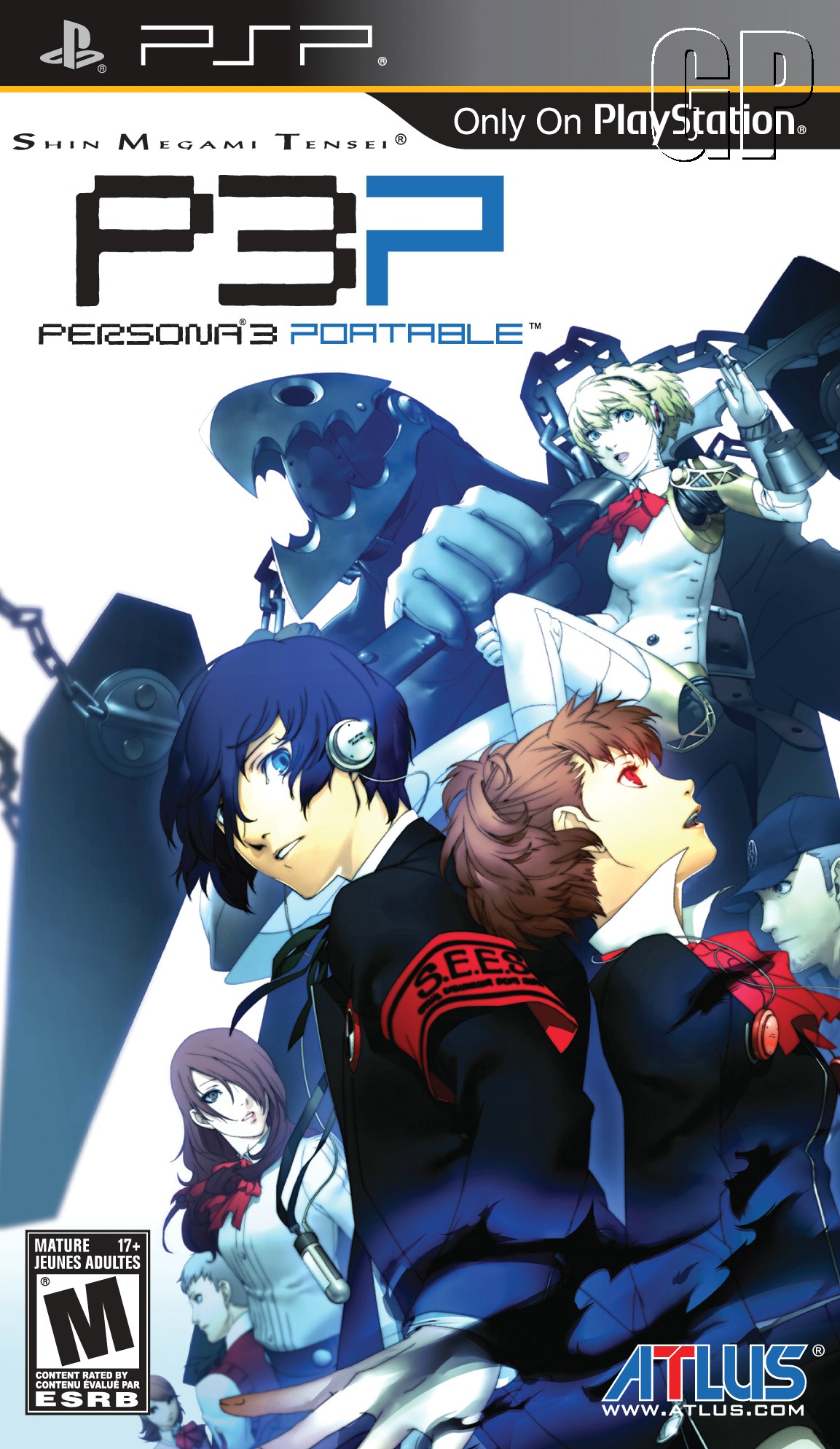
To be sure, Persona 3 received a few coats of paint in between 2007 and 2011. An enhanced PS2 version, Persona 3: FES, added an epilogue and tweaked the core game; the PSP port I played, Persona 3: Portable, added an alternate, female protagonist and imported some of Persona 4’s gameplay enhancements (though it also had to replace in-engine cutscenes with still art and “talking heads”). But the core of the game has been the same throughout. You guide a modern-day high schooler through one year of his (or her) life, allocating precious time slots between studying, shopping, socialising with one of ~20 people – school buddies, an elderly couple, a little kid, and more – and, uniquely for a teenager, dungeon crawling. The “social simulator” and “dungeon crawler” halves of the game are linked: the main character derives his/her combat abilities from guardian spirits called Personas. Each Persona, and each possible character relationship, is assigned to a given “arcana”, and the stronger a friendship, the stronger a newly created Persona of that arcana will be.
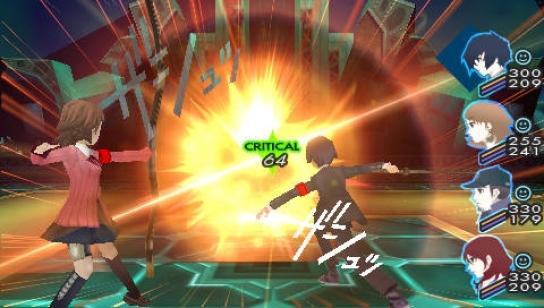
Battling monsters: one half of the game.
This design has several implications:
First, it brings Persona 3’s gameplay in line with its subject. Regardless of story, the gameplay in most RPGs (Japanese or Western) usually skews towards combat – but with its social simulation, its evenings spent doing homework, and its bites grabbed on the way home from school, Persona 3 conveys how its teenaged hero actually lives.
Second, the need to manage time weaves interesting choice into the fabric of gameplay. Do I hang out with character A, because I want a Persona of the relevant arcana to clear this stretch of the game? Do I push him to Tuesday so I can see character B instead? Should I spend my evening dungeon-crawling, or should I hit the books instead?
Third, more subtly, it fosters roleplaying. In a video game, we roleplay by making choices: Do I back this side in a dispute, or that side? Do I obey my lord, or follow my own conscience? These choices are typically discrete: the end of a quest might offer multiple solutions, or the main plot might branch off at specified points. In Persona 3’s case, the plot might be linear, but the constant stream of choices allows players the same opportunity. Yes, you can approach it as an exercise in powergaming… but it was far more rewarding for me to decide “as my character would”, spending time with NPCs I liked, and behaving consistently with the personality I imagined him to have.
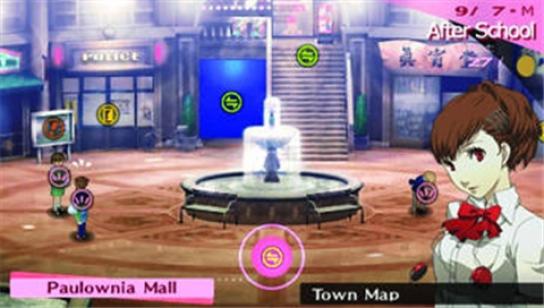
Hanging out in town: the other half of Persona 3.
None of the game’s elements is perfect. As a dungeon crawler, it suffers from some overly long and tedious late-game boss fights. As a social simulator, it loses a bit of interesting tension once you max out the main character’s stats around the halfway mark. And its main plot suffers from several flaws. Gameplay and story segregation create occasional plot holes; the plot is weakened by a reliance on in-universe logic (think “Captain, we have to replace the dilithium crystals!”) rather than character conflict; and it labours under a fundamental contradiction: it takes itself very seriously at the same time that it revolves around superpowered teenagers.
But ultimately, those flaws are minor compared to what Persona 3 does right. It’s a very good dungeon crawler, a very good social simulator/time management game, and most of all, it delivers the most precious attribute in an RPG: it made me care.It made me care about its world, the world I explored every time I sent the main character through town in search of a friend or a coffee. And through great dialogue and voice acting, it made me care about its characters. Their story arcs more than made up for my complaints about the main plot: not all were great, but some were hilarious, others moving. From the first hour of gameplay, I laughed at their antics; when the story turned sombre, I felt for them. And through their unfolding stories, the game was able to convey some surprisingly meaningful themes.
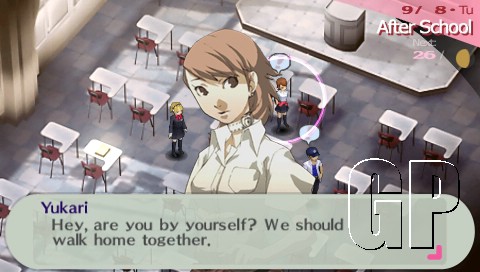
Yukari is one of the many well-realised characters in Persona 3.
Evidently, a lot of players agreed with me. Not every game enjoys the recognition that it deserves, but this saga has a happy ending. The Persona franchise has gone from strength to strength: a PS2 sequel, Persona 4, came out in 2008, and in the limited time I’ve spent with it, it addresses every complaint I have about Persona 3. A PS Vita port, Persona 4: Golden, and a PS3 fighting game, Persona Arena,are both due out later this year. And most recently, Persona 3: FES has been re-released as a Playstation Network download for PS3. For anyone with a Sony platform, these games are easily accessible.
That’s a good thing. This is one game that every RPG aficionado should play, even those who normally don’t enjoy Japanese RPGs. With its marriage of a great concept and good execution, Persona 3: Portable wasn’t just one of the best games I played last year – it’s one of the best RPGs I’ve ever played. Highly recommended.
We hope you enjoyed this retrospective/review! To quickly find this post, and our other articles, click the “reviews” or “features” tabs at the top of this page.
Warlock: Master of the Arcane is very upfront about what type of game it is. The first word tells you everything you need to know. Warlock – person who uses magic; this part is readily apparent. Add a hyphen, and a second meaning emerges. War-lock – a game where you are, essentially, locked into perpetual war until a lone victor stands atop a pile of skulls.
Warlock bears a much-remarked upon resemblance to Civilization V, and is described by its own marketing as a 4X game. The Xs comprise: explore, expand, exploit, exterminate. These factors combine to create a certain expectation in the player, and I do not think that serves Warlock particularly well. Compared to more traditional 4X games, such as the Civilization series or Master of Orion, Warlock has a narrower, deeper focus. If you enter the game with the wrong expectations, it is easy to be disappointed by what it does not offer. Let’s get those factors out of the way right at the beginning, so we can focus on what Warlock does offer. There are not many peacetime options, and peace acts as a chance to prepare for the next bout of fighting. Diplomacy is very poor indeed. Whilst it is possible to form alliances, and a few other diplomatic staples, the AI is generally reluctant to play along. City management is quite lightweight. Terrain has no influence on city production outside of special resource hexes, and impassable hexes like mountains. Terrain is very important when it comes to unit movement and combat calculations, however. Constructing as many cities as possible is the best strategy; there is no equivalent to other game’s happiness or corruption to hold back the sprawl, and no advantage gained from remaining small.
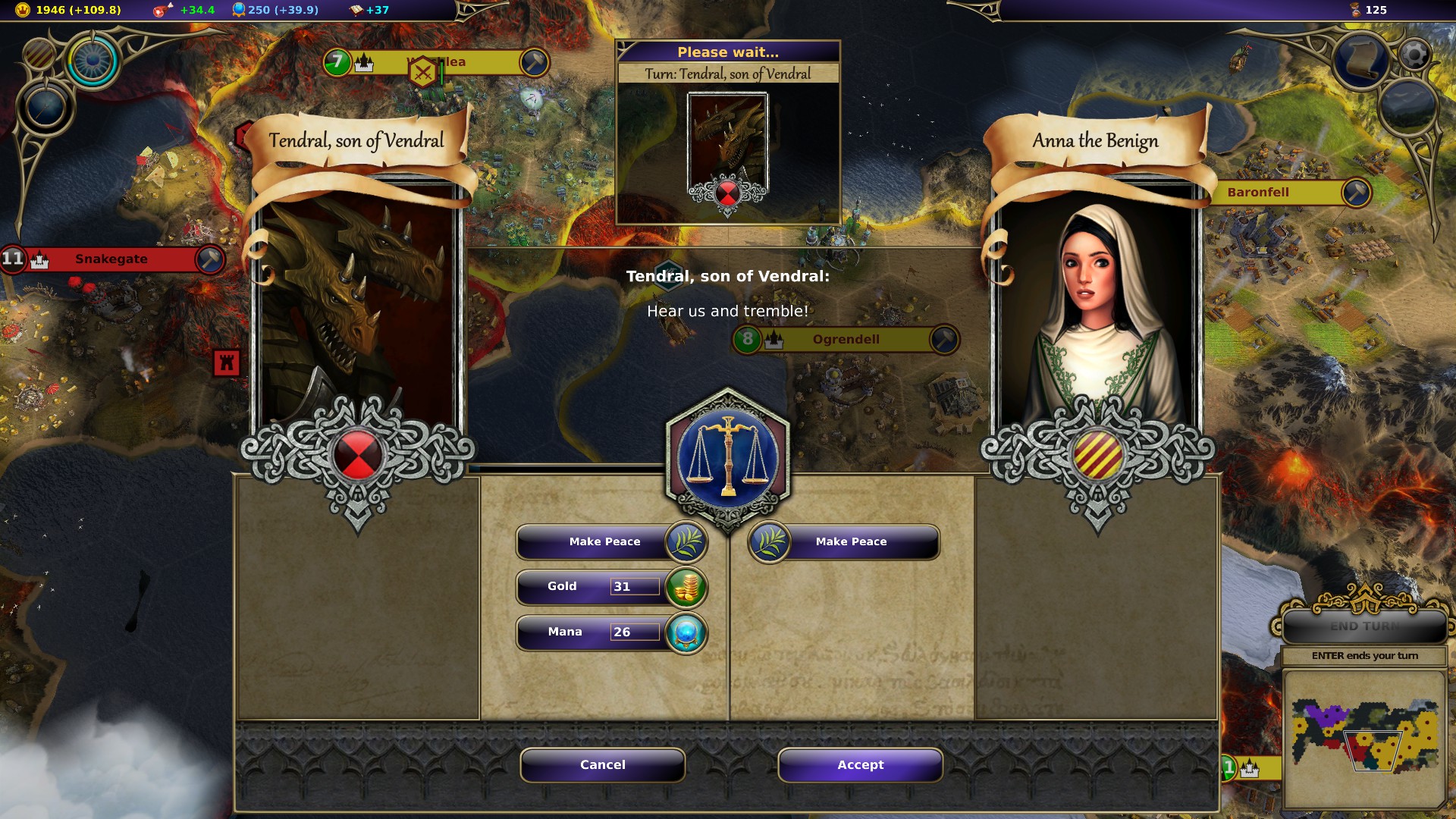
If the player is doing particularly well in a war, the AI may sue for peace and sweeten the offer with tribute.
What does Warlock do well? Creative, flexible, occasionally deranged warfare. It’s a game where open-minded players will thrive. Magic allows the game to offer additional solutions to age-old strategic questions such as, “How can I break through this choke point?” To answer that question with Warlock‘s toolset, you can:
1) Use strong units to assault the choke point head on, grinding your way through in a battle of attrition.
2) Use ranged units and magic attacks to weaken the defending units before sending in your heavies.
3) Use a ship to bombard the enemy from the sea, if terrain permits.
4) Use a teleport spell to send individual units behind enemy lines.
5) Summon units like imps or ghost wolves behind enemy lines
6) Use a spell such as “water walking” or “levitation” to flank and/or bypass the choke point.
7) Use a unit which can naturally fly to flank and/or bypass the choke point.
8) Use debuff spells like “weakness” to reduce the defenders to pitiful shadows of their former selves.
9) If the enemy unit is using a particular damage type, cast defensive spells of the appropriate type to make your unit partially immune to the enemy’s attacks.
10) Use magic to resurrect dead units and send them right back in for another go.
11) Dragons. Nobody likes being burped on by a dragon.
That’s quite a range of options! Sometimes the detail is as important as the outline. Yes, you can send in a unit of flying swordsmen. You can also send in a unit of knights riding flying donkeys, or water-walking tophat-wearing werewolves! Hence the aforementioned “occasionally deranged”. Warlock does not always take itself seriously.
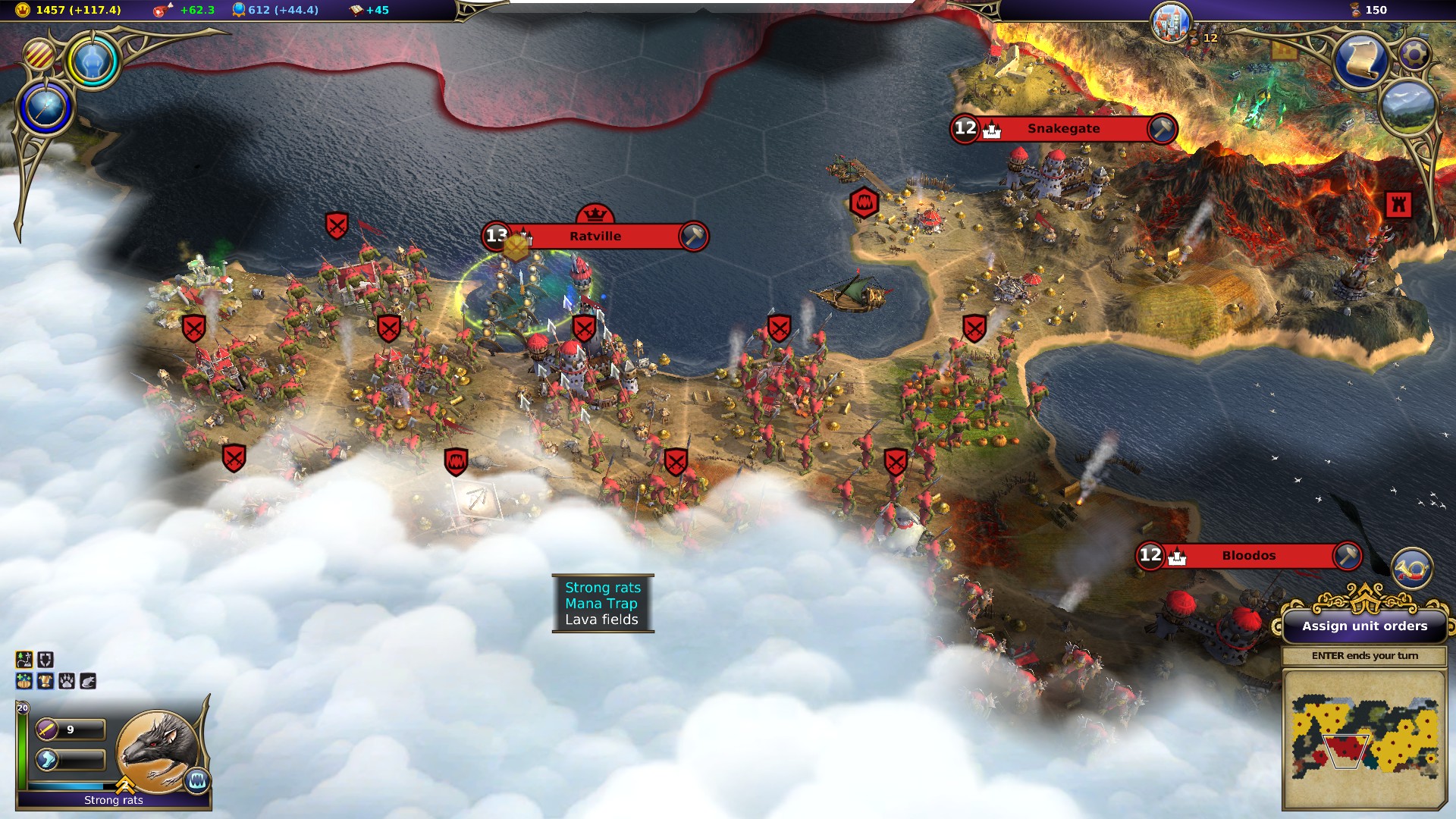
Some of the special resources are more … special than others.
While there are only three playable races, they are well individualised. In addition to having unique graphics, buildings, and units, each race is tailored to utilise – and produce – one of the three main resources more heavily than the others. The undead are geared towards mana, humans gold, and monsters food. In the early game, playing towards these strengths is important. By the mid-game, a diligent player will have captured at least one city of each race. At this point specialisation pays dividends; the racial production bonuses and unit recruitment apply no matter who owns the city. Thus, an undead city owned by humans will still produce more mana, still consume mana instead of food to support its populace, and still have the potential to recruit various types of skeleton warriors. There will, however, be a 20% penalty on resource production if the owner is not of the same race.
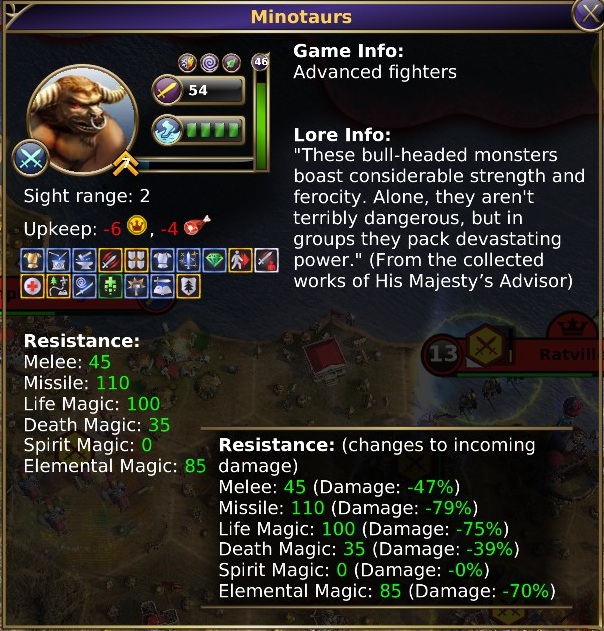
Unit variety is not as limited as the small number of playable races might imply. In addition to the three playable races, the game features numerous minor races. Enterprising warlocks can recruit units from races including elves, dwarves, dragons, and minotaurs. These units are not casual re-skins of the major races’ units; they have their own building requirements, strengths and weaknesses. As you might expect, you can also summon magical creatures to serve in your army, from ghostly wolves to greater elementals. The hostile “wild” unit spawns feature a diverse array of units. In total, the game offers a very generous range of units. Units acquire experience during combat and over time, and will level up at set amounts. Each time they level up, they can choose one of three perks. The game features a wide range of unit upgrades, such as masterwork armour or enchanted weaponry. There is no limit to how many of these upgrades a unit can possess. Once available, upgrades can be purchased for any eligible unit. Lower tier units can also be upgraded into more advanced forms once the necessary buildings have been constructed. This means three things: units never become obsolete, units become highly personalised, and veteran units become powerhouses.
Spell research is quite simple. You begin the game with a set amount of research coming in. To increase it you must build certain city improvements on special resource tiles, e.g. an excavation on some ancient ruins. Research does not increase with city quantity, nor with population growth, gold income, or any of the other genre staples. The game will present 5 spells, each chosen randomly. Select one, research it, and you will be offered another 5. The spells which you passed over last time will remain, and the one you researched will be replaced by a new random selection. This randomness can, on rare occasions, be rather frustrating. Gaps will be left in your repertoire until you have played long enough to perform a lot of research. If you lack a favourite attack or buffing spell, you can usually improvise with another. This is a welcome prompt to player creativity. However, if you lack a more specialised spell, such as the one which allows you to banish curses like the “mana drain” spell, you may need to soldier on under the penalty until the research screen finally offers the correct option.
On higher difficulties, the AI is not shy about building a large army.
Warlock‘s AI is best described as competent. Unless it finds itself hemmed in by other factions, poor terrain, or very strong wild monsters, it can be relied upon to expand. It’s smart enough to pack its cities in densely but not to the point where it over-crowds, thus ensuring maximum usage of space and making defence easier. On the default difficulty the AI does not seem to recruit large armies; however, it is happy to do so on higher difficulties. It recruits a mixed force, using melee, ranged and magical units. Happily, it uses the units correctly! Warlock will not hide its melee units behind its mages, and will attempt to skirmish its ranged units back to safety whilst shooting. The AI is definitely better on the defensive. It is capable of complex movements such as surrounding an isolated unit, swapping damaged units for fresh ones, and using multiple attacks on a single target. It will gleefully use magic against you, with the area of effect fireball spell being a particular favourite. The AI will always use cities and defensive towers to attack when an enemy unit is within their range. Sadly, the AI fares less well when it goes on the offensive. It fails to send sufficient units to get the job done, trickling in two or three units at a time for the player to kill. It will only send more units when the first wave is dead. It attacks the same locations repeatedly, predictably, futilely. The main problem lies with the AI’s unit selection: it insists on using basic and mid-tier units to the exclusion of all else. It will apply some upgrades and magical buffs to its units, but will not take it as far as the player. This means that in a unit-to-unit comparison the AI is badly out-classed from the mid-game onwards. It doesn’t matter how many units it fields in home defence if the player’s units are killing them in a maximum of three hits, with one or two hits being very much the norm.
The game’s stiffer challenge lies in exploring the alternate dimensions. Accessed via set portals, these separate maps are packed with Warlock‘s strongest units. Tempting rewards lure the player in. Certain resources do not exist in the normal world, and can only be found inside these alternate dimensions. Other resources are exceptionally rare in the normal world yet abundant in the alternates. Should a beachhead be established, cities can be built, and this provides a measure of back-up should matters go pear-shaped in the normal world.
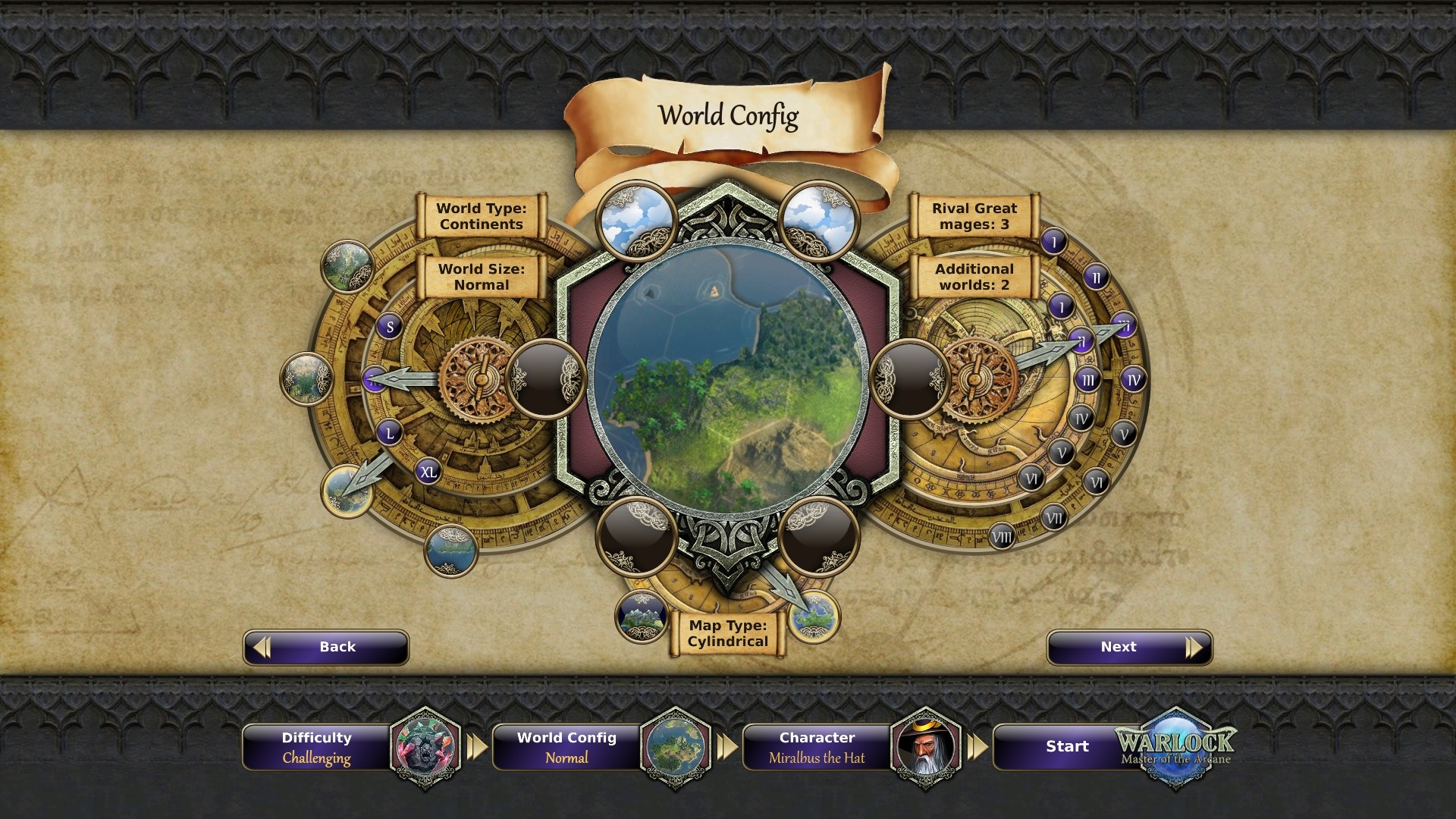
The game setup screen is confusing at first glance, but the elaborate design manages to keep most of the options on a single screen and eliminates drop-down menus.
The interface is clean and easy to get on with. Most important information is available at a glance, and breakdowns of global resource income are accessed via tooltips. Combat predictions are accurate and detailed, although the occasional critical hit sees a unit doing more damage than predicted. Hotkeys are present, if sparse. I do feel that the developers missed an opportunity when it comes to scoring. There isn’t any! It would be nice to gauge the relative strength of each warlock. A Civilization IV-style post-game breakdown would also be appreciated. In a game which places such importance on individual units, it’s a little strange that there’s no way to track how many kills you have made, how many units you have lost, how many kills each unit has, and so on. The lack of a proper in-game encyclopaedia is keenly felt. Right-clicking a unit or spell will bring up a little encyclopaedia entry, complete with stats and lightly comical descriptive blurb. But if you do not have the item available to right-click you have no way to access the entry.
Right-clicking on a unit will bring up a detailed information box. Tooltips provide further breakdowns of stats, including resistances, active spell buffs, and unit upgrades.
Warlock does not feature a campaign, and currently lacks multiplayer. It does have a fully-featured random game generator. There’s a variety of map sizes and types, and you can control the number of AIs and extra dimensions. If you do not wish to use a pre-set warlock, you can create your own using a small yet significant selection of perks. Sadly, it is not possible to tinker with advanced settings, such as wild monster spawn frequency, starting resources, or available victory conditions. The map generator does throw out the occasional nasty starting position. Some players may enjoy this as a challenge; others will want to re-roll. Replay value is moderate to high.
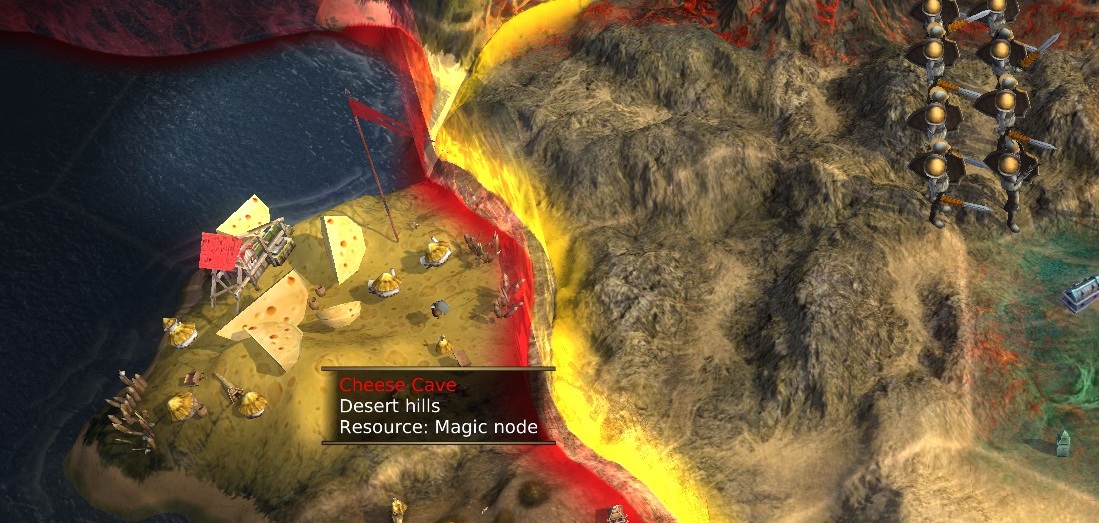
Warlock: Master of the Arcane is a game which set out to meet specific goals, and it has succeeded in that. Within its narrow focus, it offers a generous toolkit and gives the player room to experiment. It is not a game for everyone. Peaceniks need not apply! Other strategy gamers should at least download the demo and search for the fabled cheese caves.
We hope you enjoyed this post! To quickly find this post, and our other reviews, click the “reviews” tab at the top of this page.
Length of time spent with the game: 4 completed games, approx 38 hours of play (including time spent with the demo).
What I have played: Normal and challenging difficulties; small, normal and large map sizes; continents and super-continent map types.
What I have not played: Impossible difficulty, and those rated below normal; two remaining map types; the largest map size.
Rachel McFadden (aka frogbeastegg) has been gaming since she discovered the original Prince of Persia on the IBM 286sx PC. Whilst strategy and RPGs are her preferred genres, she is a multiplatform gamer who will play almost anything provided it isn’t sport, car racing, or multiplayer only. Under the frogbeastegg name Rachel has written guides for many of the Total War series, various AARs for strategy games, and a few pieces of fiction. When not engaged in reminding various virtual populaces that she is in fact the Supreme Ruler of the Universe and the One True Hero, Rachel can typically be found with her nose in a book.
Note: the above comments are based on a review copy supplied by the game’s publisher, Paradox Interactive.
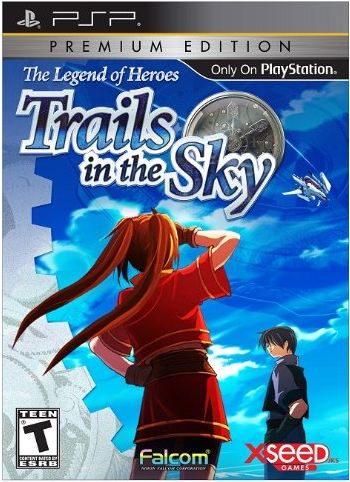
After a heyday spanning the Playstation and Playstation 2 eras, Japanese RPGs (at least, those translated into English) have retreated from home consoles: the Playstation 3 offers nowhere near the riches that its predecessors did. To some extent, portable consoles such as the PSP have picked up the slack with excellent tactical RPGs such as Tactics Ogre and Final Fantasy Tactics, as well as pure JRPGs such as Persona 3: Portable. How does another contestant in the PSP camp, pure RPG The Legend of Heroes: Trails in the Sky (Falcom 2006, released in the US by Xseed in 2011), measure up?
The answer is, “It’s a trick question.” From its roots up, I found Trails to be a very different beast to many other RPGs, including those I named above. This is not because it’s groundbreaking. It’s not: the story is linear and combat is turn/party/menu-based. Rather, where other games are built to challenge – for example, P3:P offers challenging gameplay, while FFT and Tactics Ogre also challenge the genre’s storytelling conventions – Trails seems built for relaxation.
For example, Trails’ story and characters are a mishmash of familiar archetypes. Its young heroes – a cheerful hothead and her calmer brother – rove the land Fighting Evil and Righting Wrongs. The plot twists are guessable, the other party members out of central casting. But it works. The heroes are likeable, and their dialogue often witty – witty enough to make me laugh out loud a couple of times. The villains are dastardly, but never disturbing. The music is cheery, the towns and landscapes detailed. The net effect: a mood that’s nice and pleasant, and a world conducive to wandering around and seeing the sights.
(A quick story aside: Trails is the first game in a trilogy, and also the only one, so far, to be officially released in English. However, its plot mostly stands alone – there is a sequel hook, but it feels like the first act of a new story rather than a loose end. As such, this shouldn’t be an obstacle for potential buyers.)
Trails’ gameplay produces a similar effect. For starters, it avoids the single most annoying genre convention: random battles. Instead, you can dodge monsters a la Chrono Trigger and Persona, which saves a lot of aggravation. And there’s precious little need to grind – I did almost every sidequest in the game and that was plenty. Character management is reasonably complex: I had to put some thought into juggling different party members’ specialties, and mixing and matching the “orbments” that determine available magic spells. But I found the actual battles pretty easy: most enemies, and even most bosses, just didn’t hit hard enough to be dangerous. True, combat needed some mental involvement – I couldn’t just mash X to attack. But once I equipped a sensible choice of orbments, I’d just bring out the appropriate elemental spells, then heal as needed. The outcome was rarely in doubt: I could count on the fingers of one hand all the times I Game Overed. (Even when I did, no big deal; you can instantly replay a lost battle, and the game allows saving anywhere.) No hair-tearing moments here, just an agreeable way to while away time.
And that is how I’d sum up my Trails experience: “an agreeable way to while away time”. If you’re not already a JRPG fan, I don’t think this will bring you on board – it adds nothing radically new to the recipe. But if you do enjoy JRPGs, Trails is like comfort food: low-stress and easygoing. For genre buffs in the mood for old-fashioned home cooking, Trails might just be worth a look.
I hope you enjoyed this post! To quickly find this post, and my other reviews, click the “reviews” tab at the top of this page.
Japan is best known in western geekdom for her video games, anime, and manga, but from time to time, we see the novels (often illustrated YA “light novels”) that inspired some of these works. These usually come out in the West under the auspices of manga publishers: transhuman space opera Crest of the Stars, coming-of-age fantasy The Twelve Kingdoms, and high-fantasy spoof Slayers were released by the now-defunct Tokyopop, while economic fantasy Spice and Wolf (my review here) is published by Hachette’s manga/graphic novels imprint, Yen Press. (One exception is Moribito, published by Scholastic.) Yet in the West, these are nowhere near so well known as their adaptations – it’s reasonably common for science fiction, fantasy, and video game geeks to watch anime; rather rarer for them to read the source novels. Why?
I can think of several potential explanations:
Poor quality? At first glance, this is an unlikely culprit – the respective anime adaptations of Crest, Twelve Kingdoms, and Moribito are all excellent, at least as good as any live-action Western competition. If there’s a problem, it must be peculiar to the books – such as prose. The only one I’ve read, Spice, suffers from a weak localisation, and one Amazon review suggests that so does Crest, but without further data I couldn’t say if the problem is more widespread. Still, a possibility.
Lack of Kindle availability? Ebooks have been a boon for mid-tier fiction, yet none of the books I mentioned above is available for Kindle! (At least in the case of Spice, its few illustrations are no excuse; they’re mostly black-and-white, which the Kindle screen can handle.) I don’t think this is individually decisive, and certainly there are light novels that buck the trend by appearing on Kindle, but it surely can’t help.
Poor market positioning? I have not seen these books marketed at all beyond the manga crowd, despite their potential appeal to science fiction and fantasy buffs! The closest they’ve come has been the Spice novels, which use photorealistic dust jackets to conceal manga-style covers. This seems the most likely suspect to me – if sf/fantasy communities aren’t even discussing these books, even to say “they’re bad!”, that suggests the problem is awareness.
For whatever reason(s) it occurs, this phenomenon is too bad – not only do some of these works deserve to be better known, but I’d like to see the fruits of creative cross-pollination. And if any readers are familiar with these markets, I’d love to hear your insights. Either the problem is not so easy as I’ve made it sound – or else there is an opportunity here, waiting for somebody to grab it…
I’ve previously written about Xenonauts, the indie strategy game inspired by UFO: Enemy Unknown/X-Com: UFO Defence. Developer Goldhawk Interactive has taken pre-orders for a long time, but now it’s launched a Kickstarter campaign to raise US$50,000, and released a public, alpha demo of the game. Is it worth your attention?
After spending some time with a preview build (a recent predecessor of the public demo), I can say this: as promised, Xenonauts is evolutionary, not revolutionary. Its concept, mechanics, and feel are straight out of the original game; however, Goldhawk’s clear intent is to make it more user-friendly; iron out some of the original’s annoyances; cut down on busywork and no-brainer decisions, and replace them with interesting choices. Here are the details of what I saw:
Geoscape (world map)
The Xenonauts’ base: Earth’s last, best hope
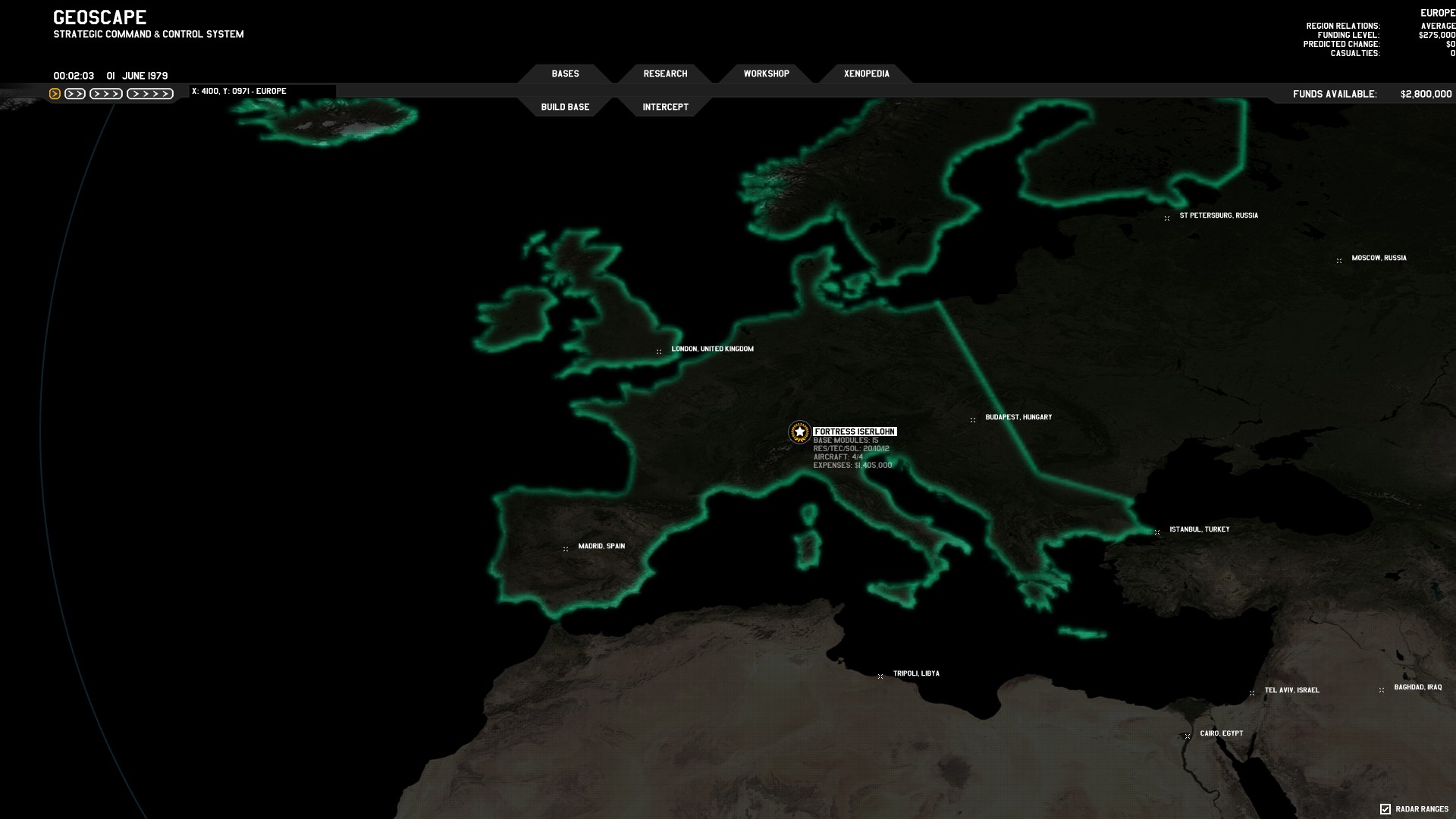
As with the original X-Com, your first sight of the game will be its world map – black, stark and crisp, but still recognisably the good old Geoscape. Zooming down to an individual base reveals management has been tidied up. One general store will now hold all your goods. Conventional Earth weapons are now available in unlimited supply – not only does this make sense thematically, it cuts down on the workload at the start of the game. Unusable loot (e.g. duplicates of a widget you’ve already researched) is automatically sold or destroyed. Soldiers’ stats – and their encumbrance! – are now visible on the inventory screen. All in all, the emphasis here seems clearly on reducing tedious maintenance in between the good parts.
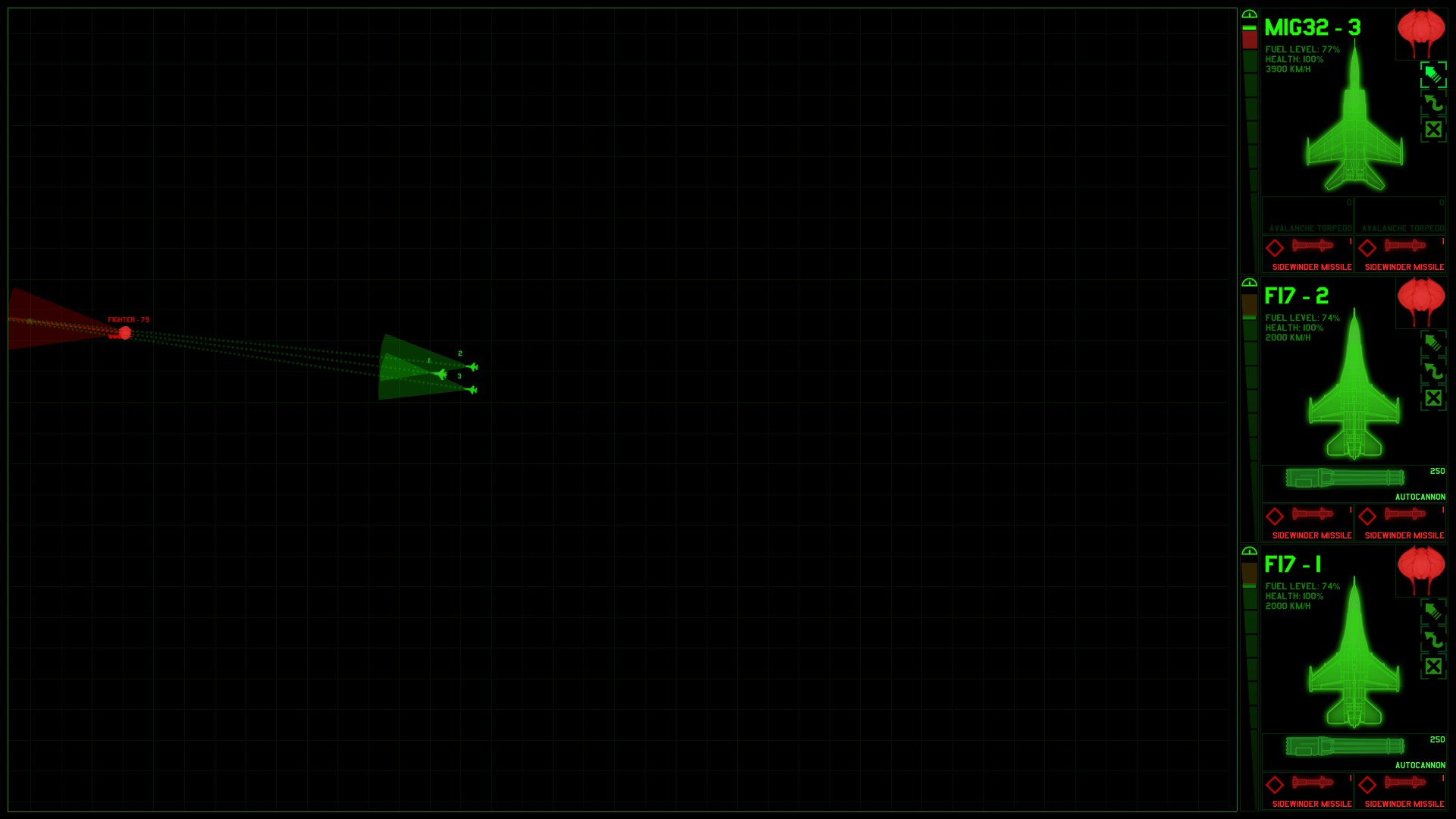
Air battles are much more involved than in the original game. Instead of hitting one button to engage, your aircraft and the UFOs now manoeuvre in pausable real-time – a little like a real-time Steambirds. And unlike the original game, where two air-to-air weapons were hands-down optimal (Avalanche missiles at the start of the game, then plasma beams once they became available), Xenonauts’ air combat is closer to rock-paper-scissors. You now have two fighters available early on, and each fills a different role: F-17 Condors armed with cannon and light missiles are good against small, agile UFOs, while lumbering MiG-32s with Avalanche torpedoes are good against bigger foes. So far this is a nice change, though it’s possible it could eventually become repetitive.
Air combat
Ground battles
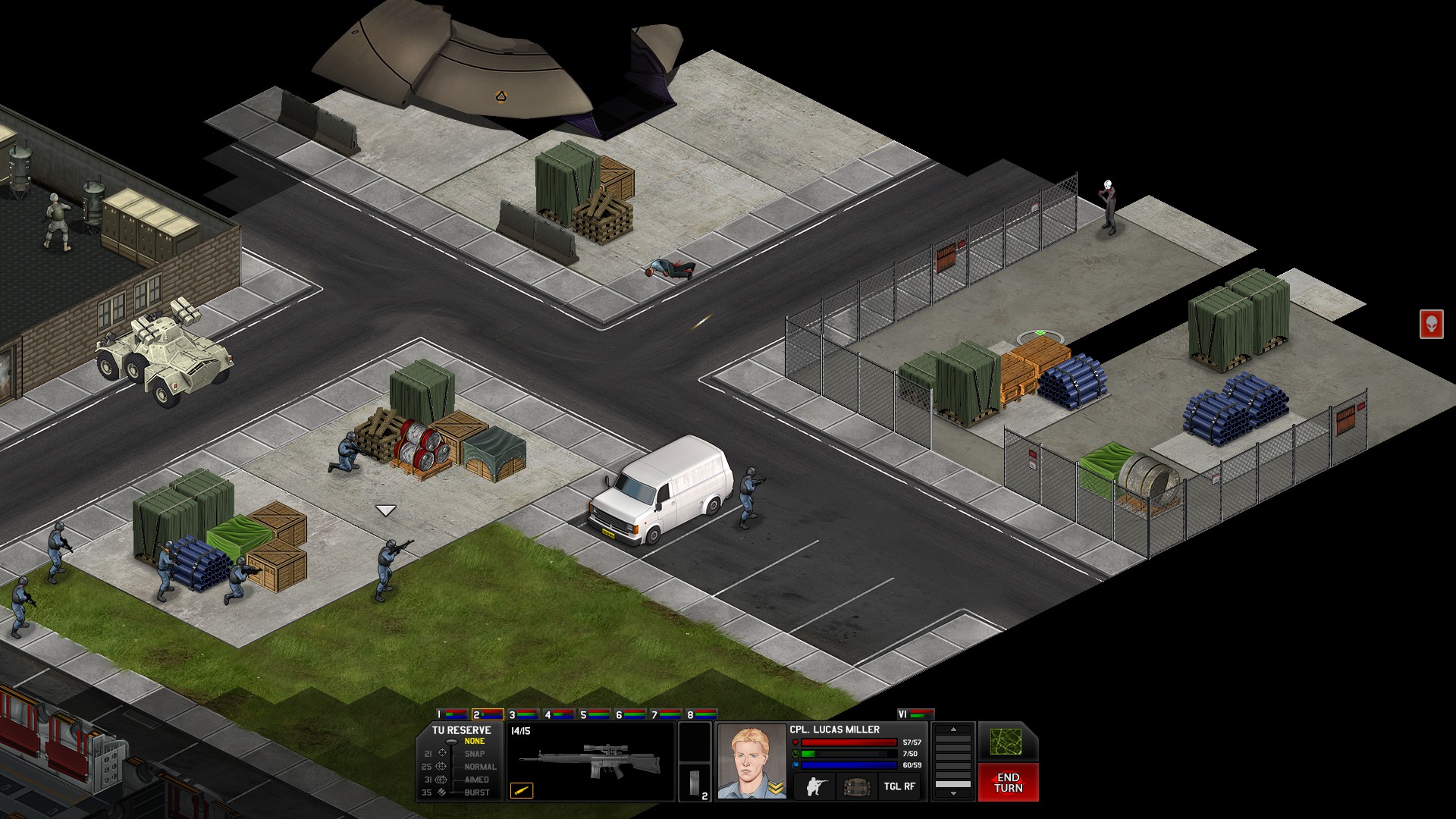
Xenonauts’ clean UI and aesthetic are also evident in its battles. There are fewer buttons to worry about; the art style is simple but clear; and a faint dark outline helps you pick out soldiers and aliens. The controls feel like Jagged Alliance 2’s: left-clicking on a destination square will show a soldier’s projected path and how many APs will remain; right-clicking on a target determines how long a soldier will aim his shot; burst fire is toggled by hitting a button. Unsurprisingly, this is a big improvement over the original.
The Xenonauts (bottom left) prepare to engage an alien (top right)
The “interesting choices” extend to your soldiers’ weapons, which feel nicely differentiated. Take the small arms. Assault rifles are jacks of all trade, masters of none. Shotguns are hideously short-ranged, but take relatively few action points to shoot, meaning a Xenonaut can still fire after moving long distances. At this stage, however, it looks like the squad’s real killing power is in its support weapons. These are heavy, take an accuracy penalty if their bearer moves and shoots in the same turn – and hit like a ton of bricks. Machine guns can unleash whole volleys at a time. Even unaimed, precision rifles take plenty of AP to fire, but investing just a few more APs pushes their accuracy into the stratosphere. And rocket launchers, just as they did in the original, will level anything near their target.
All in all, if the early game is any indication, Goldhawk knows what it’s doing at the design level. It has plenty of work yet to do, and it’s too soon to tell how balance, pacing, and the other ingredients of “fun” will eventually come together. However, if Goldhawk can (A) sustain the quality of its ideas through the mid-to-late game; and (B) get the nuts and bolts right, this would bode very well for the final product. In the meantime, yes, Xenonauts is definitely worth your attention.
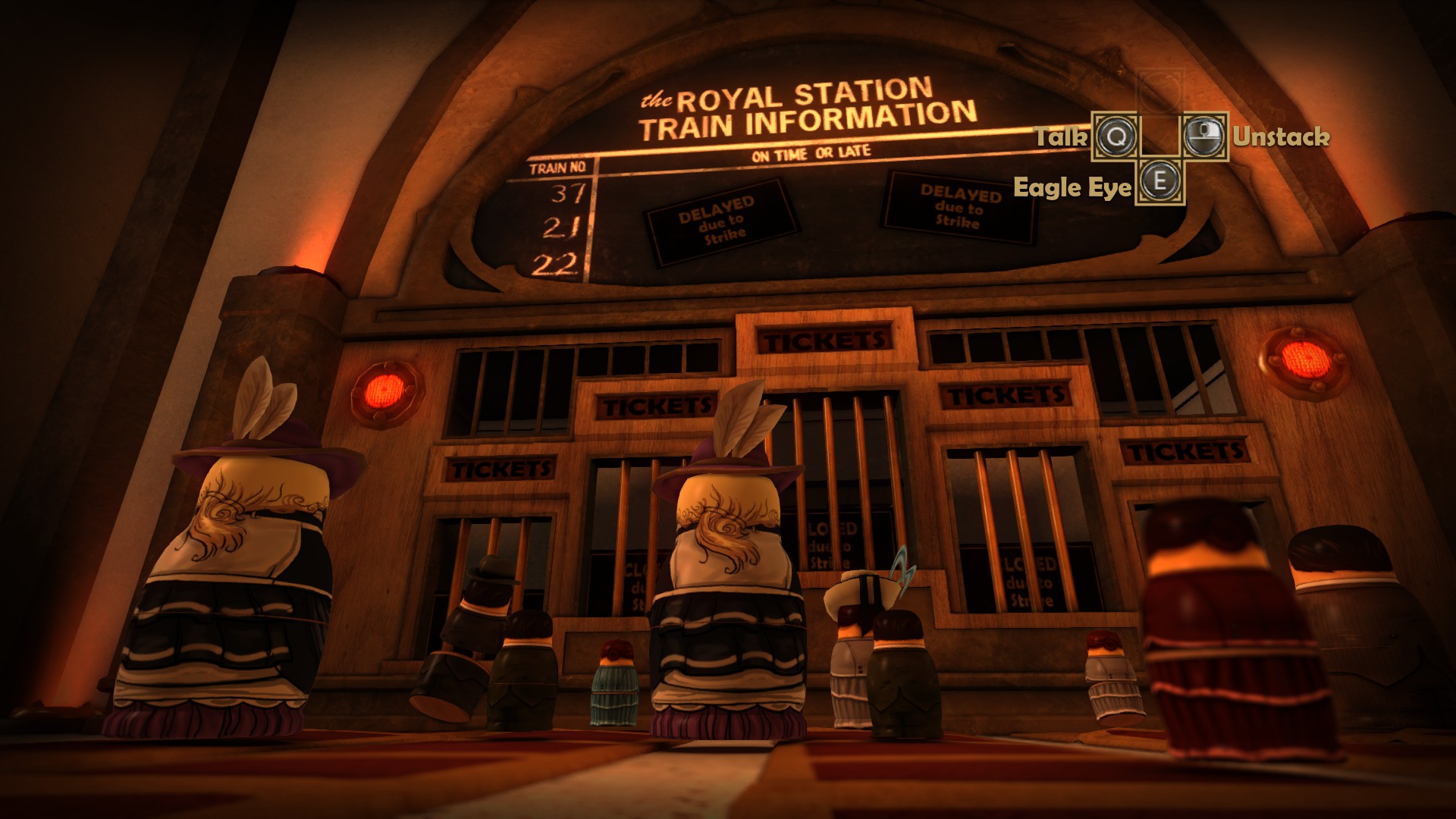
Double Fine Productions’ adventure game, Stacking, has an illustrious pedigree: Double Fine founder Tim Schafer’s resume is littered with genre pillars, from Monkey Island to Grim Fandango. Born out of an internal Double Fine game jam, Stacking debuted on consoles in 2011, and has now reached the PC. How does it stack (sorry) up? Pretty well, thanks to two distinct strengths.
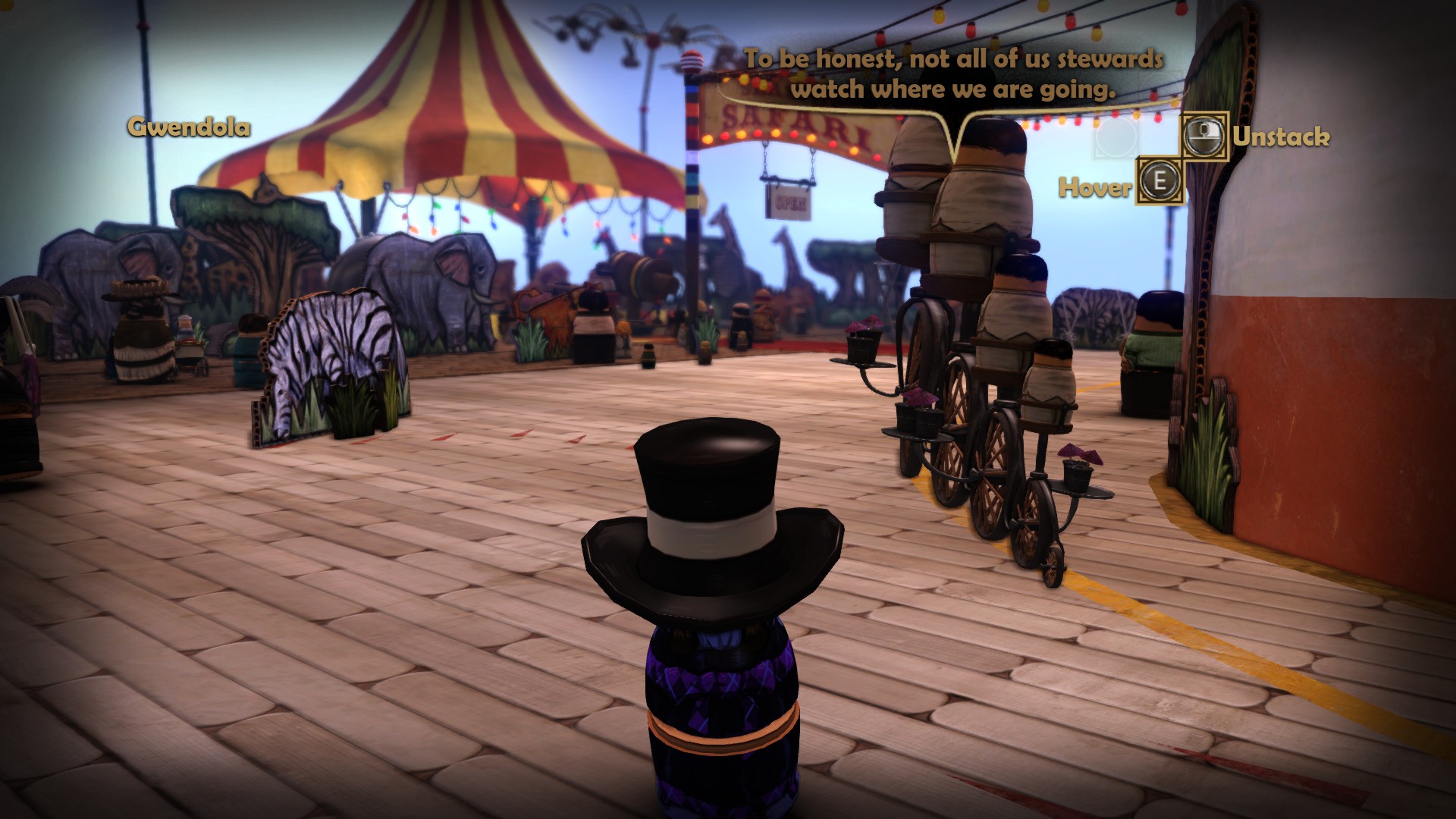
The first is its original premise: the residents of Stacking’s world aren’t humans, they’re Russian matryoshka dolls. Your character is the tiniest of all, but “stacking” into a small doll will allow you to jump into a medium-sized doll, which will allow you to jump into a large doll, and so on. Each doll has its own ability, which you can use while stacked into it. As such, instead of the usual “fiddling with every item in your inventory”, solving puzzles is a matter of working out which doll’s power to use – or, sometimes, which dolls’ powers, as some puzzles require the combined use of more than one. (Using multiple dolls is Stacking’s equivalent of “use every item with every other item”, but thankfully, the puzzles are more sensibly designed than that!) It’s fresh, it’s quirky, and at first, it’s a delight to stack into every doll in sight, in search of the next new ability.
Yes, you can stack into all those bicyclists
The second is how neatly it avoids the traditional sin of adventure games: the ease of getting stuck. Normally, adventure game puzzles have one solution, and if you can’t guess it, tough luck (short of resorting to GameFAQs). This is especially bad when the game expects you to, say, make a moustache out of cat hair. While Stacking does offer an in-game hint system, it also addresses the root of the problem: in this game, puzzles have anywhere from three to five solutions. One or two will usually be obvious… but the challenge comes from trying to work out the rest. This is a much better way of designing an adventure game: it lets you set your own pace (do I want to blast through, or tick off every solution?) and gives a good reason to be completionist (some of the solutions are laugh-out-loud funny).
Stacking’s greatest limitation is that its characters and plot aren’t very deep – not deep enough to carry the game. Without the compelling stories of, say, The Longest Journey or Gabriel Knight, Stacking relies on novelty value. And eventually, the novelty wears off: by the time I finished, I found the game less amusing and enjoyable than when I began. (I also stopped bothering with every solution: I just wanted to wrap up!) But Stacking is short enough for this not to be a serious problem – I finished it in ~8 hours, before it outstayed its welcome.
At the end of the day, Stacking isn’t a great game, but it is a good one: the video game equivalent of a healthy snack. Cute, imaginative, and sometimes hilarious, it’s especially well suited for quick breaks – if you’re tired or short on time, you can dip in, solve a puzzle or two, and call it a day. Worth a look for genre fans.
Europa Universalis II was my first Paradox game. Since then I’ve played every strategy title Paradox has produced, excepting the Hearts of Iron series. Whilst I have great respect for their scope and ambition, and do not care to think about how many hours of my life they have consumed, I have often found them rather soulless. Not quite the proverbial Excel spreadsheet – but not all that far off. They lacked atmosphere and felt like they had little to do with the era they portrayed outside of a handful of specific game mechanics and some window dressing. After a lengthy process of gradual improvement, I find that Crusader Kings II demonstrates that Paradox has put the final nail in that soulless feeling’s coffin.
How have the developers managed this? With a swooshing camera, trivial artwork, nicely timed music, and a few other entirely frivolous details which, taken together, add up most pleasingly.
When Crusader Kings II launches, it greets the player with a stained-glass version of the Paradox company logo. This is not unusual: the other games all feature a customised version of the logo. The intro music begins to play immediately, a gentle piece with soft chanting over the top of a small selection of instruments. If you do not own the game, you can listen to the title music here. The logo swaps to a slideshow of unique illustrations. After 52 seconds, the point where the game will transition to main menu on most computers, the music begins to pick up both in pace and in complexity. At 1:03, bam! The music temporarily kicks up another level as the player surveys their options, then goes softer to permit undistracted thought. At 2:06, around the time I’m seriously pondering the merits of a particular dynasty, the music kicks up to full fever and my head fills with visions of epic conquest. Whether the harmony of game timing and music pace is intentional or a happy accident, the sequence does possess a few advantages over Paradox’s prior games. The two immediately prior handily demonstrate two different approaches, neither of which I feel works as well. Sengoku observes total silence through the loading screens; music makes its first appearance when the player arrives at the main menu. A House Divided, the expansion pack for Victoria II, has an animated intro sequence prior to the loading screens. Whilst this works nicely on the player’s first game, on all subsequent ones it is skipped. This results in a burst of disassociated music before the video vanishes and the majestic loading screen music begins. Compared to Crusader Kings II’s smooth sequence, the result feels uneven and disrupted.
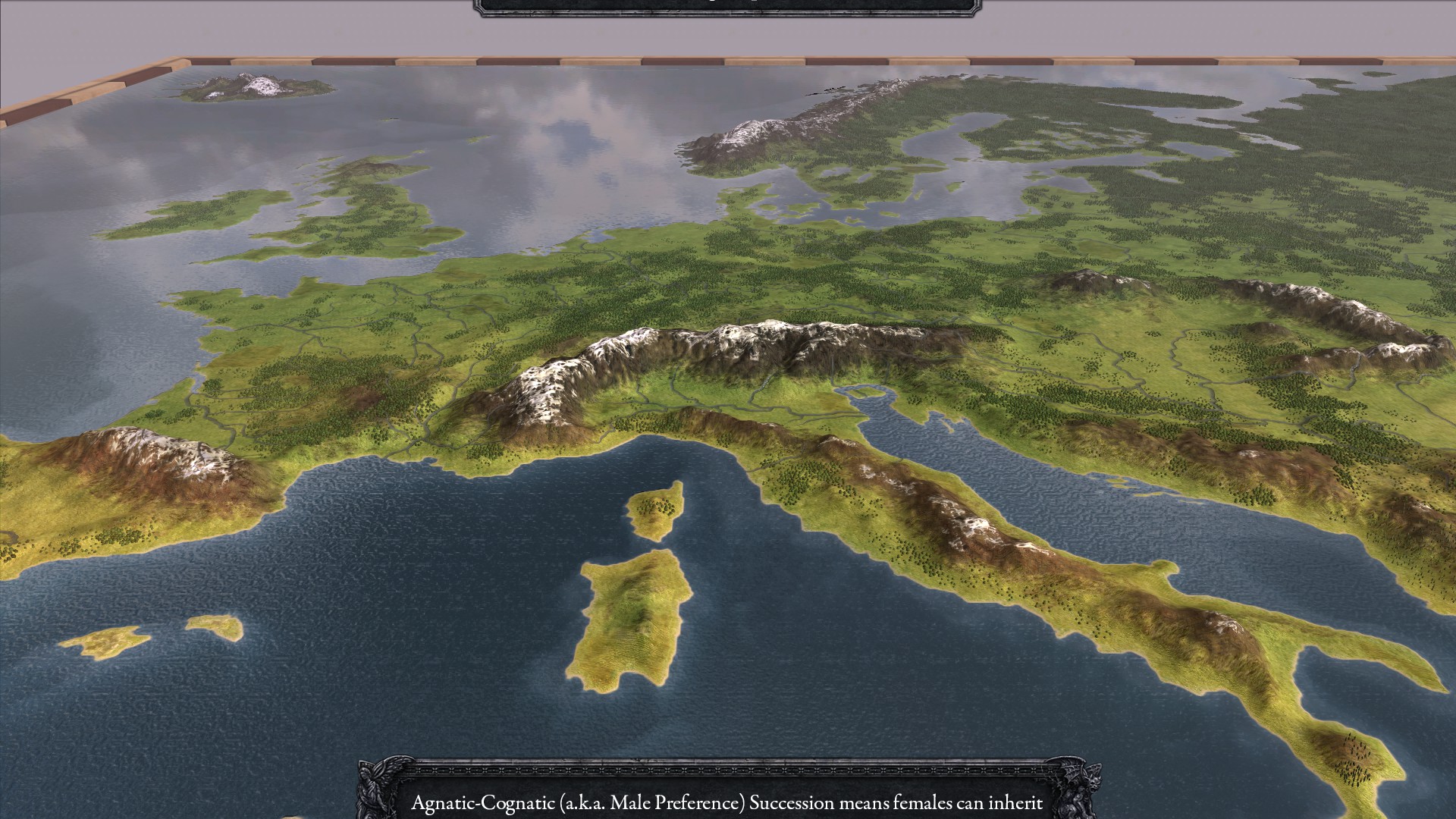
Crusader Kings II has another trick up its sleeve for the opening: my titular swooshy camera. The main menu is a 3D map of Christendom plus neighbouring non-Christian lands. Click on ‘single player’ and swoosh! The camera swings in, seamlessly transitioning the map from background to the centrepiece on which you choose your dynasty. Choose your dynasty and start the game, and swoosh! Once again, a seamless transition as the map zooms in on your starting location, the interface swaps to the in-game set, and the game is ready to play. As Nintendo 64 owners used to tell their Playstation ‘rivals’ during the fifth-generation console wars, smooth transitions and no loading times matter. In this instance they preserve the atmosphere the game creates, and allow for one very neat visual effect. The swoosh itself, despite being a tiny bit of programming, makes the game feel more luxurious than previous Paradox titles. It feels like a Big Boy Studio effect.
The swooshy camera also reveals an overt secret. When the camera begins its first swoop, you can see the boundaries of the 3D world. Rather than cutting off in an ugly crop, there is a raised, patterned wooden border. The world exists as a sculpture inside a tray. Who would possess such a map? How about the fabled Emperor Qin, whose tomb is said to possess a map of China with rivers made out of mercury. Plush! Crusader Kings II is not the first game to present its map as precisely that. Victoria II mimicked a school atlas when the player zoomed out far enough, and CA’s original Shogun: Total War plays out on a parchment map with carved wooden counters, to name but two. That said, the effect is unusual, and presented in a manner which feels distinct to this one game.
What about the sound effects? Where most games feature bland clicking sounds when you hit this or that interface button, Crusader Kings II features various harp chords. Move around quickly enough and you create your own little tune. This only applies to the ‘choose your dynasty’ screen, so it does not have the chance to wear out its welcome.
That’s the swooshy camerawork and the well-timed music. What about the rest?
As a casual glance at any screenshot will reveal, the game’s interface is a concoction of stained-glass, occasional gilding, muted colours, and niello. In-game, you will notice a multitude of little details, like sections of scrollwork carving. The stained-glass buttons are made up of numerous little panes, not crude chunks of colour. Messages are presented on scraps of tattered parchment. There’s a large variety of custom paintings used across the interface, from the reclining lady in the pregnancy announcement to the soldiers on the battle screen. This is an image-rich game. I cannot think of any other Paradox game with as many supporting artworks. In this aspect Crusader Kings II is once again the culmination of a slow process; each Paradox game has added a little more care to the UI artwork, passing from the functional ugliness of the early games, through the passable but bland games like Victoria, to the almost-but-not-quite of Sengoku‘s tasteful wooden panelling.
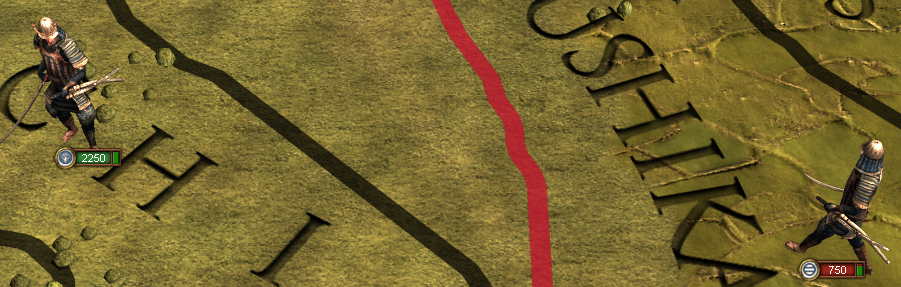
Having given a nod to the most obvious, I’d like to move to the minor detail I myself find most important: armies. In prior games, armies tended to look very similar, to the point where I occasionally found it difficult to tell who owned what! Crusader Kings II gives each province’s army its own unique coat of arms, and an army levied from that province will wear the coat of arms on its surcoat. Additionally, different cultures have different army models. Instantly, the world feels far more alive, the game more detailed. Now that sounds confusing in the opposite direction. How do you tell which army belongs to whom? Answer: it’s easy to recognise the coats of arms, yours and your foes’, because you see them all the time whilst playing the game. Heraldry works – that’s why it was used for so many centuries. If that’s not enough, the owning faction’s icon appears below the army model, and it’s that vital bit bigger and clearer than similar identifiers in games like Sengoku, whilst not so disassociated as the big flags in games like Europa Universalis III.
Armies in Sengoku. Two warring clans ... but which one is mine?
Armies in CK2. Look-it the purdy surcoats!
The characters speak for themselves. Instead of being filled with rather bland countries differentiated only by their flag, Crusader Kings II has a world filled with varied faces, traits and statistics. This is the evolution of a design which began in Crusader Kings I, then grew in Europa Universalis: Rome and Sengoku. Whilst the range of character stats and actions is a little larger, it is once again the seemingly unnecessary frippery which helps Crusader Kings II take that leap ahead. Due to a wider range of character portraits, improved visual detail on those portraits, and a better visual aging process, the game feels that bit more convincing. That in turn supports the character-based gameplay, with all its inter-personal relationships and event choices. In a satisfying loop, that gameplay bolsters the portraits by making the faces feel like more than a randomised bit of art.
A swooshy camera, lots of minor graphical frippery, a few frivolous details – all unnecessary fanciness with little relation to gameplay… all vital to making Crusader Kings II feel alive.
Rachel McFadden (aka frogbeastegg) has been gaming since she discovered the original Prince of Persia on the IBM 286sx PC. Whilst strategy and RPGs are her preferred genres, she is a multiplatform gamer who will play almost anything provided it isn’t sport, car racing, or multiplayer only. Under the frogbeastegg name Rachel has written guides for many of the Total War series, various AARs for strategy games, and a few pieces of fiction. When not engaged in reminding various virtual populaces that she is in fact the Supreme Ruler of the Universe and the One True Hero, Rachel can typically be found with her nose in a book.
Note: the above comments are based on a review copy supplied by the game’s developer, Paradox Interactive.
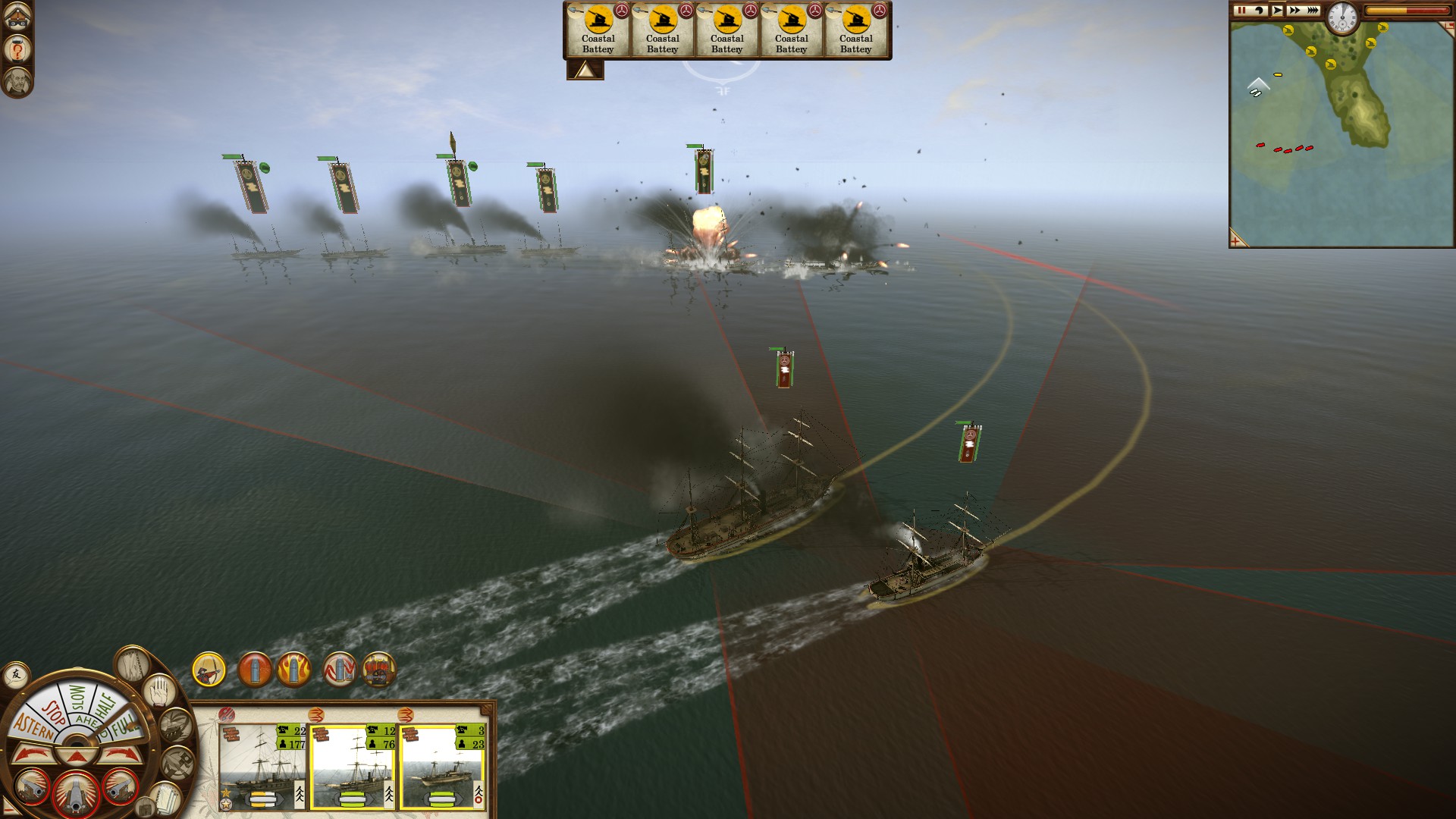
Set during the sixteenth-century zenith of the samurai, Creative Assembly’s Total War: Shogun 2 (2011) was one of the best strategy game in years. CA soon followed it up with a first expansion, Rise of the Samurai¸ which wound the clock back to the Gempei War of the twelfth century. Now the latest, stand-alone expansion, Fall of the Samurai, wraps up almost a millennium of Japanese civil strife by moving forward to the nineteenth-century Boshin War. How does it compare to its illustrious parent?
The promise
Fall’s greatest strength is the clarity of its theme: this is a game about change, in a way that no other Total War game has been. In fifty years, Japan went from a land of shogun and samurai to a power that could beat a Western empire; and from look to feel to mechanics, that wrenching transformation is written all over Fall.
You’ll notice the game’s new aesthetic straight away: riflemen face samurai in the game’s loading screens, the new map looks like a nineteenth-century atlas rather than a Japanese scroll, most of the playable daimyo are dressed in Western uniforms. As you build up your empire, you’ll see more wonderful touches in the graphics and flavour text. Trains puff smoke and chug through little tunnels. Generals receive stat boosts by picking up Western knick-knacks: pianos, penny-dreadfuls and more. New technologies are accompanied by poetic blurbs, running the gamut from bleak to resigned to hopeful. (Compare the descriptions for six techs: “arms deals”, “modern army”, “cordial relations”, “gold standard”, “capitalist production”, and “charter oath”.)
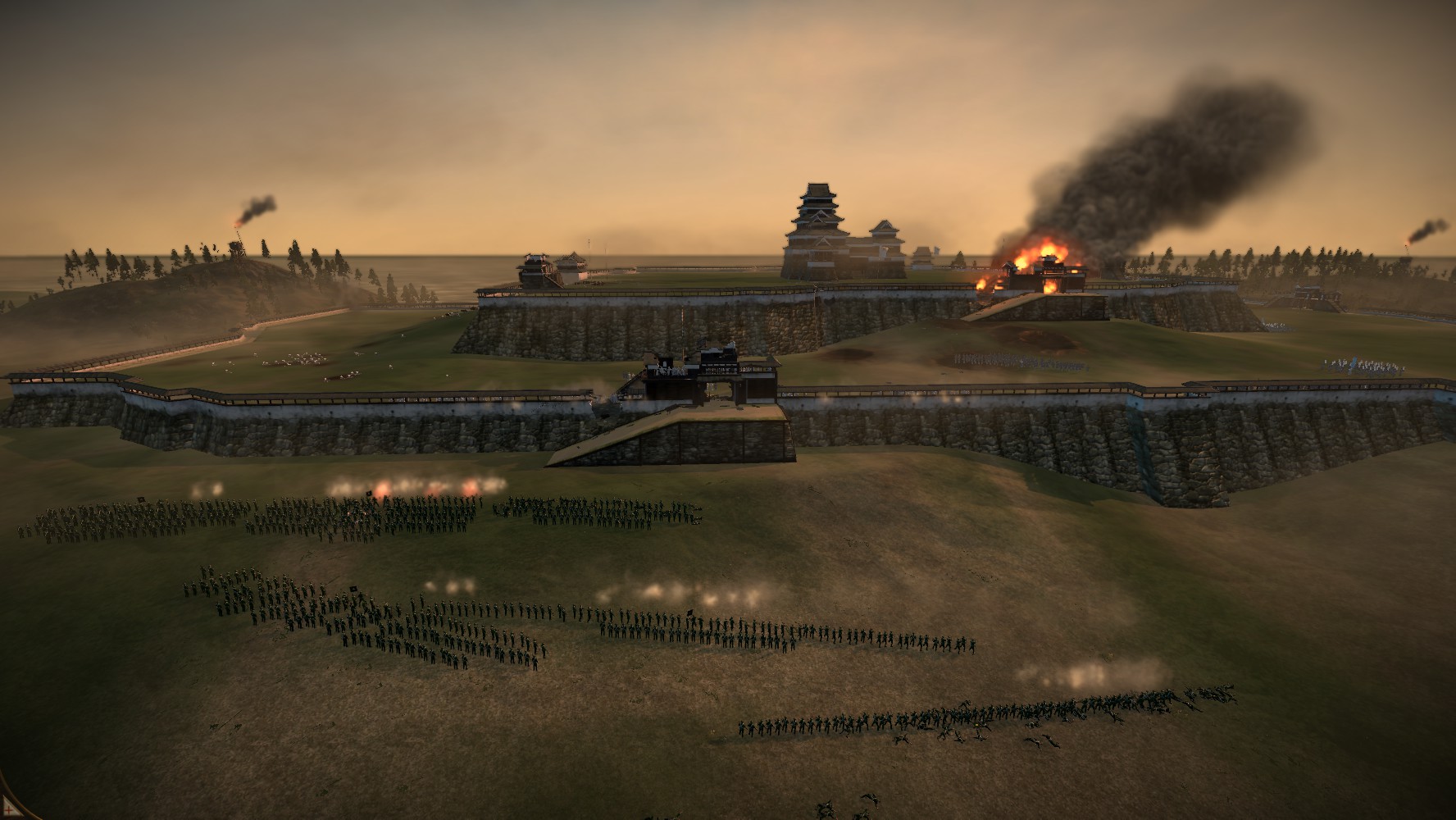
But text is only part of the story. Gameplay mechanics are another vital way to communicate theme, and this is where Fall shines. As you fight your way across Japan, you’ll witness the end of an era, or more precisely, the transition through several eras, compressed into a single frantic period. Within the span of a single campaign, you’ll go from the shock-dominated battlefield of the Middle Ages, through the pike-and-shot era, to the fire-dominated age of industrial war. At the start of the game, samurai and even levy spearmen will roll right over peasant musketeers, but soon enough, trained soldiers with modern rifles will take their toll on anyone who approaches on foot. As firearms get better and better, riflemen more and more skilful, and artillery more abundant, modern armies will eventually massacre hordes of samurai or peasants with barely a scratch.
A bang, not a whimper: the power of modern weaponry
As such, modern weaponry is a literal game-changer. But not just due to its lethality. Riflemen do what bowmen have always done in the Total War games, just much, much better. Even greater transformations are visible in the other arms, cavalry and artillery, and what they do to the overall feel of combat. Traditionally, battles in the Total War series were about pinning the enemy’s infantry in melee with your own, preferably heavier infantry, then swinging around with cavalry to roll up the enemy from behind. Heavy infantry beat spearmen, spearmen beat cavalry, and cavalry beat anything if it attacked from behind. Even in the gunpowder-era games (Empire and Napoleon: Total War), battles were decided after the armies were close enough to see the whites of each other’s eyes. Not so in Fall. Spearmen still counter cavalry if they catch them in hand-to-hand… but now the cavalry have guns aplenty, and they need them. The best counter to a charging lancer is no longer a man with a pike; it’s another horseman with a gun, or perhaps even a well-trained rifleman. And woe betide the spearman who tries chasing a revolver-armed horseman. That is, if that spearman survives artillery that long. The inaccurate cannon of Empire and Napoleon are gone: American Civil War-era Parrott guns unlock early on, and they will rack up hundreds of kills per battle. Massed Parrotts will knock out even elite regiments long before they enter the fray, and later artillery is even more lethal. You will see the death of chivalry in this game, and you will see the road towards the slaughter of the Great War.
The failings
At their best, Fall’s battles might just be the finest in the entire series. The key phrase is “at their best”. All too often, the battles are not at their best, due to problems with the campaign AI. And that sums up Fall’s greatest weakness: it all too rarely fires on every cylinder. Here are some examples:
1. Land combat. Battles at the start of the game, when both the player and the AI rely on levies backed by a handful of samurai and modern riflemen, are tense and fun. The problems come later: the computer just doesn’t understand how badly quality eventually beats quantity. Even in the endgame, I’ve only seen the AI use high-end modern infantry once. I see rather more regular modern infantry (especially after installing an AI mod), but I also see lots of samurai and peasants – by this stage, target practice. All too often, the game serves up fodder instead of challenge.
This becomes repetitive after a while
2. Sea combat. The war at sea is meant to take a similar course to the war on land. Wooden ships burn en masse once explosive shells show up, and ironclads sound their final death knell. Pitched fleet battles, especially in the presence of coastal defences, can be spectacular. Unfortunately, the designers evidently thought it was fun to make the player play whack-a-mole against constant, small raiding fleets (especially on “Hard” difficulty). It’s not. The problem is exacerbated by naval zones of control that are too small; and puny coastal defences. I alleviated this with a homebrew naval mod, but I shouldn’t have to fix games myself.
Wooden ships: all too vulnerable
3. Diplomacy. In the base game, diplomacy was “every man for himself”, but Fall divides Japan into two broad camps (based on the way religion worked in the original game): pro-Imperial and pro-Shogunate. Players of the same allegiance enjoy a healthy bonus to diplomacy; players of opposing allegiances take a serious penalty. The victory conditions reflect this: your camp has to take X number of provinces and both Edo and Kyoto, but you personally have to take far fewer provinces (14 in the short campaign, rather than the base game’s 25). And rather than “you vs the world”, realm divide now functions as the final Shogunate/Imperial showdown: only the opposing camp will attack you, while clans of the same allegiance will rally behind you instead.
On paper, this is a great idea. And when it works (i.e. when the war between the two factions hangs in the balance), it works well. It’s very cool to be part of, as opposed to the focus of, a greater conflict – especially after realm divide. Unfortunately, it doesn’t always work: the course of the broader war is a crapshoot. If your faction does too well, the game is boringly easy. If your faction does too badly, then the game turns into a grinding slog. It’s aggravating when such a key part of the overall experience comes down to luck of the draw.
4. Difficulty and balance. More broadly, Fall’s campaign feels as though the developers didn’t have the time to properly tune the game’s balance. It shows up in the difficulty settings: on “Normal”, the campaign is often rather easy. “Hard” is a different story, but not because the computer is cleverer. No: everything costs roughly 15%-20% more, and the computer players team up for a game of kick-the-human. It shows in the victory conditions: requiring that your camp hold Edo and Kyoto might be historically accurate, but it skews the game, since both (particularly Edo) are within Shogunate territory. As a result, my Normal Shogunate campaign felt much shorter and more anticlimactic than my Imperialist campaigns. (Compare the base game, in which you fought your way towards Kyoto, in the centre of the map.) It shows in the game’s economy. The developers clearly intended money to be scarcer: trade nodes have been removed, most farmland is poorer than in the base game, and everything costs more. But they went too far: now money is artificially, annoyingly scarce unless you beeline for “fertile” and “very fertile” lands (especially bad on “Hard”). And it shows in the issues I described above. Given time, surely the developers would have fixed the AI issues, the ship spam, and so forth.
As such, my playthroughs of Fall have been a decidedly mixed bag. Playing on “Hard”, my campaigns began promisingly, with plenty of challenge and thrills, before eventually degenerating into frustration. Playing on “Normal”, one game I spent fighting small, weak clans was dead boring. One game in which the opposing faction took over most of Japan started well, but turned into a slogfest. And my final, most rewarding playthrough delivered the experience that Fall should have been from the start. I played differently that last time – by then I knew the “optimal” path to take, and I didn’t turtle (which I think helped the game’s pacing). But I also had to apply the AI and naval mods mentioned above, and I benefited from luck (e.g. with the progress of the Imperial/Shogunate war).
Conclusions
The Twilight Samurai
Ultimately, Fall of the Samurai didn’t live up to my hopes. Fall brings together theme and mechanics with a superb battle system, only to hamstring itself with a wildly inconsistent campaign. Its highs are higher than the base game’s – but its lows are just too frequent, and too annoying, for it to fill its predecessor’s shoes.
At the end of the day, I have to formulate my recommendation based on one wonderful campaign –and five (!) that were love-hate. And that is: wait for patches, mods, and/or a bargain sale. Buy Fall of the Samurai then. But don’t buy it now.
Radious’ AI mod. It’s hard to unpick the difference made by a mod, but I do think this helped the AI recruit better armies.
My homebrew naval mod. To install, simply unzip and place in the \data folder in the game’s Steam directory. Its key features are:
Bombardment range is still 8 (or 10 for Tosa, which gets a +2 bonus).
The Tier 1 harbour (“If this is a port, then one wall is a house!”) remains defenceless.
The Tier 2 port now has level 1 defences (equal to the base game’s trade ports) with a range of 12. The defences are silenced at 70% health.
The Tier 3 trade port now has level 2 defences (equal to the base game’s military ports) with a range of 12. The defences are silenced at 50% health (again, equal to the base game’s military ports).
Tier 3 military ports and the foreign (British/French/American) tier 4 trade ports now have Level 3 defences (equal to the base game’s drydocks), with a range of 12. The defences are silenced at 30% (again, equal to drydocks).
Drydocks, whose defences were already maxed out, have received no boost.
The naval intercept radius is now 12.
These changes will be reflected in the tooltips when you mouse over the buildings, but not in the in-game encyclopaedia.
The basis of my review
Time spent with the game: I estimate at least 20 or 30 hours.
What I have played: Two campaigns won (Nagaoka/Normal/Short, Tosa/Normal/Short). Four campaigns aborted: two as Nagaoka/Hard, one as Tosa/Hard, and one as Tosa/Normal. Briefly, the cooperative multiplayer campaign (Choshu/Hard, with a friend playing Tosa). A couple of multiplayer battles.
What I haven’t played: The PvP multiplayer campaign.
Eugen Systems has released a new content patch for Wargame: European Escalation (officially a “free DLC” – the only practical difference is that you’ll have to download it separately), while for the weekend, Amazon and Steam are now selling the game for US$24, representing a 40% discount. Reader Wolfox wonders whether the game is worth it, for an offline gamer, at that price.
My answer is “probably”. At a design level, Wargame is fantastic, and the new patch has fixed two issues that had marred player-vs-AI games. You can now do comp stomps, and you can now unlock new units by playing the skirmish mode or comp stomps (albeit more slowly than through PvP). The skirmish AI still offers less challenge than an experienced human player, but it plays well enough to make me work for victory. (Think one of the better Total War games, or, well, most strategy games.) And there’s a fun way to enhance the challenge – play with a themed deck, e.g. by restricting yourself to units of just one nationality.
Meanwhile, my recommendation for the game’s target audience (folks who enjoy PvP multiplayer) hasn’t changed. Wargame was worth it at full price, and it’s definitely worth it at 40% off!
Going forward, I’d still like to see more options to handicap the game or customise victory conditions. However, Eugen’s track record (in addition to the above additions, it’s patched in a new gameplay mode, more maps, and continued balance tweaks) makes it very plausible that we’ll see future additions along these lines. Keep up the good work, Eugen!
Stacking, Double Fine’s Russian doll-themed adventure game, is a treat for the eyes as well as the funny bone. In the above screenshot, a mismatched crowd queues up for tickets at a train station; their distinct designs, and the station’s warm ambience, speak to the love and craft with which this game was made.
This British Chieftain tank destroyed 8 enemy tanks, 3 armoured cars, a jeep, a personnel carrier, and a helicopter. Give the crew a VC!
Summing up Wargame: European Escalation, Eugen Systems’ latest real-time strategy game, is easy. It’s designed to do two things: evoke the modern (1970s-1980s) battlefield, and give the player choice. Picking it up is easy. But mastering it – that’s hard.
Playing Wargame is about putting the right troops in the right place at the right time. Unlike Eugen’s earlier RUSE, there is no base-building and almost no economic management – more dangerous parts of the map are worth more reinforcement points, that’s it. Instead, tactics are king. The basics are simple: use recon units to size up the foe; recognise that in an equal fight, the defenders will win; attack where the odds are unequal in your favour; and defend or fall back where they’re not. The tricky part is the “how”. With 361 units in the game, who are the right troops for a given situation? On large maps, laden with forests and swamps, highways and towns, where is the right place to attack, hold, lay an ambush? On battlefields this fluid and lethal, when is the right time to act?
And that is the beauty of Wargame. From a thematic perspective, while the game is a long way from a realistic simulation, it borrows enough to feel believable (think Total War or Panzer General). Simply but clearly, Wargame illustrates the importance of scouting, flanks, supply lines, terrain, and more. Its huge arsenal helps bring the setting to life – it’s addictive to compare an Abrams to a Leopard 2 to a Challenger, or a Marder to a Bradley to a BMP! From a mechanical perspective, it epitomises Sid Meier’s definition of a strategy game as a “series of interesting choices”, beginning with which units to unlock and which of those unlocked to take into battle; and culminating in the myriad of decisions made during a match.
The right unit, in the right place, at the right time: Flamethrowers at point-blank range
Unfortunately, the game’s single-player campaign can’t do justice to its design. I’m not convinced that linear campaigns and scripted missions fit a game built around choice, and while I did get past the introductory campaign (5 missions out of 22), the next mission I tried prompted me to abandon this mode out of frustration*. I think enjoying the campaign would require a taste for scripted (and difficult!) RTS levels, one which I don’t share. The game’s skirmish mode is much better suited to its design, and decently implemented: I can beat the computer player almost every time, but barring the odd off day, it’s usually good enough to give me an exciting fight. The bigger problems with skirmish are a lack of customisation options and a failure to tie into the metagame: skirmish is limited to 1v1 matches (in a game where most maps are intended for >2 players), you can’t save skirmish replays, and you can’t unlock new units by playing this mode. (Update: Eugen has now added a comp stomp mode to Wargame, and you can now unlock new units via skirmish, albeit more slowly than via the campaign or PvP multiplayer.) As such, I would love to see a expansion that added a dynamic campaign, a la Dawn of War:Dark Crusade or Rise of Nations. It’s in multiplayer where Wargame really shines.
(A couple of quick notes about multiplayer. The community is mostly civil – I think Wargame benefits from not being the kind of title that draws the ‘l2p nub’ crowd. And while forum discussions are filled with complaints about unit balance, exploits, and immersion-breaking tactics, my actual experience could not have been more different: 95% of my matches have featured well-rounded armies deployed in reasonable ways. I have no doubt that exploits exist, but Eugen’s track record makes me confident it’ll patch the remaining holes.)
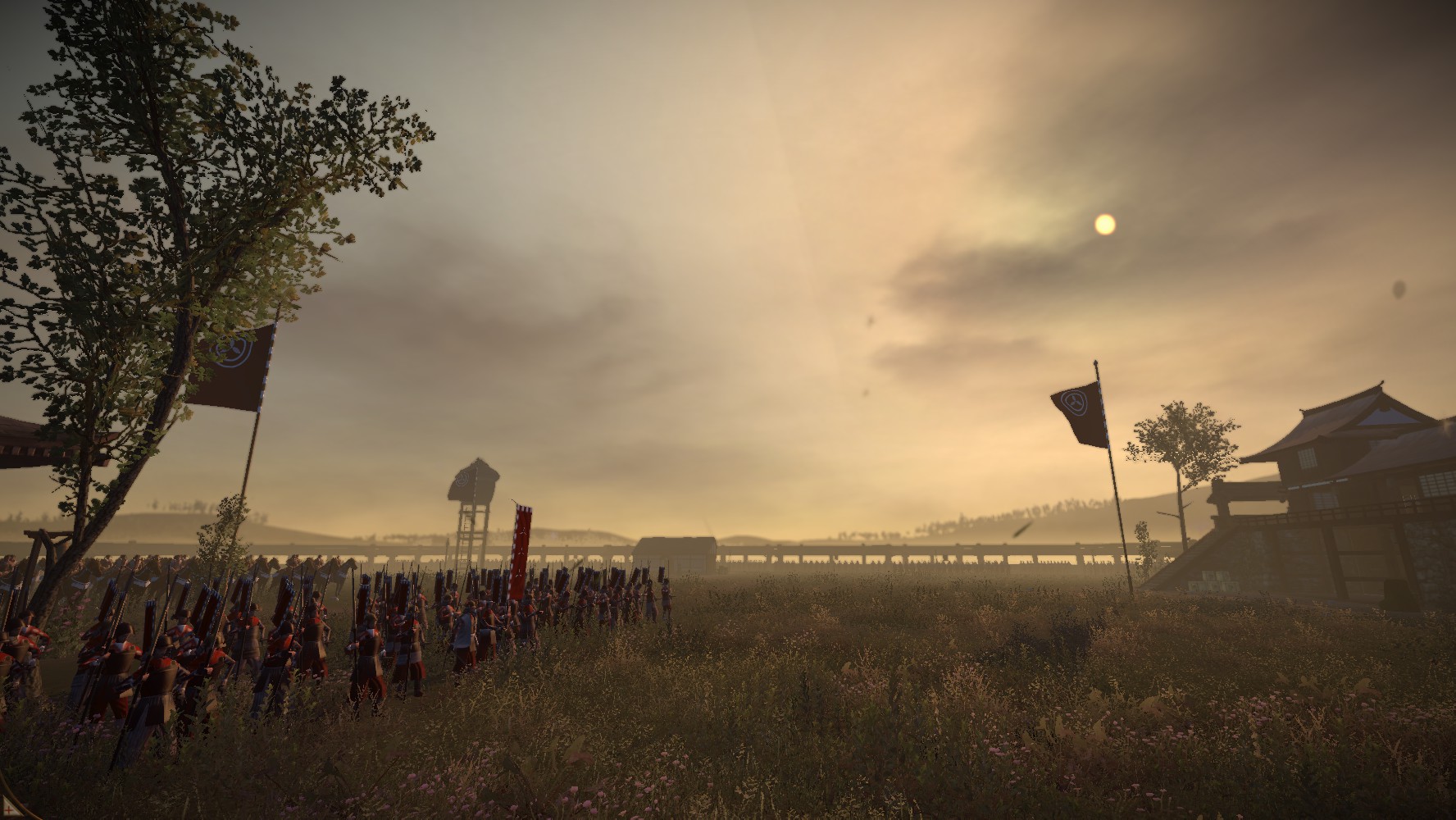
Lastly, I should warn that Wargame’s plethora of units has a downside: I’m sure it would steepen the learning curve for players new to the period. The game’s manual provides brief descriptions of each category of unit, and detailed stats are available in-game. However, short of poring over those, there is precious little guidance as to which tool to use for which job. How would a Leopard 1 fare against that T-80 coming down the road? (Badly.) Is the Challenger or the Chieftain the high-end British tank? (The Challenger.) What’s the difference between the Dragon and TOW anti-tank missiles? (The Dragon is carried by infantry, the more powerful TOW is carried by vehicles.) While surmountable, this could well be an early stumbling block.
Driving into the sunset
At the end of the day, Wargame won’t be all things to all players. For someone who isn’t interested in the period, an offline gamer, or both, my advice would be to wait for a demo, a sale, or perhaps new features in a patch– the campaign is just too taste-dependent, while skirmish is a bit limited. (Update: The new features have come, and Eugen has added comp stomps, which should enhance Wargame’s appeal to non-PvPers.) But for a gamer who is interested in Wargame’s subject – say, someone who grew up playing Gunship 2000 and M1 Tank Platoon, or reading books such as Nato and the Defence of the West, Red Storm Rising and Jane’s Modern Tanks – and who enjoys multiplayer, this will be a dream come true. Highly recommended to the latter, and a candidate for Game of the Year.
* This mission placed me in command of an American force stuck behind enemy lines, low on fuel and ammo, and reliant on captured Soviet supply depots. Very cool concept, but wearyingly implemented.
You can buy Wargame: European Escalation from, amongst other vendors, Amazon US and Gamersgate.
We hope you enjoyed this post! To quickly find this post, and our other reviews, click the “reviews” tab at the top of this page.
Time spent with the game: I estimate 20-25 hours. Steam says almost 50 hours, but this includes a lot of time away from the computer. Meanwhile, the game’s figure of 18-plus hours seems to underestimate time spent in single-player, checking unit stats, etc.
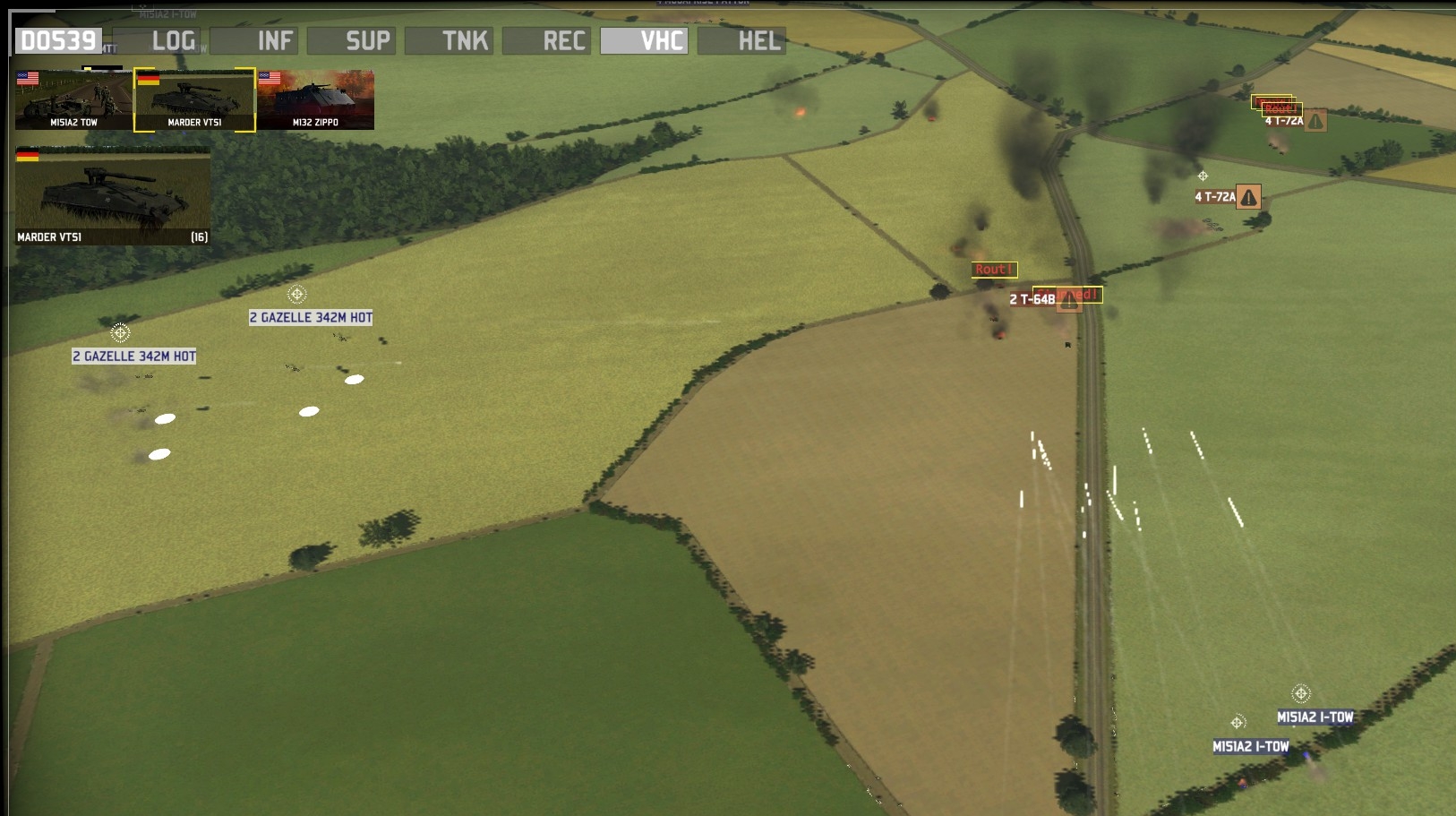
What I have played: A lot of unranked multiplayer games (mostly team games – 2v2, 3v 3, 4v4), one ranked 1v1 multiplayer battle, a fair number of skirmish games, the first campaign (5 campaign missions out of 22 total). This has mostly been as Nato.
What I haven’t played: The remaining campaign missions; the Warsaw Pact (much).
With its promise of firearms, ironclads, and railroads, I was eager to leap into Fall of the Samurai, the nineteenth century-themed expansion to Shogun 2. After getting ~70-80 turns (up to 1867) in my abortive first campaign on “hard” difficulty, starting a second hard campaign, and then reaching the mid/late game (1866) of a third campaign on “normal” (all three times as the Nagaoka clan), here are my early thoughts:
I like the balance between firearm and traditional units. At first, cheap spear levies should remain the core of any army – early muskets are inaccurate and slow-firing, which makes levy musketeers better suited to manning fortress walls than to the open field. However, it doesn’t take long (~12 turns) to unlock modern rifles, which shoot much faster and more accurately than the muskets. Train up a decent force of riflemen (again, this doesn’t take long; they’re not too expensive, and they only take a single turn to recruit), and you can safely relegate the spearmen to anti-cavalry support or castle wall fodder. And not only does better technology unlock new units, it also grants bonuses to the basic ones, so those basic riflemen remain useful later on. In my first game, it was a delight to give a whole army of charging samurai a lesson in modern warfare.
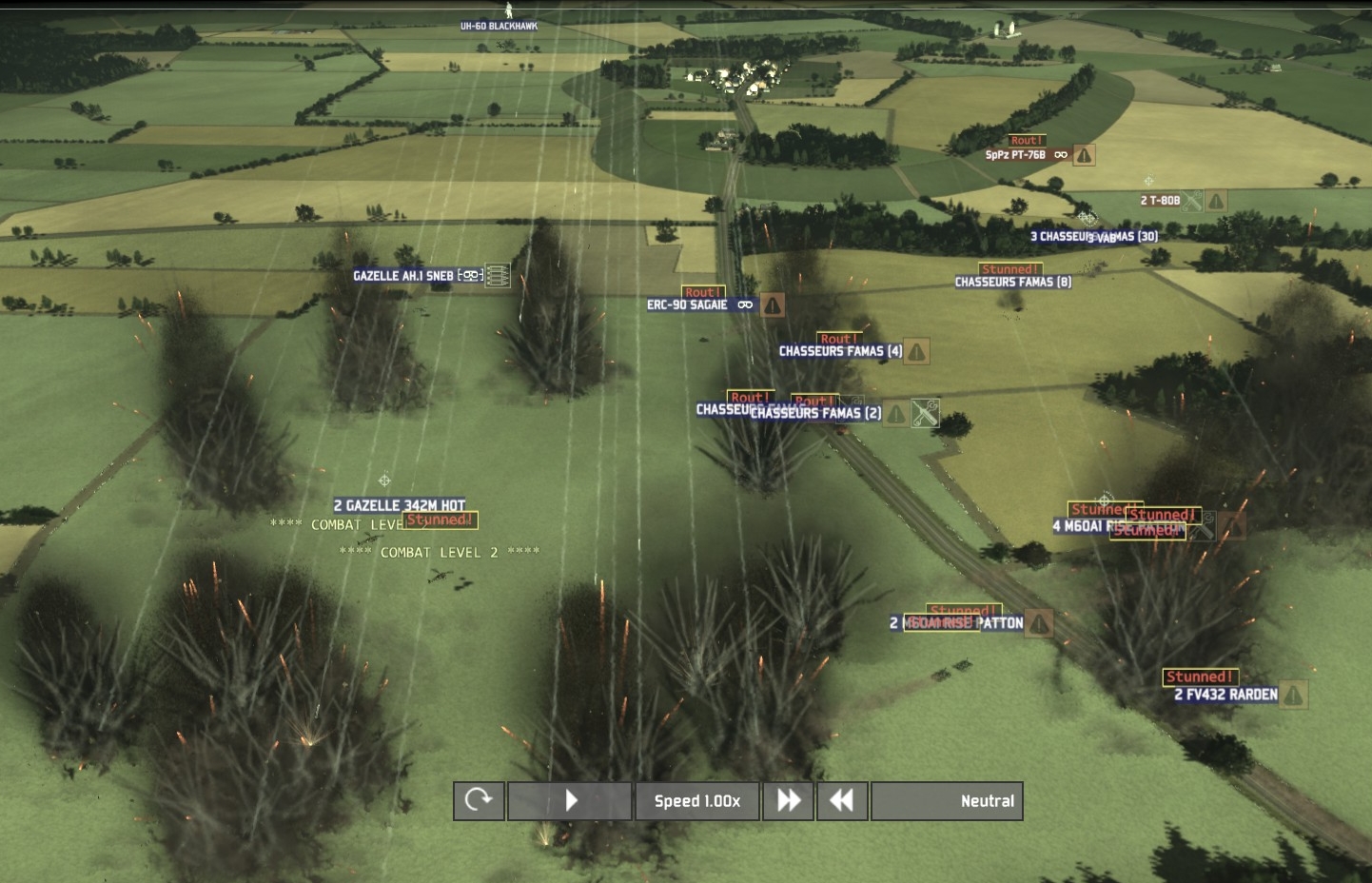
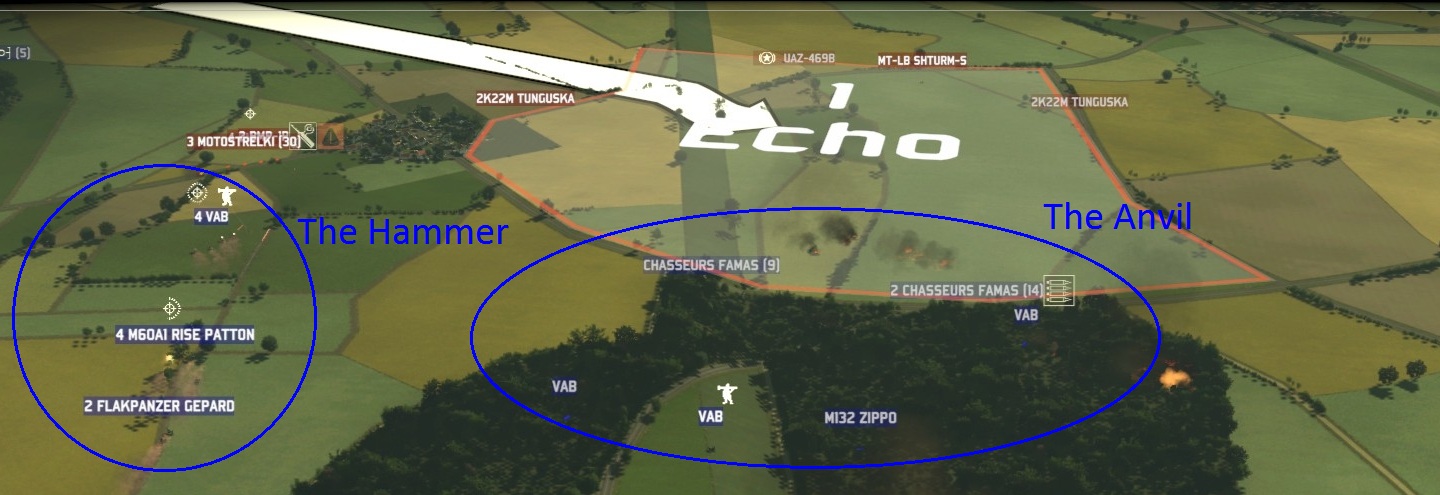
Fortress assaults are even more lethal, due to the ubiquity of guns. Against well-defended castles, artillery seems to be essential.
I have yet to get the hang of naval warfare. Unlike Empire and Napoleon: Total War, all the ships are steam-powered, so the wind doesn’t play as big a role as it did in those games. For now, it seems to be a matter of bringing the most (and the most technologically advanced) cannon, engaging broadside to broadside, and praying one of your ships doesn’t blow up to a lucky hit. I have not yet unlocked the high-end naval units (ironclads and torpedo boats), so these might shake up the equation.
Naval bombardments are cool without unbalancing the game. If a land battle takes place near a friendly fleet, you can call in up to two barrages. While powerful, they have a very long cooldown and aren’t especially precise, so navies aren’t the “I win” button.
Money is harder to come by. There are no more trade nodes, so to obtain goods for export (silk, tea, etc), you have to seize the provinces where they’re produced. As such, resource-producing provinces are now far more valuable than in the base game. This is even more pronounced when playing on “hard” difficulty, in which everything is more expensive.
On “hard”, the AI loves to dogpile you – especially if you’re at war with its allies. You do get significant diplomatic bonuses with clans that share your allegiance (pro-shogun or pro-imperial), but that, by itself, is no guarantee of your safety. In this regard, Fall feels similar to the previous expansion pack, Rise of the Samurai.
The in-battle voices have deteriorated. No more Japanese voice acting from your units, no more “yari ashigaru de gozaimasu!”, and no more advisor yelling, “shameful display!” Instead units acknowledge orders in accented English a la Rome: Total War, and the battle commentary now comes from a hammy, booming-voiced, all-American sort (“The enemies’ allies run like he-eathens from a preacher, sir!”). I liked things better in the original. Still, this is a relatively minor problem for me.
The “hard” difficulty setting lives up to its name – after a while, I found it more frustrating than fun. “Hard equates to more demands on less money (costlier buildings + more enemy armies to fight), and the overall difficulty is closer to Rise of the Samurai than to the base game. Unless you’re a lot better than me at Shogun 2, I don’t recommend Hard for your first game.
Meanwhile, “normal” turned out to be pretty easy once I hit the midgame. It would be nice if there were a difficulty setting in between. (Of course, realm divide could shake me out of my complacency!)
Apart from the difficulty, though, so far so good. I missed Empire’s gunpowder warfare, and I’m glad to see it back in Shogun’s more polished form. Watch this space for more!
UPDATE: So as of late 1867, I can state that on “normal”, the short campaign is quick enough to finish in a single day. I haven’t finished… yet. But I’m two provinces away from fulfilling the victory condition (14 provinces, plus Kyoto and Edo in the hands of Shogunate-aligned clans), and standing on the cusp of realm divide. I could easily have won the game any time in the last hour and a half; I’ve just been holding off so I can unlock the endgame units (Gatling guns!).
UPDATE 2: Went back to an earlier save and won the campaign, on “normal”, in one day! Hurray!
UPDATE 3: Reflecting on my campaigns as Nagaoka, I feel disappointed with Fall. While as noted above, I really like Fall‘s basic building blocks, the difficulty and pacing have prevented my early experiences from becoming the sum of their parts. I’ve described above my problems with the “hard” campaign, and “normal” turned into a pushover once I got past the early game — all the nearby clans were either friendly, too small to be a threat, or both. And since I was playing the short campaign, realm divide wasn’t a serious danger: this only kicked in after I took 13 provinces, and only needed one province more to win! (The victory thresholds, at 14 provinces for the short campaign and 26 for the long, are far lower than for the base game.) However, I’m willing to give Fall another chance: it’s possible I was (A) unlucky*, (B) playing a less fun faction, (C) unwise to play a short campaign, (D) not experienced enough for my first, “hard” campaign (when I was still learning how Fall worked) and too experienced for the later, “normal” campaign, or (E) some/all of the above. I look forward to reporting back once I’ve tried another campaign.
I wish I were as good as this guy: Zhuge Liang, the original strategist
It’s pretty clichéd to describe inventions – military, cybersecurity, maybe even medicine – as a race between offence and defence: I invent a weapon, you invent armour, I invent a bigger weapon. But that could almost sum up how my approach to Wargame has evolved. It’s not just that I’ve learned how to counter unit X, or how best to use unit Y. My overall strategy, the way I look at a map and lay my plans, has shifted: first from overly-aggressive to overly-defensive, and now hopefully to a happy medium.
This is how I learned.
1. Never believe everything you read on the internet
The "I win" button?
Internet forum threads made multiplayer mode sound so easy. Most players are careless, the forumites boasted. They don’t guard their backs with anti-aircraft units, they’re heedless of the dangers that can lurk in forests. All I had to do was:
i. Fly over a few Black Hawks, loaded with the toughest troops money can buy.
ii. Drop off my men in forests near enemy HQs.
iii. Laugh as they roll over unsuspecting targets.
Why learn the intricacies of commanding tanks, infantry, artillery? Chop off the head (eliminate all of a team’s command units) and the body dies (that team loses the game). It worked against the computer, when I tried it once! The war would be over by Christmas!
As it turned out, most players were not that careless. Anti-aircraft fire swatted away helicopters that flew too close, and a few tanks or flamethrowers could usually swat away commando raids. Meanwhile, I found myself regularly outplayed in the nuts-and-bolts ground war.
2. The art of defence; or, David vs Goliath
Ambush by anti-tank missile team
Out went the tactical gimmicks, which sounded so good on paper and were so easily countered by simple precautions. In came a focus on learning the basics of the game – down to defending against frontal assaults. Since I usually play Nato, this meant “how not to be overrun by cheap, powerful, abundant Eastern Bloc tanks.”
This was when I learned the value of cheap anti-tank missiles, carried by infantry (as in the above screenshot), or as in the screenshot below, jeeps and French Gazelle helicopters.
How to stop unsupported tanks
Cost of a jeep with an I-TOW missile launcher: 25 deployment points
Cost of a Gazelle with HOT missiles: 45 points
Cost of a high-end Soviet tank, such as those they demolished: 60 to 110 points
Satisfaction of gutting the enemy assault: Priceless
True, in this case, the opposing team had played exceptionally poorly, driving tanks down a highway with no recon; no anti-aircraft support (this had been left in the next village over, where it was completely useless); and inaccurate and mis-targeted artillery. But a victory was a victory!
3. The last argument of kings
Find good defensive position, dig in with infantry and jeeps with anti-tank missiles, support with other units as needed, massacre attackers. Win?
Fighting in the shade
The above screenshot shows my troops being rocketed by one of the most powerful artillery units in the game, the Soviet Smerch. It wasn’t quite as devastating as it looks: my column was on the move, and many of my units (e.g. the tanks) were armoured. But infantry and jeeps with anti-tank missiles are not armoured. And if they’re in a defensive position – i.e. not moving – that leaves them frightfully vulnerable to well-aimed artillery. Guess what I encountered more and more often?
Clearly, finding one spot to turtle was not the answer.
4. The art of attack; or, know thy battlespace
Around the same time I realised I was placing too much emphasis on defence and not enough on manoeuvre, I watched a Youtube replay of a match between top-10 players. The contrast could not have been more stark. These guys made full use of the large map: they spread out their troops, they sent out raiding parties, they tried to flank each other using side roads, they were proactive.
Back to the tactical drawing board I went. It was time I rediscovered the offensive – or, to be precise, time I learned how to balance offence and defence. Time I moved freely instead of pinning myself down; time I learned to strike along one front while defending along another. And to my frequent joy, I discovered that while most players know to watch their backs against aircraft, only the better ones seem to watch their flanks.
A successful attack
The transition wasn’t instant. In my first ranked battle, I crushed my opponent with a small but powerful flanking force of tanks supported by an infantry-heavy anvil*. Soon afterwards, in the exact same forest on the exact same map, I focused too much on the anvil only to have the enemy blast it to bits. One match exemplified this – I pushed ahead with scouts, realised the other team had left their entire flank open, and bulldozed their artillery – and while our team lost by a hair, we might just have won if I’d brought more tanks (good on attack and defence) and fewer infantry (best on defence).
But the trend was there. And it reached its most satisfying point in the last match I played, the source of that Smerch screenshot above. The other team brought enough artillery to blot out the sun, enough to wipe me out if I’d turtled.
I did not turtle.
A target-rich environment: enemy artillery & supply depots
When that Smerch barrage came in, my armoured column was already halfway to the other team’s artillery. My soldiers regrouped; drove on. And once they arrived, revenge was sweet. The battle wasn’t the pushover I’d hoped: the other team called in more and more tanks to defend. But slowly, surely, it went my way. When my first wave went up in flames, my second wave picked up the slack. The enemy reinforcements slowed to a trickle. And my third wave started rolling in. Our team’s score had been well behind the enemy; now it leapt up and up. We fired the last shot, and when the match finished, we were ahead in points.
The game called it a draw, but I know who really won.
* I won despite accidentally buying the wrong infantry unit to support my tanks in the “hammer”!
1. Lack of male heirs. No sons, no other applicable males, and no time to rush through that female inheritance law.
2. Failure to read the fine print. Matrilinear. Important word. If your heir is female, it’s the single most important word in the English language after “tea”. It means that her offspring will inherit her dynasty name, i.e. you can play as them. Marry your little princess off in a standard marriage – in which she joins her husband’s family – and it’s the end of your line, no matter how many bratlings she produces.
3. Mass death. So you’ve done your duty and provided for the succession. Then the plague/Mongols/assassins/tournament come to town, and before you know it, people are dropping dead left, right and centre due to freak bad luck.
Too Many Relatives
4. Ill-considered gavelkind. You succeed, overwhelmingly. Title after title falls into your sweaty little hands. Heirs pose no problem: you’ve got sons and to spare. Then, your character dies. Suddenly your realm fractures – and you discover that under gavelkind law, the eldest heir only receives a single “copy” of the highest level title. All “duplicates” at that level will be handed out to the younger heirs. Where before you were the King of England, Wales, Scotland and Ireland, you are now the King of England, with neighbourly Kings of Scotland, Wales, and Ireland. Back to square 1; say hello to fraternal in-fighting, and freshly predatory neighbours.
5. Uncles. Your new character is a 2-year-old with the ‘drooling moron’ trait. He’s rated at 0 in every stat. Even his twin sister hates him. Thanks to dear Daddy’s martial exploits, the treasury is empty, the armies are dead, and family authority shaky. Along comes dear uncle with his shiny blood claim, and it all goes like the proverbial fairytale. In no time at all moron-boy is reduced to count of a single African province which provides no income and no levies thanks to being recently conquered. Did I mention kindly Uncle has a different dynasty name to his darling nephew? Control will not pass to him should Tiny Tim have a tragic accident…
Own Petard, Hoist By
6. Wives. So your wife hates you, you’ve got no children, and she’s just gained the ambition to become your spymaster? She’s got a good intrigue score, and fulfilling her ambition will make her happy. What’s the worst that could happen? This could be the turning point of your relationship, the start of many years’ happy contentment and, more importantly, the source of a child or three. Two months later you notice your wine tastes funny…
7. Wives II: The Revenge. After 20 years of marriage you still haven’t got a child. A beautiful young courtier looks at you in a certain way, and something pops up. No, not that, thank you! An event offering you the chance of an affair. The tooltip says you have a chance at producing a bastard child! You click “Woohoo!” as quickly as your mouse will allow, brain already alight with plans for legitimising your bastard and using it as an heir. Score – one baby on the way! Then you die. Belatedly you recall that your wife has a high intrigue rating and a jealous disposition. Since it’s a mite difficult to rule a kingdom whilst in the womb, game over.
8. Being too liberal. Your son and heir is now a grown man. Capable of making his own decisions. Right? You give him some titles and off he goes, leaving your court to establish his own and begin building his prestige. Wait – you did marry him off before you let him go, right? You didn’t?! Now he’s free to choose his own wife. Next thing you know, you’re pasting a fixed smile on your face, shaking the hand of your chaste, octogenarian daughter-in-law and wondering how much it will cost to get her removed. Then you notice your son’s spymaster is way better than yours, and you’ve no chance of killing her. Oh well, at that age nature will soon take its course, right? Amazingly, this elderly lady out-lives both her husband and her father-in-law.
9. Marriage. You marry your daughter to the son of a powerful neighbour. It’s all good, right? You’ve got a powerful ally, and the next generation on that throne will have your blood – oh crap! Your blood! Thanks to your current laws, that means a claim on your titles, and their army is like ten times bigger than yours! Kill the happy couple? It’s the only hope! Assassin fail, assassin fail, assassin fail, bankruptcy, discovery, pissed off marriage-ally, train headed down tunnel right at your face.
10. Getting too clever for your own good. Family tree grown a bit messy? Too many people got blood links and claims to your shiny stuff? The future could get scary. Why not tidy things up a little with the aid of your good friend, Mr Assassin? Yay! Now the tree is all nice and neat, like a pretty little bonsai. Then your heir discovers he prefers other men, your daughter-in-law takes to religion in a hardcore way, and your sole grandkid dies of the plague. Whoops!
Live By The Sword…
11. Pope-assisted suicide. So you’re the lord of a tiny realm with an income of three goats and a sheep per year? Life’s sweet – in another 70 years you will be able to afford that rickety wooden palisade castle upgrade which you’ve been eyeing for the last 2 generations! Then along comes Il Papa with his talk of glory, religious duty, and sweet, sweet loot, and off you rush on Crusade, eyes a-gleam at the thought of funding a new chicken coop with liberated gold. Only to realise that one province target has a whole alliance network, meaning half of the Muslim universe is now coming to visit you at home. Peace? They don’t want peace – they want your chickens, your palisade fund, and your sole title! Meanwhile, the rest of Christendom wisely decided to sit this one out.
12. Ambitious AI lords. When your liege, King Suicide McDeath III, declares war on a more powerful kingdom for the twentieth time that decade, you’d better find a get-out clause in that vassalage-contract, or you’re going down in a flame of bankruptcy, rebels, stress, battle wounds, and angry mercenaries.
13. HRE. That’s Holy Roman Empire for those of you who don’t have the game. You are a minor lord. You’re outside the HRE. The HRE think that by rights you should be part of it. They declare war. Approximately 100,000,000,000 soldiers are now headed your way, supported by the wealth of half Europe. Your army of 11 people and a pig stand no chance! Swiftly, you send a grovelling peace offer. Denied! They want your title, without you attached. And since you can’t give away your last title, that means…
14. Pagans. Hi, I’m the King of Poland. My realm is compact, and pretty, and peaceful, and rich, and it’s got some nice armies too. Life is happy! Oh look, one of my neighbours is a one-province pagan dude with no allies. He will be easy to crush. Based on the number of soldiers I get from my provinces, he should have around 250 soldiers. War time! Let’s loot – er, convert the savages. Argh! Where did they all come from, the thousands of angry pagans, with the anger and the pointy weapons, and did I mention that there’s thousands of them!? Gah! My armies are all dead without so much as denting the hordes! Now all my other pagan neighbours are declaring war on me too! God? I need some help spreading Your word (and not dying) here. God? Are You there? God? God!?
Being a small collection of ways to win:
1. Survive over 300 years and reach the end date. You’ll get shown your score, and probably be told you did worse than various historical dynasties.
2. Lose.
3. I mean it: lose.
4. Losing is far more fun than building a huge kingdom and holding it until 1453. Thus, winning is losing by another name. Losing, now that’s a whole pile of win!
Rachel McFadden (aka frogbeastegg) has been gaming since she discovered the original Prince of Persia on the IBM 286sx PC. Whilst strategy and RPGs are her preferred genres, she is a multiplatform gamer who will play almost anything provided it isn’t sport, car racing, or multiplayer only. Under the frogbeastegg name Rachel has written guides for many of the Total War series, various AARs for strategy games, and a few pieces of fiction. When not engaged in reminding various virtual populaces that she is in fact the Supreme Ruler of the Universe and the One True Hero, Rachel can typically be found with her nose in a book.
Note: the above comments are based on a review copy supplied by the game’s developer, Paradox Interactive.
Dragonfly Falling, Blood of the Mantis, and Salute the Dark are respectively books 2-4 in Adrian Tchaikovsky’s Shadows of the Apt series, and the quickest way for me to describe them would be “more of the same”. Together with book 1, they constitute a distinct story arc within the overarching series, and as #2-#4 in particular feel like one giant novel, I have chosen to review them in a group. (You can find my review of book 1, Empire in Black and Gold, here.)
These books are “more of the same” in a literal sense: they follow the same protagonists along the same story arc begun in Empire in Black and Gold. They are epic fantasies, and they offer an imaginative world with some spectacular set-pieces. And they represent an improvement over the first book in one small but noticeable way – no more head-hopping!
Unfortunately, they also offer too much of the same in one key way. Where Empire’s plot was strong and tightly focused, its sequels introduce a common genre problem: sprawl. Over these books, the characters fan out across the world, meeting new faces, discovering new locations, and getting into subplot… after subplot… after subplot. I didn’t care for all of these, but I’m willing to concede that’s a matter of taste; besides, I loved one particular subplot, almost Miyazaki-like in its evocation of a brotherhood of aviators. The problem isn’t so much the quality of the subplots as their quantity: they slow down the story to a crawl, culminating in a weak book 3/early book 4. It doesn’t help that the sequels fall into another genre trap, noticeable character plot armour, that the first book cleverly sidestepped.
In the second half of book 4, though, Tchaikovsky rediscovers his muse.The subplots come together, the action speeds up, the story arcs incubating since book 2 finally come to fruition, and the plot armour vanishes. And this is what redeems these books. At that magic moment in book 4, I went from dissatisfied to newly enthralled, and that momentum carried me through to the end.
Ultimately, these books aren’t quite what I’d hoped: compared to his debut, I think Tchaikovsky took two steps forward and one big step, labelled “PACING”, back. Nonetheless, they finish well enough to be worth a look for people who enjoyed book 1. I do plan to check out the next book at some stage, and I hope Tchaikovsky learned his lessons.