The World That May Have Been, a Europa Universalis IV Let’s Play – Part 4: The Death and Rebirth of the British Empire

This entry is part 6 of 12 in the series Europa Universalis IV

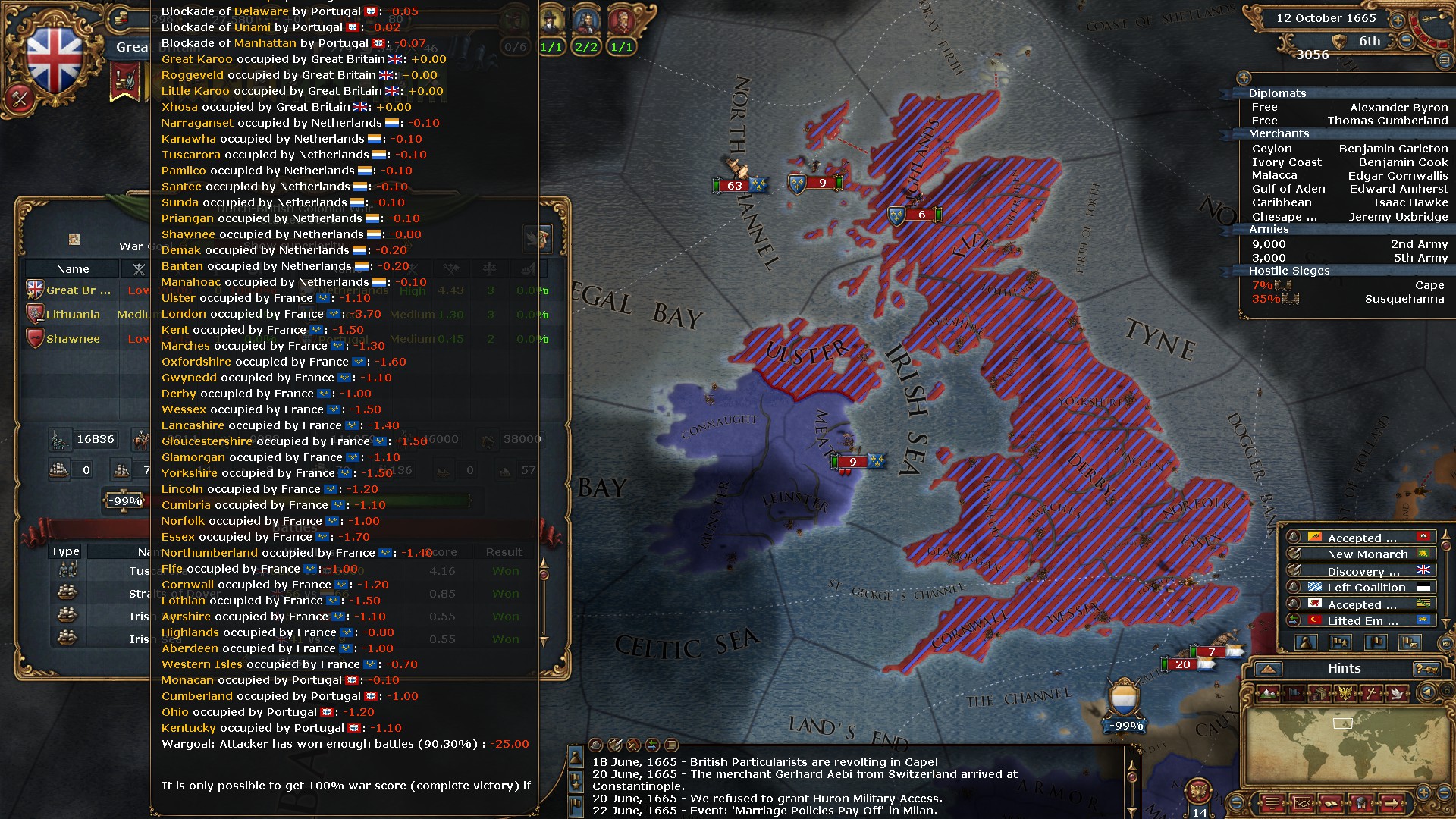
EU4_Pt4_01_FranceoccupiesGB


In 1665, Great Britain lay in ruins, her navy and trade fleets sunk, her cities occupied by French soldiers. It was the culmination of a series of unsuccessful wars waged throughout the 17th century, and as His Britannic Majesty’s hangdog envoys filed into the negotiating room, it was in doubt whether Britain would even survive. Previous wars had seen Wales, Cornwall, Northumberland lost, albeit temporarily. Could her victorious enemies even force her to give up Scotland?


The troubles had begun in the year 1600, when Great Britain had barely found its feet after the last century’s Wars of Religion. Decades earlier, Catholic rebels had not just wrested Ireland from the British crown; they had pledged their fealty to France. For Britain’s king, Octavius I, this was intolerable. His plan seemed foolproof: the British fleet would keep the French bottled up in harbour, Britain’s Austrian and Spanish allies would keep the French army busy on the European mainland, and Britain’s own modest army could seize an undefended Ireland. What could go wrong?


As it turned out, plenty. Distracted by rivals closer to home, the Austrians soon signed peace with France. The French demolished the Spanish army, and occupied Spain. Britain in turn occupied Ireland, but compared to the victories the French had racked up on the continent, that mattered little. The war settled into stalemate – the French fleet unable to match the British, the British army unable to match the French – and it could have dragged on forever.


(If this were a normal war Spain would have separately capitulated, but Spain and I were in a coalition war, in which individual coalition members can’t sign separate peace treaties. This rule seems a little odd – after all, if Napoleon could pick off coalition members, why can’t we?)
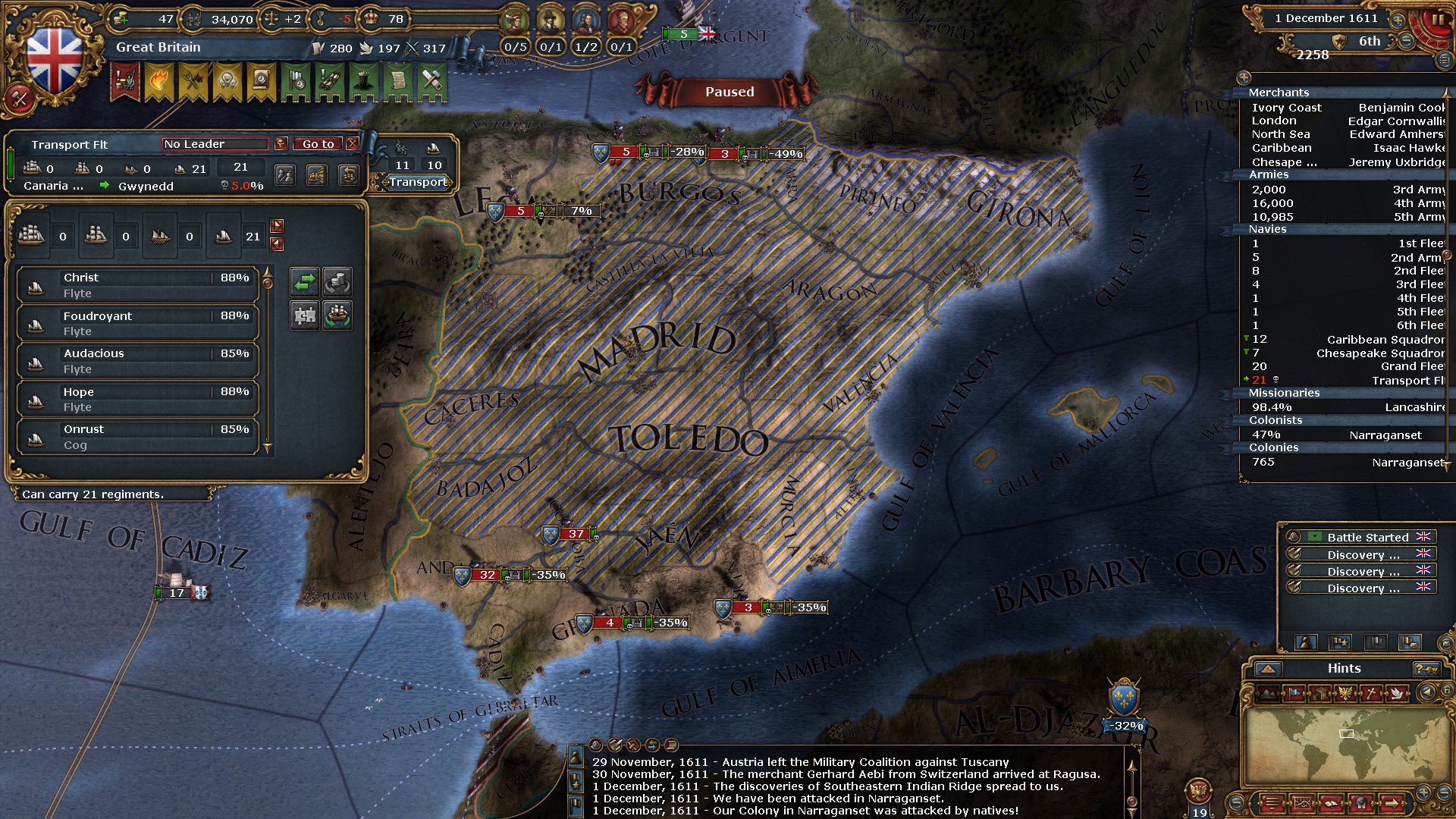
 

EU4_Pt4_02_FranceoccupiesSpain

Read more

Clippings – 4 September 2013

  1. Total War: Rome 2 is now out; here is a roundup of the early reviews. The reports of bugs and AI flaws are disheartening, especially after the polished Shogun 2, but I haven’t picked up the game yet and hence, haven’t been able to judge for myself. If you’ve played it, what do you think?
  2. The role of dopamine in how we react to games.
  3. An interesting review of Wii U game Pikmin 3, which characterises it as an anti-war exercise.

Musical Monday: “The Stonemasons” (Europa Universalis IV), composed by Andreas Waldetoft

This week’s song, which I’m pretty sure is a remix of the Europa Universalis III theme, is perhaps my favourite from EU4. There is war in the game, and there was war in this period in history – lots of it! – but there was also trade, culture, and splendour, and this song feels like an expression of the latter. Enjoy!

Read more

Clippings — 28 August 2013

My playthroughs of Europa Universalis IV and Ni no Kuni continue! The good news is, no more rebel problems in EU4. The bad news is, well, let’s just say this rematch with France is not going as well as I would have liked. Today’s news relates to three of my favourite gaming topics — strategy, JRPGs, and soundtracks:

  1. Ubisoft has announced Child of Light, a sidescrolling JRPG partly inspired by Final Fantasy VI! This will be one to watch.
  2. IGN has a good preview of XCOM: Enemy Within.
  3. Sid Meier’s latest game, iOS strategy title Ace Patrol, is now out on PC (Steam, Green Man Gaming, etc). Here is  a good retrospective on Meier’s career from several months ago.
  4. I’m keeping an eye on this Kickstarter campaign for Video Games Live: Level 3,  a proposed album of orchestral video game music.

The World that May Have Been, a Europa Universalis IV Let’s Play — Part 3: If You Can’t Beat Them…

This entry is part 5 of 12 in the series Europa Universalis IV

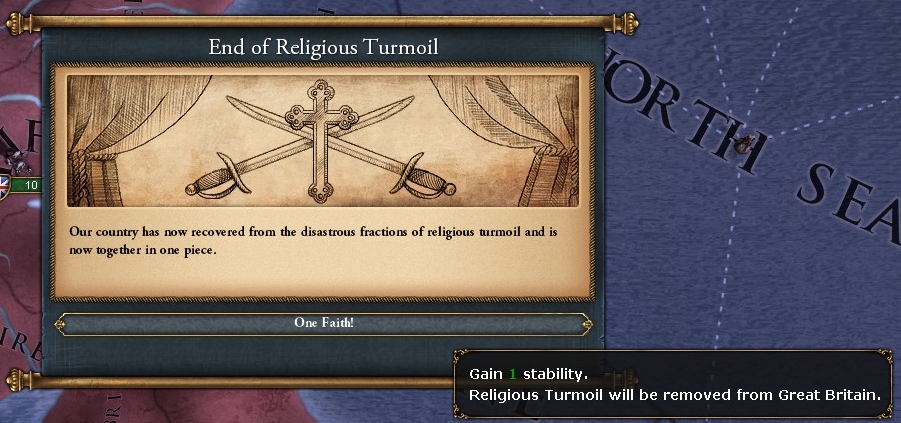
In 1584, under siege by French-backed Catholic rebels, King Augustus I of Great Britain renounced the Protestant faith. It was a last resort; the British treasury was empty, the army shattered, the realm ruined – and the rebels endless. One could almost hear the cackles in Paris as Augustus put his signature to the document reinstating Catholicism as the state religion of Britain; it was the greatest humiliation a British monarch had suffered since the Hundred Years’ War. Well satisfied, the Catholic rebels went home. The British Wars of Religion had come to an end.


eu4_pt2_001_endofreligiousturmoil


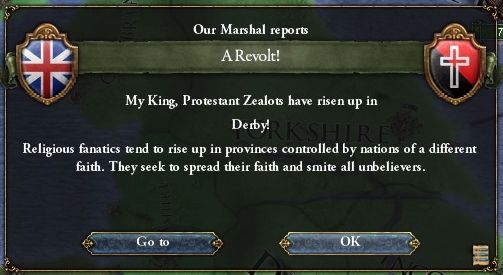
Or had they?


eu4_pt2_002_derbyprotestants

Read more

The World that May Have Been, a Europa Universalis IV Let’s Play — Part 2: The Best of Times, the Worst of Times

This entry is part 4 of 12 in the series Europa Universalis IV

The Navigator Queen


eu4_pt2_001_anne


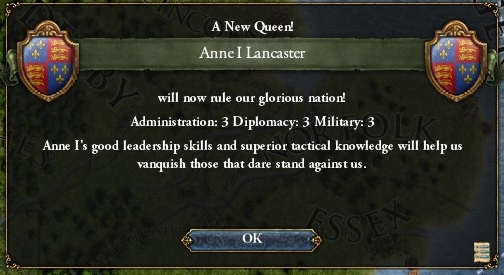
In the summer of 1475, Anne, Queen of England, celebrated the fifth anniversary of her assumption of power from her regency council. They had been five fruitful years; her first act had been to standardise weights and measures throughout the realm. Some of these we still use today. Her second act had been to order the reconquest of Wales and Cornwall, which had broken away after the English defeat in the Hundred Years’ War. These campaigns did not last long: the English army was a pale shadow of what it had been a generation earlier, but it still outnumbered the Welsh and Cornish three to one. Now, as foreign ambassadors filed in to pay their respects, the queen seemed justified in resting on her laurels.


(Anne was a competent though uninspired ruler – she had a 3 in all her stats, out of a maximum of 6. Still, after Henry VI’s solid zeroes, this felt like manna from heaven.)


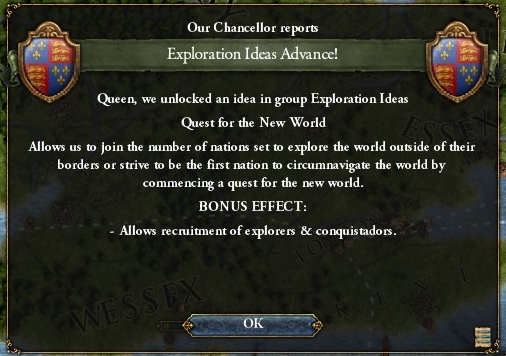
Then, as Anne waited for her next audience to begin, a man tumbled out of a rug. A moment later, he began to speak – very quickly, as the queen’s guards and the bolder courtiers were advancing on him. Apologies for the intrusion, but this was the only way he could think of to gain an audience. His name was Albert Gloucester, navigator and sea captain. He planned to sail west through the Atlantic, and that way reach distant Asia. Would the queen sponsor him?


eu4_pt2_002_quest_for_the_new_world


She would. The next year, in May 1476, Gloucester set sail from the Portuguese-controlled Azores with three ships. He was not heard from until the following January, when his three ships limped back into the Azores, badly damaged, their crews half-dead, starving… and bearing tales of a New World.

Read more

Occult Chronicles Q&A, with Vic Davis

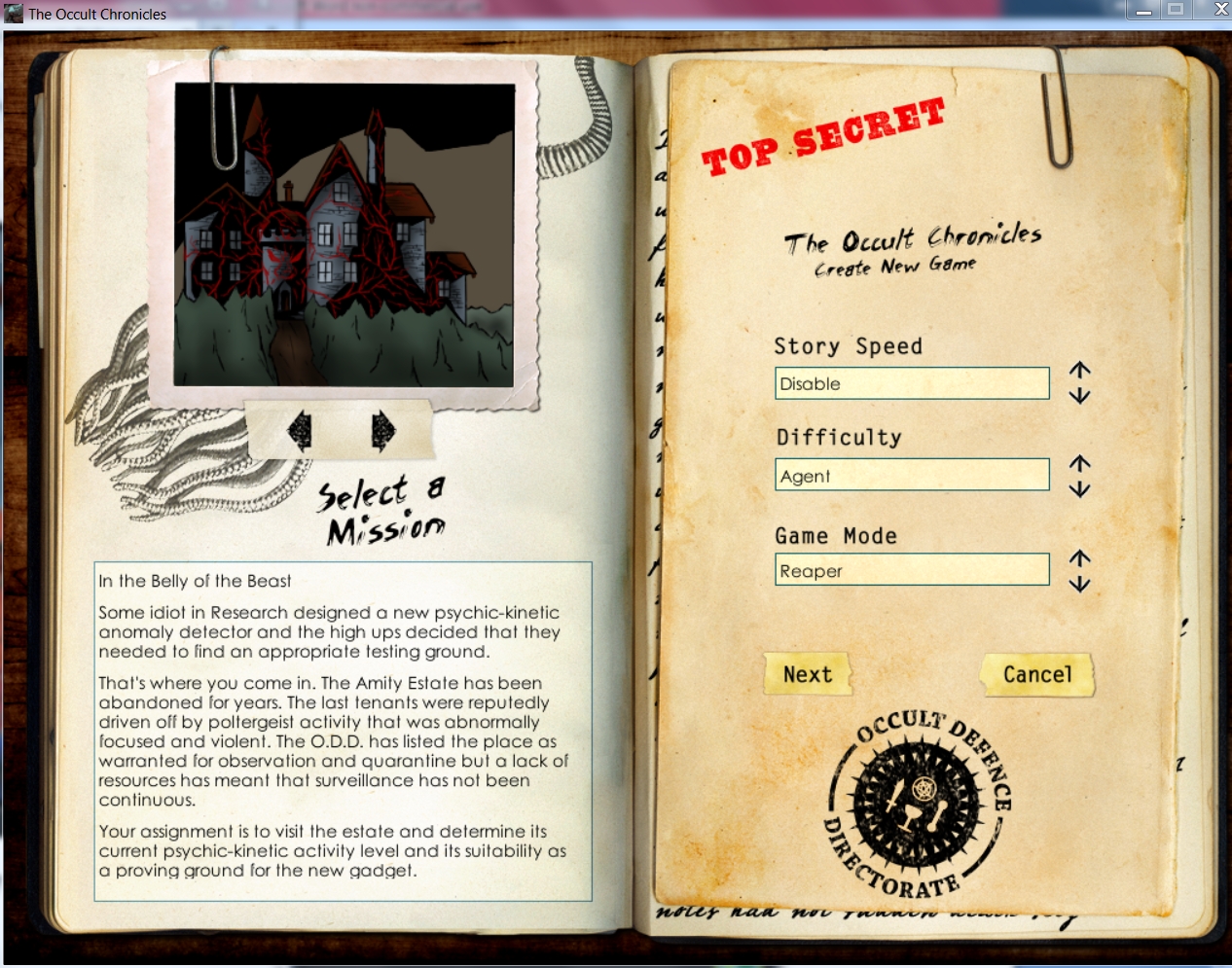
OC Poltergeist Mission


I am very pleased to publish an email interview with Vic Davis, the indie game designer behind Armageddon Empires (one of my favourite strategy games), Solium Infernum, and Six-Gun Saga. Read on for our conversation about Vic’s latest title, roguelike/board game hybrid Occult Chronicles, in which we discuss his inspirations, his lessons learned, the challenges of indie development, and more.


Peter Sahui: Hello Vic – welcome to the site! Occult Chronicles is your fourth game, after Armageddon Empires, Solium Infernum, and Six-Gun Saga. What lessons from your previous games came in handy for this project?

Vic Davis: Well from a technical standpoint I have over a decade of experience with the development environment that I use (Adobe Director).  I’ve also got a huge library of code for doing everything from creating drop down menus to path finding for any AI.  On the design side it has helped a lot to have shipped previous games.  Even though attempting a rogue like is a new direction for me, I was able to draw upon the experience that I had gained while designing turn based strategy games.  In the end my new game is really just an adventure strategy game so it shares a lot of the same elements.


Peter: Compared to Armageddon Empires, random chance seems to play a much bigger role in Occult Chronicles. What made you emphasise luck, and how did you balance it?

Vic: Yeah, without any of the map or positional elements that most TBS games offer, the conflict resolution elements really pop out to the fore. And Occult Chronicles has a lot of rpg baggage so you have this paradigm of stats/abilities being used to influence some probabilistic outcome matrix.  Calling it luck though is something of a misnomer in my opinion.  Chance plays a big part but I tried to craft a system of mechanics where smart playing could nudge the scales in your direction.  In the Occult Chronicles you need to weigh risk versus reward when you encounter various “challenges” in the game. You are usually given various options that key off of your attributes so it might be better to talk to an encounter rather than attack it.  Similarly, sometimes it’s better to run away or postpone a choice. I do admit that the way I designed the results phase for the game where you basically pick random cards to determine your rewards or penalties for an encounter, does serve to really accentuate the idea that the game is really random.  And I’m not sure random is really bad especially in a rogue like.  It’s something that is demanded for the map generation and figures prominently in many other aspects like what you encounter on a level or whether you hit it.  Coping with the random elements is really supposed to be part of the fun. But then so is dying a lot so go figure.

Read more

Musical Monday: “World Map” (Ni no Kuni), composed by Joe Hisaishi

Besides Europa Universalis IV, I’m also playing Ni no Kuni, a PS3 RPG born from a collaboration between RPG developer Level-5  and legendary anime house Studio Ghibli. It is an utterly gorgeous game, and its music – composed by Ghibli regular Joe Hisaishi and the lesser-known Rei Kondoh – is just as effective at bringing the game’s fairy-tale world to life. Below, I’ve linked the world map theme — enjoy!

Read more

The World that May Have Been, a Europa Universalis IV Let’s Play — Part 1: Never Pick on Someone Your Own Size

This entry is part 3 of 12 in the series Europa Universalis IV

The World that May Have Been


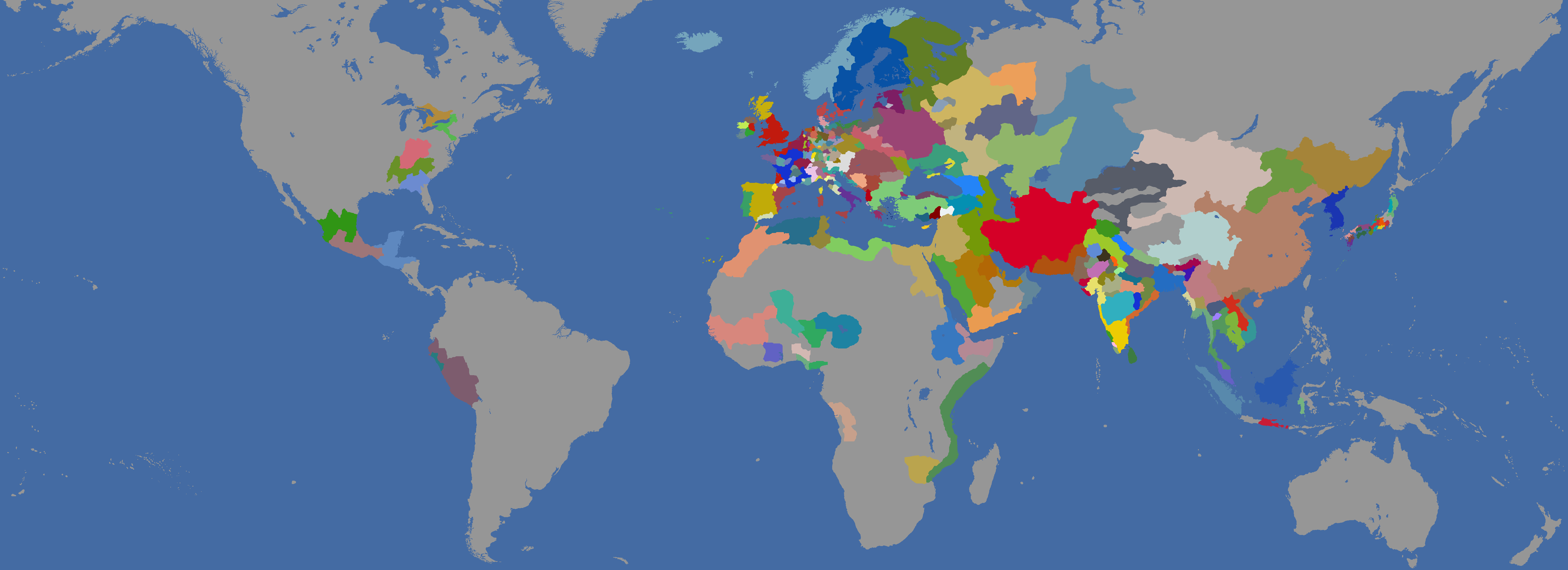
eu4_map_---_1444_11_11_1


Introduction


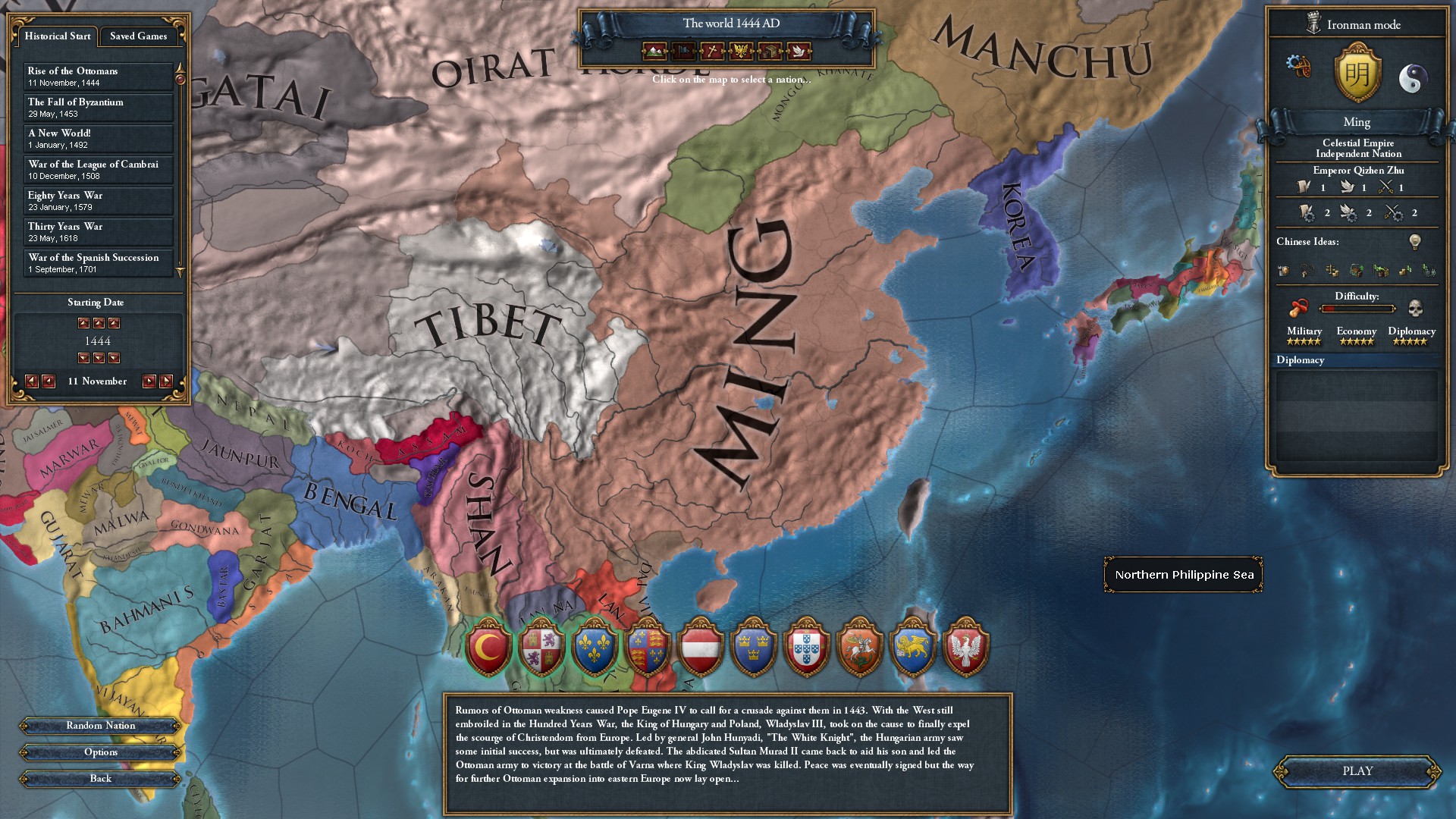
November, 1444. Under the Ming Dynasty, China is the greatest empire in the world:


Eu4 Ming Start


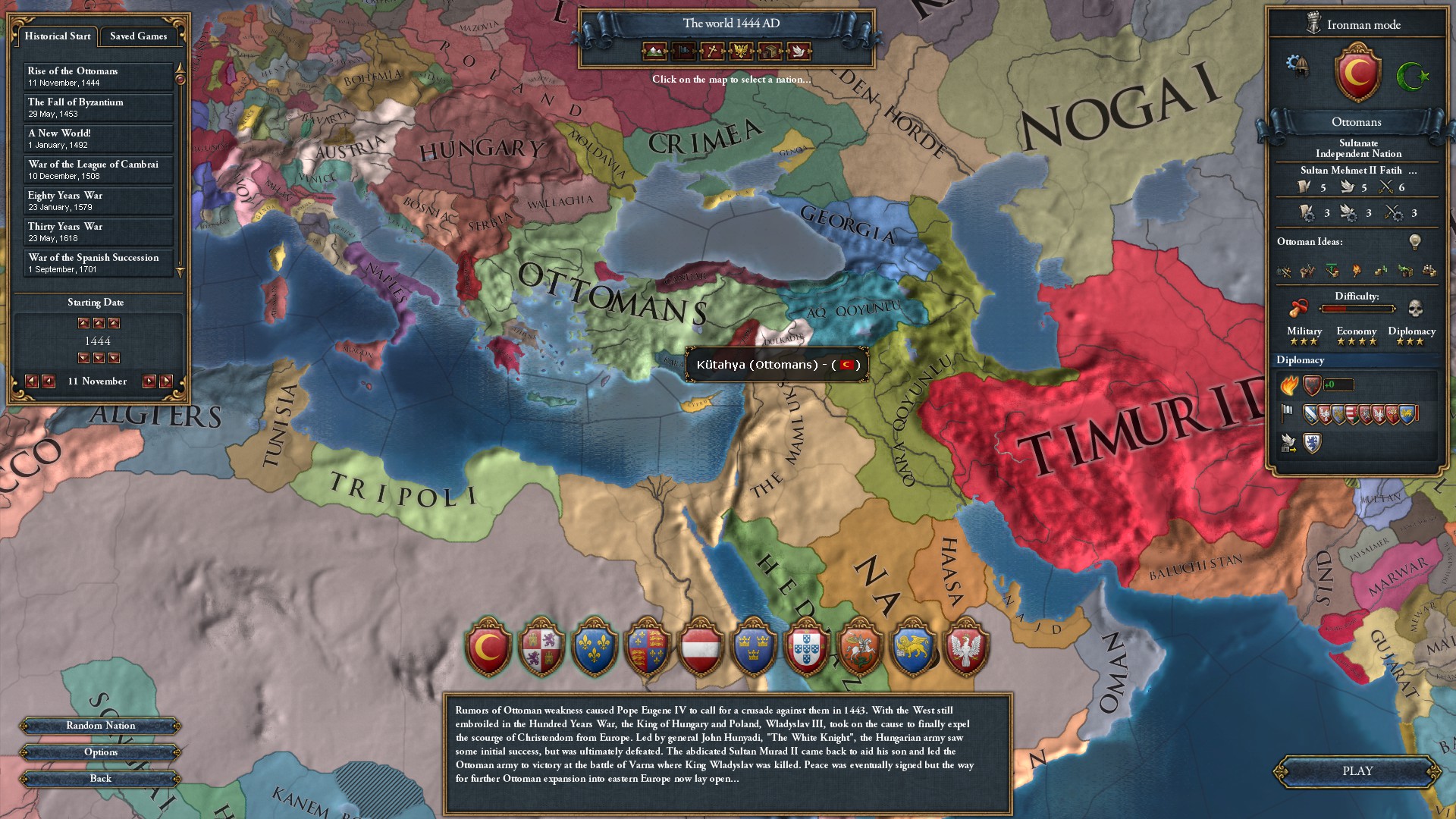
Further west, the rising Ottoman Empire dominates the Middle East and is pushing into eastern Europe:


EU4 Ottoman Start


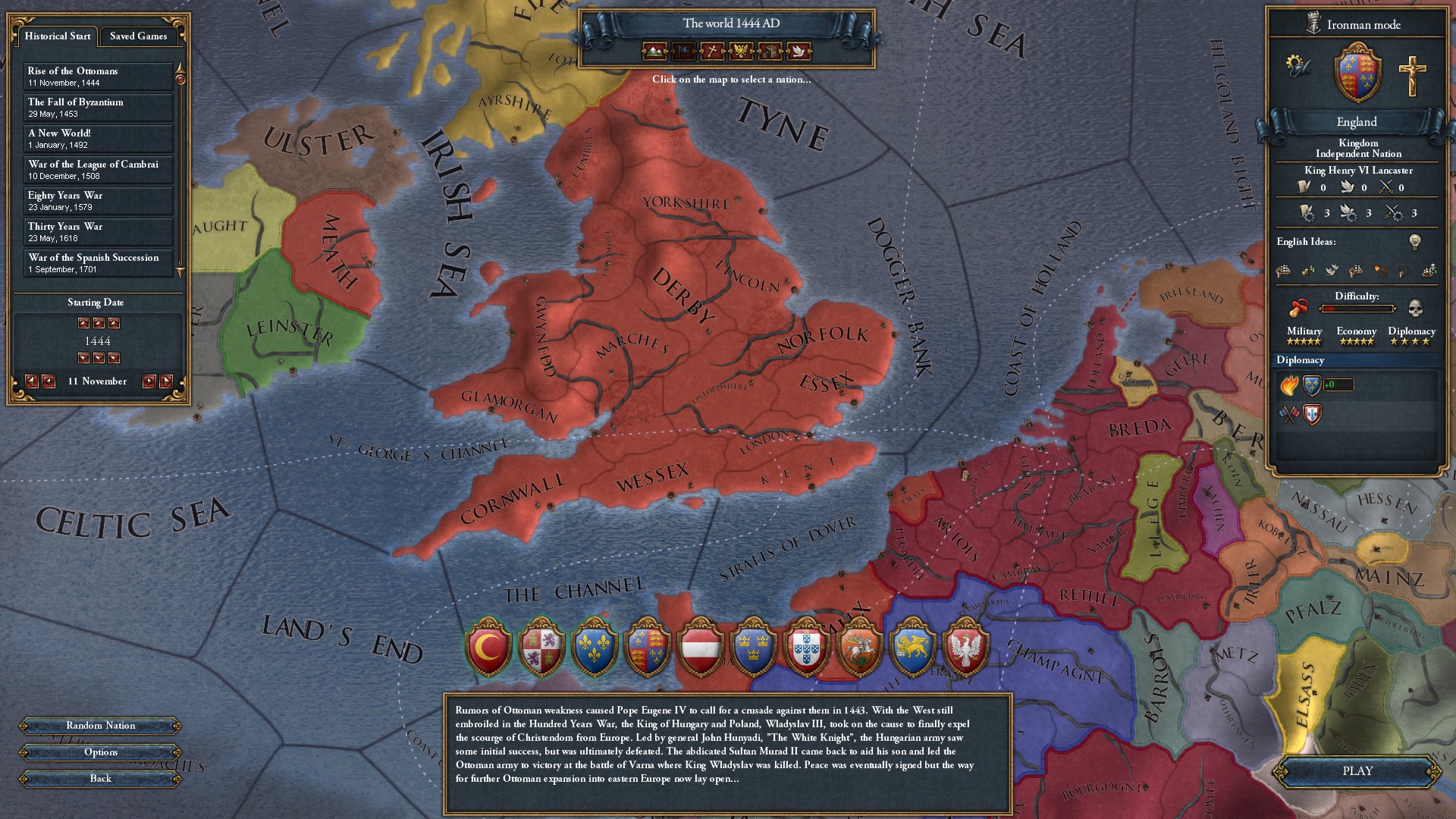
Western Europe is a chaotic patchwork of kingdoms and duchies and free cities:


EU4 England Start


The world system that existed just a century or two ago, which saw Europe and China tenuously connected by the likes of Marco Polo, has fragmented; now Europeans and Asians and Americans carry on in their separate spheres.


The world will not stay this way.


Welcome to my Let’s Play of Europa Universalis IV, a grand strategy game from Paradox Development Studio set during the early modern era of world history. I am playing as England from the earliest possible start date, 1444; I will continue until either the game ends (in the early 19th century) or I stop having fun. In that time, I’ll explore aspects of the game such as exploration, trade, diplomacy, and war. I am also playing Ironman mode, which means I have just the one save slot and can’t abuse save/reload, and I am not using any mods except for one that enlarges the font (uncomfortably small by default). Lastly, I’ll emphasise narrative rather than gameplay, and if I do interject with an “out of universe” comment, I’ll mark it clearly, (like so). Onward to the game!


Part 1: Never Pick on Someone Your Own Size

1444 to 1469

King Henry VI, Queen Anne I


War has many faces, yet one face everywhere: anguish for the victims in the middle of it. – Lauro Martines, Furies: War in Europe 1450-1700


The winter of 1444 saw the Hundred Years’ War between England and France enter its twilight. 17,000 English soldiers huddled in continental garrisons, split between northern and western France; confronting them were over 40,000 French soldiers on the northern front alone. Henry V of England had beaten those odds a generation earlier – but his son, the reigning king in 1444, was no Henry V.

Read more

Tropico 5 announced

Well, this is big news – publisher Kalypso has announced Tropico 5, due out on Xbox 360 and PC in 2014. I was a big fan of Tropico 4, and while that was apparently an evolutionary rather than a revolutionary upgrade over 3, the upcoming 5 sounds like a far more radical change. Promised new features include a dynasty system, progression from the 19th to the 21st centuries, exploration, and trade fleets – the last sounding a bit like the Anno games. Below, I’ve embedded the relevant part of the press release:

Read more

Clippings – 14 August 2013

By the time you read this, Europa Universalis IV – the first in a barrage of releases over August/September should be out. I’m planning something new and special by way of coverage; I think you guys will like it. Links for the day:

Games

  1. A very enjoyable narrative Let’s Play of Alpha Centauri. Here is Edge’s retrospective on the game.
  2. A few months ago I discussed an early beta of an interesting indie game, Papers Please. The full game is now out, and Eurogamer has an excellent review.
  3. Rationalising our video game violence. This sounds a lot like what I did in Bioshock Infinite and especially Dishonored.

Musical Monday: “Leaving for Philadelphia” (John Adams), composed by Rob Lane

With Europa Universalis IV just a few days away, this week I present another song from John Adams, the HBO miniseries based on the career of the second president of the United States. “Leaving for Philadelphia” is a gentler, bittersweet-sounding version of the main theme, which I also encourage you to check out. Enjoy!

Read more

Waking Mars: The Verdict

The beauty of Mars. I took so many cool screenshots, but this was the only one that wasn't a spoiler.
The beauty of Mars. I took so many cool screenshots, but this was the only one that wasn’t a spoiler.

Science fiction, it is said, is the literature of ideas – a genre about going where nobody has gone before. Its iconic emotion is the “sense of wonder”; its iconic heroes are explorers and scientists. Now an indie game, Tiger Style’s Waking Mars, has distilled that spirit into a remarkable ten-hour package.


I wrote my first impressions of Waking Mars last year; you play an astronaut exploring a cave complex beneath Mars. Each area is home to a certain amount of Martian wildlife, and to progress to the next, you must increase the amount of life – the biomass – above a certain threshold. To do this, you flit about on a 2D, side-scrolling map of the area, planting seeds, tending to the newly grown plants, and collecting their secreted seeds to plant elsewhere or feed to animals. (While the game does look like a platformer, I found this is not the case; it emphasises exploration, not reflexes or timing, and in fact I recommend turning the difficulty down so you can focus on its strengths.)


This is a simple premise, but it’s done wonderfully. Over time, you encounter more, and more varied, species, each with their own ecological niche. There’s the Halid, your workhorse throughout the game: a plant with moderate biomass and the ability to produce a profusion of seeds. There are little scurrying creatures, which reproduce after eating Halid seeds; individually their biomass is trivial, but if you can fill a room with them… There are plants that offer high biomass, but that kill other organisms. And that’s just the tip of the iceberg. Along the way, you discover more and more species, more and more of the planet’s mysteries, and I wish I could spoil some of these for you – more than once, they made me think, “wow!”

Read more

Clippings – 8 August 2013

Over the weekend, I narrated and recorded my first ever Let’s Play video, containing about 40 minutes of Skulls of the Shogun gameplay. Then I discovered (a) I hadn’t captured the sound properly, and (b) even at lower resolutions, the video file was too large for my puny connection to upload. Oops. From what I’ve played — a couple of hours’ worth — Skulls is a very promising strategy game, combining elegance (there are only a few decisions each turn, but they are important ones) with charm, an original setting, and funny dialogue. Definitely worth keeping your eye on! Here are today’s links:

Games

  1. A history of Paradox Interactive, with some fascinating anecdotes. Did you know that in one week, Fredrik Wester and two other Paradox team members packed and shipped 4,000 boxed copies of the original Crusader Kings by hand?
  2. Christine Love’s visual novel Hate Plus has a new release date – the 19th of August, just a couple of weeks away. Love is tremendously talented — here is my take on her earlier works, the wonderful Digital: A Love Story and the dark, emotionally intense Analogue: A Hate Story — and I look forward to what Hate Plus has to offer.
  3. Speaking of visual novels, here is a piece on the localisation of niche Japanese games, from RPGs to VNs.
  4. The problem with video game cover art.

Books

  1. A salute to Harry Flashman.

Musical Monday: “Reign of the Septims” (Oblivion), composed by Jeremy Soule

For this week, I present another classic video game theme – “Reign of the Septims”, aka the main theme of Oblivion. (Specifically, I present the version performed by the London Philharmonic Orchestra for the Greatest Video Game Music CD.) Personally, I think the Morrowind theme (“Call of Magic”) edges it out, but it remains a solid piece of music. Enjoy!


Read more

Expeditions: Conquistador & Occult Chronicles impressions

I’m long overdue to post my impressions of two recent, interesting games, Occult Chronicles (still officially in “buy-in beta”) and Expeditions Conquistador. While they are very different, they have enough in common to be worth discussing in the same post, so let’s take a look:


Occult Chronicles is the latest project from Vic Davis (of Armageddon Empires fame); it is inspired by roguelikes and “haunted house” board games. The player controls a single investigator who wanders around a haunted mansion, uncovering tiles with each step. Most tiles are blank, but some contain encounters, which are represented as a series of randomly selected cards (e.g. a three of Wands, a Knight of Cups) that the player’s own random cards must beat. The player character gradually levels up or acquires new goodies from beating these encounters; and ultimately, s/he must descend into the basement of the house for the final encounter. Strategy is a matter of resource allocation and balancing risk/reward: Do I use my finite pool of items to modify this card draw, or do I save them for a rainy day? How do I allot my skill points? How much time can I afford to spend levelling upstairs before the – luckily customisable – in-game timer (1) pressures me to head into the basement? My biggest reservation is that there is still a lot of chance involved, especially visible (a) on higher difficulty levels (I’ve never won on anything above the easiest setting!), (b) early on, as low-level characters have few ways to influence the cards, and (c) in the occasional bouts of random sadism (2).


Conquistador is a bit like a cross between a tactical RPG and an Age of Discovery-themed King’s Bounty. The player character rides around the overworld map in search of quests, resolves them via dialogue or violence,  and fights out battles on a hex grid using a squad of up to six. Character customisation is fairly limited, but combat is distinct and satisfying. The basic strategy (use tanky characters to slow down the enemy, while healers, ranged specialists, and fast-moving characters play to their respective strengths) comes from Tactical RPGs 101, and can safely be recycled in every battle, but the details change:  I might use a barricade (3) to block off a given route on the battle map, then park an arquebusier there to snipe from safety; or use Character A to stun an enemy so the injured Character B can safely slip past. In between battles, the player must manage the camp to ensure food and medicine don’t run out, though in practice this is simple with the right party.

Read more

Clippings – 4 August 2013

Games

  1. 2K is set to reveal something named “XCOM: Enemy Within” on 21 August, at Gamescom. An expansion pack, perhaps?
  2. A retrospective on the current gaming generation. I disagree with the headline – IMHO console gaming peaked with the PS2 – but it’s still an interesting read.
  3. GamesIndustry International speaks to EA’s former CEO, John Riccitiello.
  4. HG Wells, wargame designer.
  5. JRPG fans, here’s an interesting Siliconera interview with XSEED.

Clippings — 31 July 2013

Games

  1. When choice is bad“, an article by Soren Johnson of Civilization IV fame.
  2. Kalypso has announced a medieval trading game called Rise of Venice, and here is Strategy Informer’s preview (including caveats). I’m intrigued by the setting, although I still have Patrician IV in my backlog…
  3. An interesting-looking strategy game named Skulls of the Shogun has landed on Steam; here is Eurogamer’s take on the Xbox 360 original.
  4. 2K Games has announced new DLC for Bioshock Infinite, including an arena/combat pack and a two-part story expansion, Burial at Sea, which stars an alternate-timeline Booker and Elizabeth and is set in pre-fall Rapture. The Burial at Sea Part 1 trailer is here, and here is my review of Bioshock Infinite, from back in April.
  5. ChinaJoy is bigger than E3, it’s hotter than E3 and it’s louder than E3.”

Anime

  1. These model mecha are a marvel to behold. They are from a show named Armoured Trooper VOTOMS, rough-edged but one of my favourites.

Clippings – 27 July 2013

Games

  1. The Steam sale is now over, but for Playstation owners, there is a juicy-looking Atlus sale on the US PSN. The highlight is Persona 4: Golden for 33% off (US$20), but the rest of the Persona series is also on sale, as are several other titles. For myself, I’ve snagged a couple of less-known PSP RPGs, Growlanser and Gungnir. Details over at the Cheapassgamer forums.
  2. Here is gameplay footage from the Total War: Rome II campaign. Stay tuned for my detailed thoughts on the game in September!
  3. Publisher Slitherine has uploaded a number of gameplay videos of Pandora, an upcoming TBS that looks inspired by Alpha Centauri. Screenshots are available on Pandora‘s official website.
  4. The Escapist has an interesting preview of upcoming indie game Redshirt, which simulates life as a Starfleet… well, redshirt.

Movies

  1. In a case of “turnabout is fair play”, Ken Watanabe will star as a veteran samurai in a Japanese remake of Unforgiven. This, I want to watch! There is a trailer (no subtitles) here.

Hardware

  1. PC Gamer reviews a 1TB SSD priced at £500/US$650. Getting cheaper!
  2. Two new gadgets from Google: a new version of the Nexus 7 with a 1920×1080 screen, and the Chromecast, a stick that, once plugged into a TV’s HDMI port, can be used to receive content streamed from smartphones, tablets, and PCs using Chrome.

Heroine’s journey: The Twelve Kingdoms, episodes 1-13

12K Street scene
The world of the Twelve Kingdoms is a treat for viewers.

A girl becomes a hero.


That is the premise and appeal of episodes 1-13 of The Twelve Kingdoms, the anime adaptation of a series of fantasy novels by Japanese author Fuyumi Ono (1). The show runs to 45 episodes altogether, spread across four story arcs – each based on a different book and focusing on different characters. It was one of my favourites as a teenager, and after rewatching episodes 1-13 (which constitute the first and, from memory, one of the better story arcs, corresponding to book #1, Sea of Shadow), I was impressed all over again.


But that didn’t happen straight away. I’ll be honest; the first couple of episodes were a real slog. You see, this particular story arc follows Youko, a modern-day girl flung into the strange world of the Twelve Kingdoms; and while her initial terror is understandable (and believable!), her cringing passivity made me want to yell. Nor was her supporting cast any more likeable. But things don’t stay that way: over those thirteen episodes, Youko overcomes her demons, learns courage and maturity, and discovers the wonderful, imaginative world around her.


As such, while there is a little action, this is not a show about action. There is affection, but this is not a show about romance. This is not a fluffy or frivolous or ‘light entertainment’ show; it is an emotionally intense one about internal conflict and character growth. That first story arc exemplifies the show: the Youko of episode 1 is not the same Youko of episode 13, and her transformation – sometimes trying, ultimately heartwarming – would not be so remarkable if she were not so pathetic to begin with. The end result is a set of episodes that, while initially painful, are rewarding and mature – and that make a promising start for my rewatch.


(1) Sadly, I understand it is an incomplete adaptation; the anime never adapted the last book in the series, and I do not believe the author ever wrapped up the series itself.

Musical Monday: “Milky Way (Battle)” (FTL: Faster than Light), composed by Ben Prunty

This week, I present one of the battle themes from last year’s indie hit FTL (my coverage here). It’s a catchy and cheerful song, which may just help counterbalance how sadistic the rest of the game can be! Enjoy.


Read more

Clippings – 21 July 2013

Hi everyone! Since I’ve recently started a regular (non-gaming) link roundup at my other site, I thought I’d do something similar here — every week, I’m going to post a roundup (like the one below) of news, links, and thoughts that don’t warrant their own blog post. Here goes:

Games

  1. This is a brilliant take on Steam sales. (hat tip: reader Wolfox)
  2. Speaking of the Steam sale, my haul so far has been modest – a map pack for Civilization V; indie action-puzzler Gunpoint; and Wild West shooter Call of Juarez: Gunslinger. The highlight so far (I’m several levels in) is Call of Juarez: Gunslinger, a game with a unique premise — it is a chronicle of its hero’s adventures as recounted to an audience at a saloon. In other words, it’s in-universe fiction, and everything reinforces that: the art is vibrant and colourful, the music (and the hero’s bullet time ability) are an obvious homage to spaghetti Westerns, and levels will actually change mid-way as the speaker alters or embellishes his story. The actual game mechanics are nothing I’d write home about, but that’s not a huge problem; the atmosphere is the real draw. Here is a more detailed review from Polygon.
  3. Meanwhile, Episode 2 of Back to the Future: The Game is a worthy successor to the very fine Episode 1.
  4. Previewer quill18 is posting Let’s Play videos of Europa Universalis IV on Youtube. I’ve seen four instalments so far (out of five posted), and they’re interesting stuff. He’s playing England, the same country I intend to play for my (text/screenshot) LP, and his strategies are giving me some useful food for thought.
  5. A remastered version of Transport Tycoon is coming to Android/iOS! Owen Faraday of Pocket Tactics has rounded up screenshots, and Gamasutra has an interview with creator Chris Sawyer.
  6. The bad news is, Age of Wonders III has been delayed to the first quarter of 2014. The good news is, there’s now a dev diary on the official site.
  7. There’s an interesting-looking tactical RPG on Kickstarter named Liege, which has a week left to run.
  8. I never got around to posting this link from a few weeks back – the gist is that (a) EA’s chief creative officer estimates there are 25-30 AAA console game teams worldwide, (b) this number is down from 125 seven years ago, but (c) they employ the same total number of staff (i.e. each individual team is 4x larger).
  9. I’m planning to eventually buy a Vita and a 3DS, so this Eurogamer article was encouraging news.

Books

  1. Ben Aaronovitch’s latest urban fantasy novel, Broken Homes, comes out at the end of this month in the UK. (Unfortunately, American readers will have to either wait until next year, or import.) These books are a great read, and I’ve already pre-ordered Broken Homes; look forward to reading it!
  2. After a promising (and entertainingly whimsical) start, I was disappointed by the way Jasper Fforde’s comical fantasy novel The Last Dragonslayer panned out. Oh well.

Race to Mars Q&A, with Szymon Janus

ea628dec4e69fbbbccb3b223ca0bca11_largeInspired by tycoon games and the classic Buzz Aldrin’s Race into Space, indie developer INTERMARUM is raising funds on Kickstarter for its upcoming turn-based strategy game, Race to Mars. RTM will task players with helming a private space company, with the end goal of establishing a base on Mars. Read on for my email interview with INTERMARUM CEO Szymon Janus:


Peter Sahui: Hello, and welcome to the site! Could you please tell us more about your team & your previous experience?

Szymon Janus: Hello Peter. My name is Szymon and I am the owner and founder of INTERMARUM, a game development studio in a small little city called Opole. Right now there are 12 people working on Race To Mars with different levels of involvement. Up until now we did mostly contract work and this is our first independent production. We cooperate with many different developers from known Polish companies though.


PS: How will the typical Race to Mars campaign will play out? It looks like the basic “flow” of gameplay will be: (1) accept simple contracts, (2) use the profits to develop new facilities and technology, (3) use the new capabilities to take on more ambitious contracts, and so on, until you finally have enough money and technology to settle Mars and win the game.

SJ: Roughly speaking – everything is correct ;) . Adding to that is making sure the tech has a good enough degree of quality or the safety level. It will also be important to deal with random events or training your team.
What it will definitely NOT feature is being able to choose just any contract – we will compete with different companies and, for example, we will not be able to compete with them on price at a certain stage, which will force a change in expansion strategy.

Read more

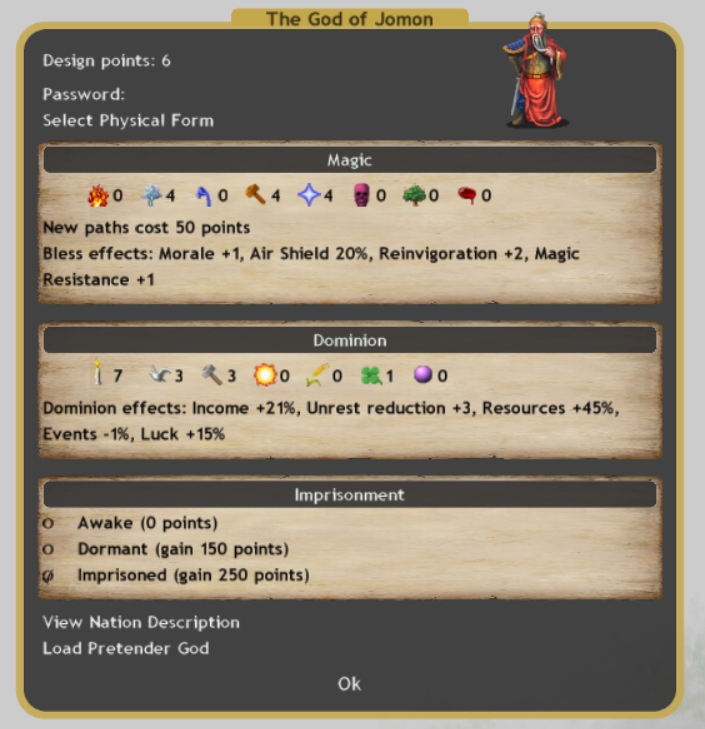
What’s new in Dominions 4: Thrones of Ascension

This entry is part 1 of 4 in the series Dominions 4
A game of Dominions begins with creating your pretender god. In my case, I've chosen the Celestial General, a powerful air, earth, and astral mage whose land is thriving and prosperous.
A game of Dominions begins with creating your pretender god. In my case, I’ve chosen the Celestial General, a powerful mage whose land is thriving and prosperous.

I’m several hours into a preview copy of Dominions 4, the follow-up to one of my favourite strategy games. Dominions 3 was user-unfriendly, a beast to learn, and a devil to master; it was also deep, rich, and rewarding, both in its gameplay and also in its mythically-inspired lore. For newcomers to the series, Gamespot’s review is very fair and, I think, very good at identifying who will like and who will not like Dominions; meanwhile, for those interested in what made Dominions’ atmosphere and worldbuilding so remarkable, check out a guest piece I wrote at Flash of Steel several years ago. For series veterans, Dominions 4 is recognisably an evolution, not a revolution; going from 3 to 4, the differences are much less visible than going from 2 to 3, or 1 to 2. However, the changes are real and, from what I have seen, positive. Here’s what I’ve noticed:


New content:

* While most of the nations in Dom4 are returnees from the previous game, each of the three Dominions eras (early, middle, late) has received a new nation or two.

*I also spotted a number of new pretender chassis, new magic items, and some new spells (e.g. some painful-looking high-level direct damage Water spells; new Nature buffs/debuffs).

Read more

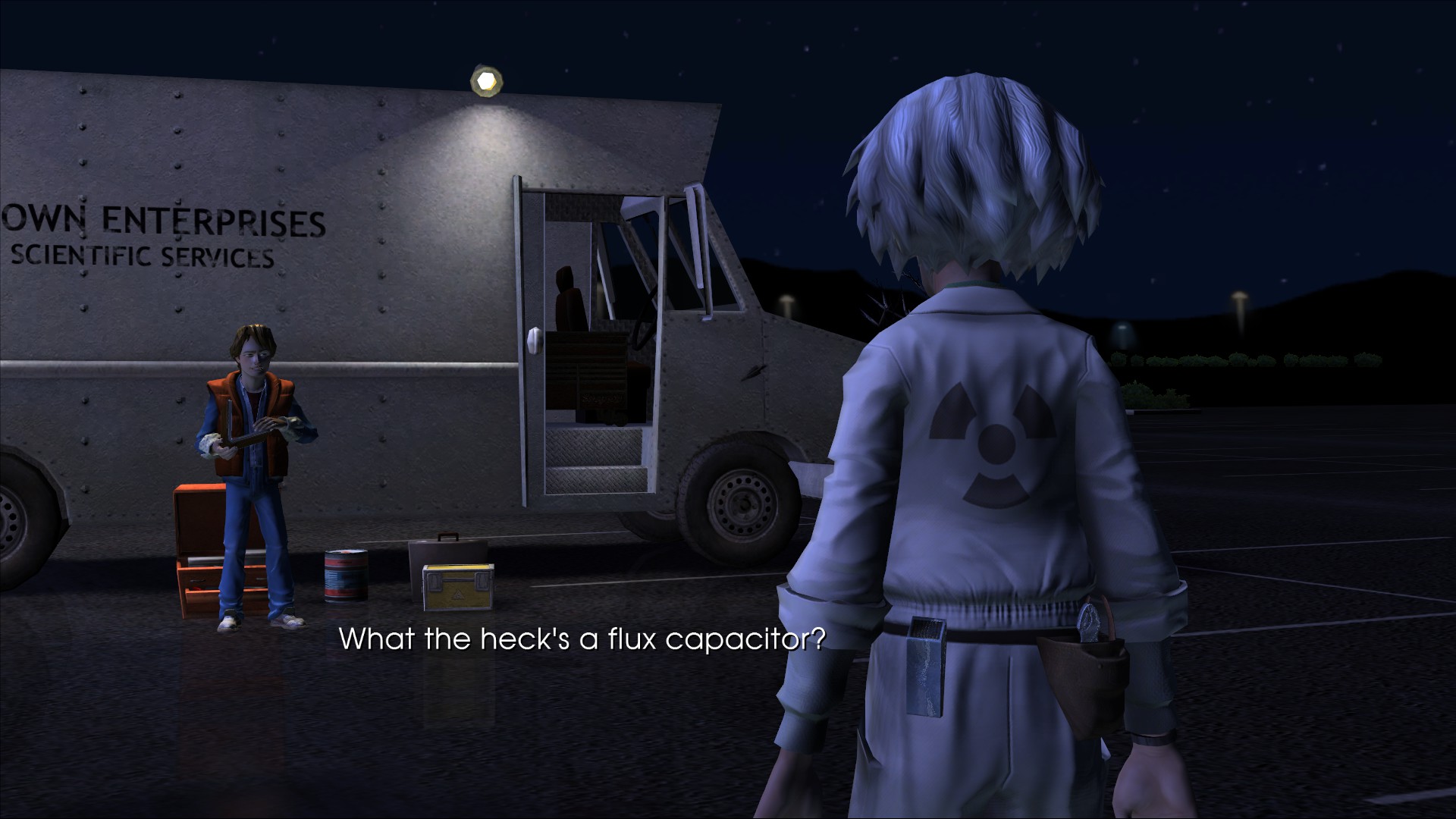
A formula for success: Back to the Future: The Game, Episode 1

For a fan of the movies, Episode 1 of Back to the Future: The Game strikes just the right balance between familiarity and originality.


I’ve just finished Episode 1 of Back to the Future: The Game, a 5-part point-and-click adventure game from Telltale Games of Walking Dead fame. (I estimate Episode 1 is around 3-4 hours long, which suggests that the entire series is 15-20 hours.) Rather than overlapping or rehashing the Back to the Future movies, the game is an original story that “begins” sometime after the end of the trilogy. It is very much a traditional adventure game, in which players control Marty McFly as he solves puzzles, uses items on the environment, and makes wry observations on his situation; if there are any elements of action or reflexes in BttF, I haven’t seen them yet. So far, I very much like it for two reasons: it succeeds both as an adventure game and as a homage to the movies.


As an adventure game, Episode 1 of BttF has the genre’s traditional strengths: it’s witty to the point of being laugh-out-funny, and solving puzzles makes me feel like a genius. The puzzles themselves are sensible and well-designed – no cat-hair moustache here! – and one, in particular, is amongst the best puzzles I can remember in an adventure game; while not challenging, it’s unique, hilarious, and perfectly fits the characters’ situation (1). Production values are a mixed bag; I do not find BttF’s graphics very attractive; but its excellent voice acting makes up for it.


As a homage to the movies, Episode 1 works equally well. The voices, as noted above, help; Christopher Lloyd reprises his role as Doc Brown, and AJ Locascio does a great job as Marty. But the writing is key, and I wish I could spoil it for you! As is, all I can say is that Episode 1 strikes the right balance between familiarity (“hey, cool, this is just like the movies!”) and originality; while it recycles the movies’ formula, the juicy details are all its own.


Overall, if you enjoyed the Back to the Future movies and you are a fan of adventure games, you should definitely check out Episode 1 of Back to the Future: The Game. While I can’t vouch for the quality of the other episodes, I do look forward to trying them out.


(1) For those of you who’ve played the game: “You’re treating me like a BACTERIA!”

Musical Monday: “Xaltocan” (Expeditions: Conquistador), composed by Leonardo Badinella

This week’s theme is one of the overworld tracks from Expeditions: Conquistador, a sort of alt-historical King’s Bounty in which players command a band of Spanish explorers/conquistadors in sixteenth-century Central America. It is a good game, and it owes some of that success to the atmosphere created by the music. Enjoy!

Read more

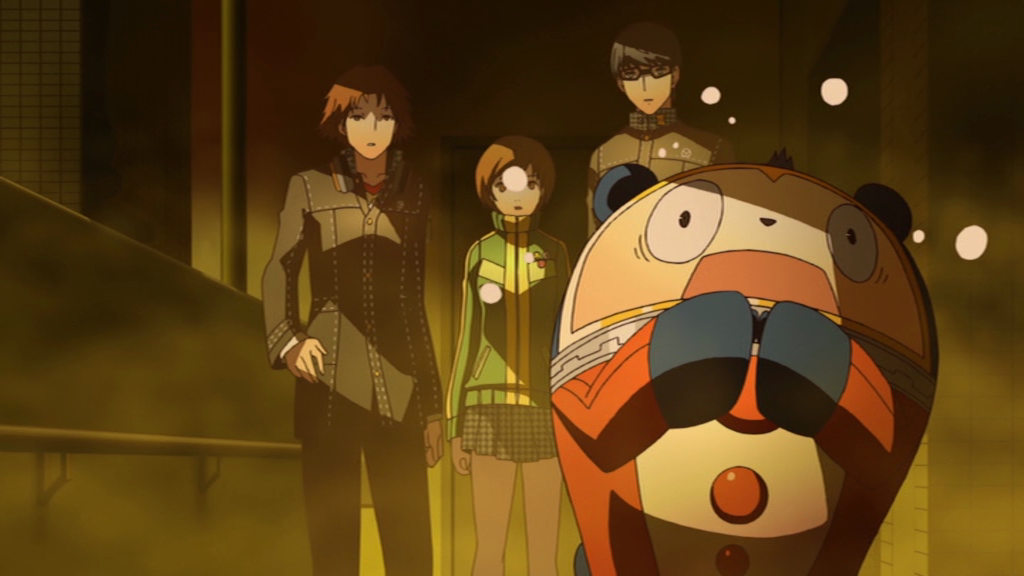
Does a good game make a good anime? Persona 4: The Animation – eps 1 to 9

This entry is part 7 of 8 in the series Persona 3 & 4

Persona 4 Anime - Our HeroesI’m nine episodes into Persona 4: The Animation, the anime adaptation of the excellent PS2/Vita RPG; as I would like to eventually finish the game (I am “only” 30 hours in), I have paused at this point in the anime to avoid spoiling myself. The anime is a lot of fun, worth the money I spent on it… and yet, I can’t shake the feeling that it is a guilty pleasure.


The anime does a number of things right. For one, it has very strong source material, with a great premise: Persona 4 follows several teenage friends who, in the course of investigating murders in their sleepy country town, end up fighting their own literal and metaphorical demons. P4’s characters are goofy (perhaps a bit more so in the anime), amusing (I’ve laughed so hard, the other passengers on my commute probably think I’m bonkers), and yet human and relatable. The anime’s fight scenes are spectacular – the titular Personas have never looked better – and its production values are excellent; the anime’s art is vibrant and attractive, and I routinely grin when it uses music from the game’s soundtrack. So what’s the problem?

Read more