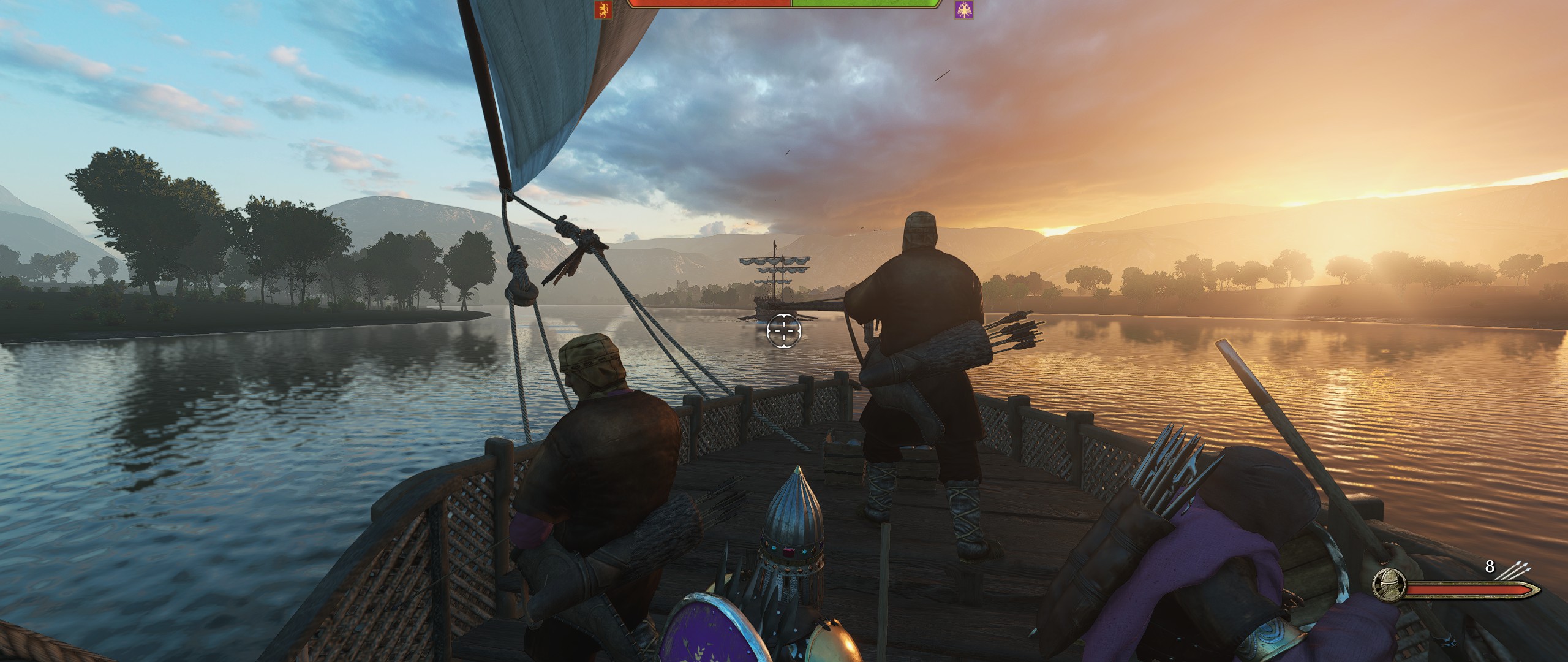
A custom naval battle in War Sails. I love the atmosphere and immersiveness.
This screenshot is from “War Sails”, the naval-themed 2025 expansion for Mount & Blade II: Bannerlord. I bought the expansion on the recent Steam sale, and after messing around with custom naval and coastal battles, fell in love with the atmosphere all over again. I look forward to making headway in my new campaign.
New releases: Terra Invicta DLC
Pavonis Interactive and Hooded Horse have just released Terra Invicta’s first DLC, “Dark Skies”. This adds two new starts for the campaign: one set in 2003, and a “Broken Earth” scenario set in the early 22nd century, as the remnants of humanity limp back into space 150 years after a nuclear war. It also adds new cosmetic ship sets.
Both new starts look quite distinct based on the pre-release footage I’ve seen:
2003 Earth is still at the apogee of the unipolar moment (making the US more dominant as the opener), but there is much less space launch capability (Boost) than in the base game (2022 and 2026) scenarios and Earth is technologically 20 years behind. Word on the Discord is also that it’s harder than the base game.
Broken Earth’s countries are in an abysmal state (poor, politically shattered, militarily backwards, and authoritarian) compared to the base game. The factions receive large and distinct bonuses (such as Earth research and laser weapons for the Academy), and it looks like they will need them…
It will be a while before I can get around to the new scenarios — I’m still playing the base game campaign that I started with the 1.0 release. At least I finally have the aliens on the run!
The two expansions are “The Neutral Lens” (casting the player as a journalist — Steam link here) and “Socialist Republic of Galmland” (moving to a new country).
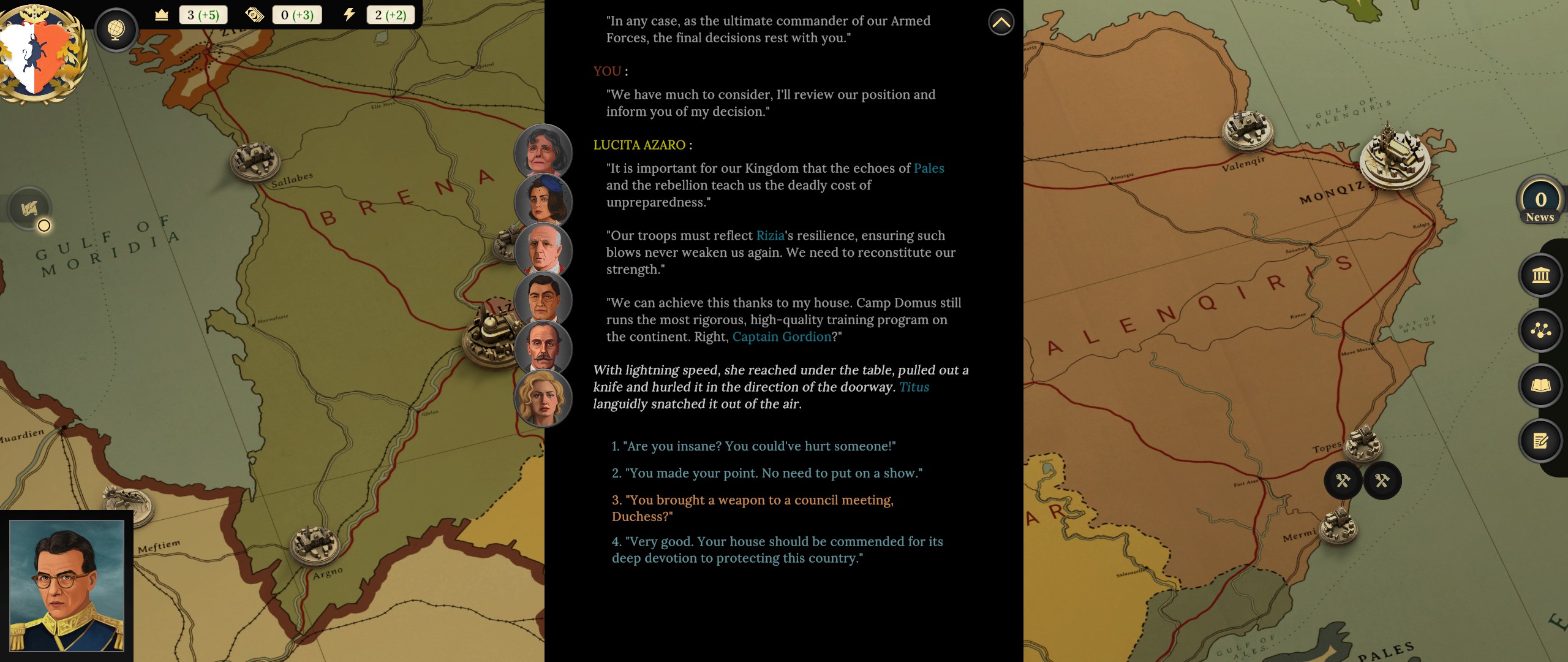
The spinoff game is Wars of Suzerain, which fleshes out the military system from the “Kingdom of Rizia” DLC into what sounds like a fully fledged wargame. It shifts to a new perspective by casting the player as a general of Rumburg, who were the heavies in the original game.
“Neutral Lens” is due out first (2026) with Wars of Suzerain and “Socialist Republic of Galmland” to follow in that order.
My picks for Game of the Year are WARNO and Metaphor: Refantazio, both of which I wrote about.
WARNO successfully iterated on Eugen’s real-time tactics formula, and gave me many hours of fun during an often-challenging period.
I picked up Metaphor: Refantazio late in the year, and it wowed me with its style, dungeon-crawling, and character interactions.
The runners-up
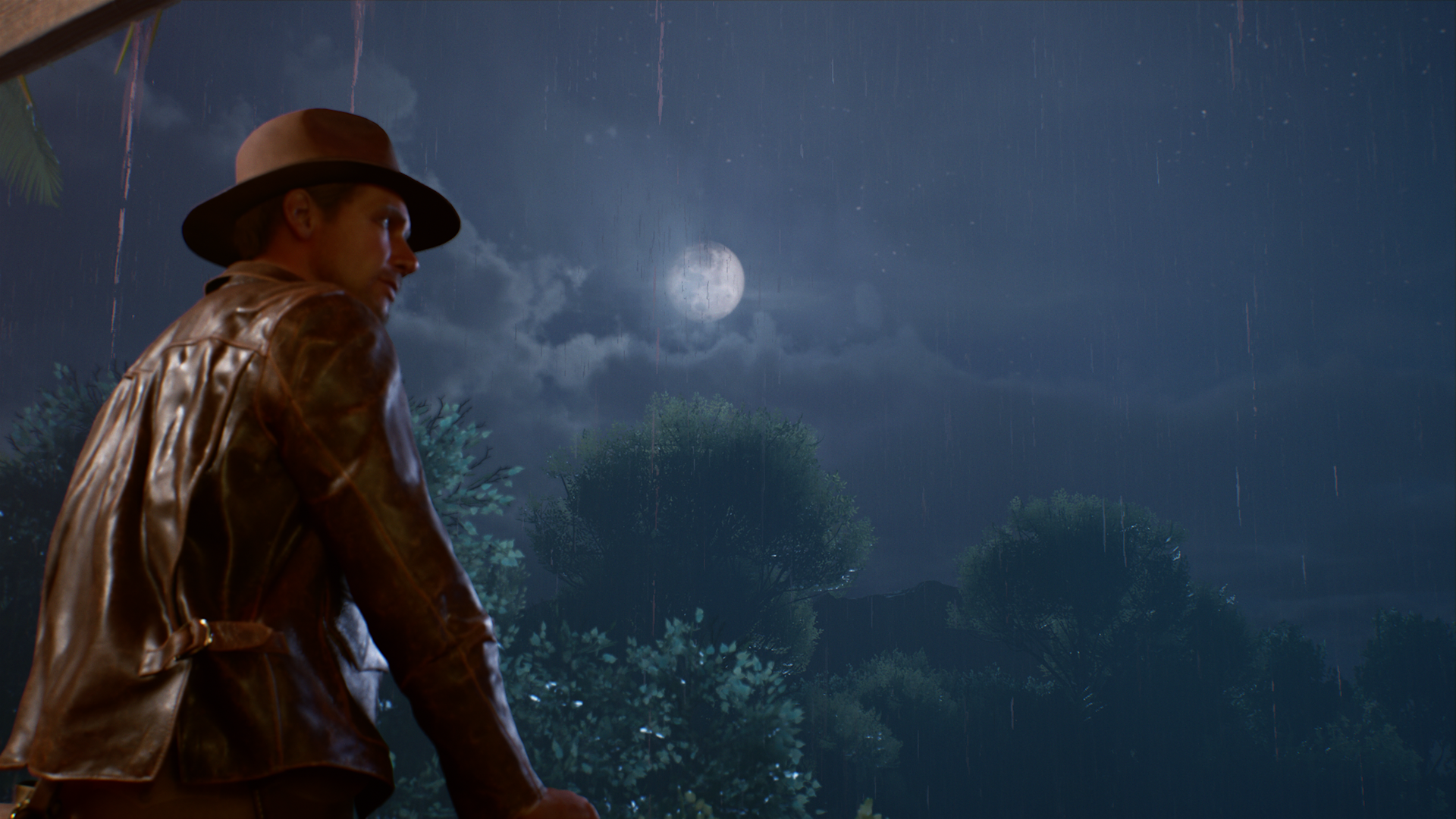
I would place Indiana Jones and the Great Circle just a notch below. This is not so much the game’s fault as a matter of personal taste — later areas moved away from the verticality, focus on freeform exploration, and gorgeous architecture that enchanted me so much in the first area, the Vatican.
Unicorn Overlord is mechanically excellent and in terms of sheer hours, was one of the games I played most in 2024. Had the writing been better, it would be higher up my list.
What titles from previous years did I discover or revisit?
After 13 years!
There were a lot of beefy, evergreen strategy games:
I revisited Old World and Crusader Kings III in response to the release of new DLCs. Old World, in particular, is a perennial on my end-of-year lists.
Anno 1800 is another perennial. I even put together a to-do list on pen and paper, as I continued working through the tremendous amount of content in the game.
Inspired by the excellent new Shogun TV series, I revisited Total War: Shogun 2 — and finally won as the Oda clan, the first clan I ever tried!
I revisited Terra Invicta and found it coming along well, two years after it launched into Early Access.
I revisited Emperor of the Fading Suns (link to my original write-up from back in 2011), a classic 1990s 4X game that has been updated and re-released on GOG.
I also tried Fantasy General 2, Field of Glory 2: Medieval, and 40K: Gladius for the first time (and dusted off FOG2‘s predecessor, Sengoku Jidai). While its production values are limited, Fantasy General 2 made a good impression on me.
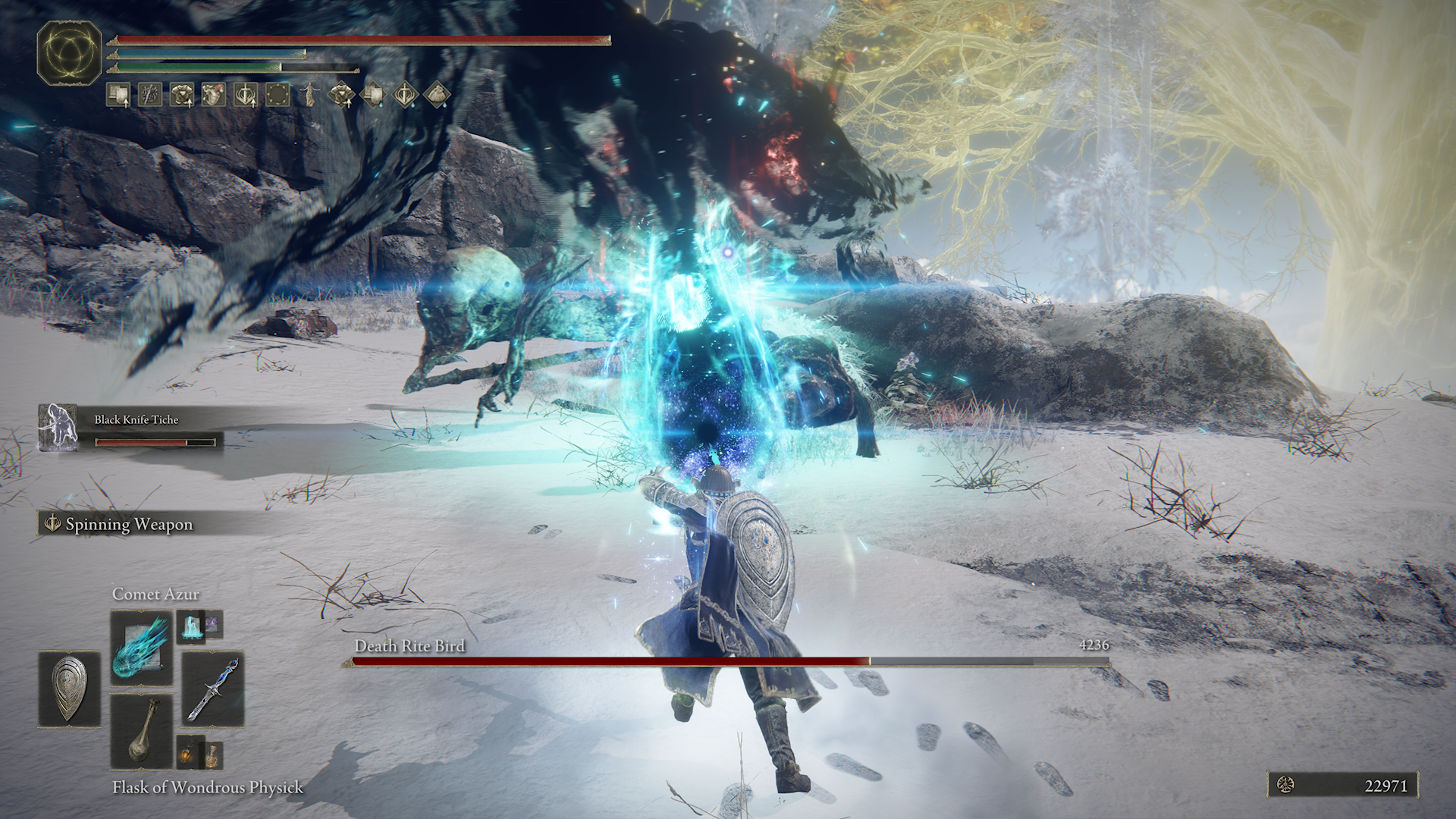
Fighting a field boss in Elden Ring.
Non-strategy games included:
Zelda: Tears of the Kingdom was my favourite game of 2023, and I finished in 2024.
I revisited Elden Ring and made it most of the way through the base game — up to the Fire Giant — as well as starting on the DLC.
A Legionary’s Life was the standout “short-form” game I discovered in 2024.
Revisiting Mount & Blade II: Bannerlord took much of the shine off (my original write-up from 2020), as this time the core gameplay loop felt much more repetitive. But what it does (spectacular battles), it does well.
I discovered and enjoyed Suzerain’s base game, leading me to pick up the “Kingdom of Rizia” DLC.
Potionomics is charming, although its central loop (brew potions, sell potions, buy ingredients to make more potions, repeat) hasn’t kept me engaged as long as some of the other games on this list.
On a technical note, I switched to a new theme, GeneratePress.
Upcoming releases
There’s only one game release on my radar, the imminent Civilization VII.
In terms of hardware, I am very interested in the upcoming Switch 2. If Nintendo releases it at a reasonable price and with a decent launch library (a new Mario Kart is already visible in the trailer video), then I’ll look to buy it as soon as I can after launch.
I look forward to seeing you around for the rest of the year.
Suzerain is a work of interactive fiction about leading a country, set in an imaginary world reminiscent of the early Cold War. Since its launch several years ago on Steam, it has become a cult classic, and both the base game and DLC impressed me when I played them earlier this year. They tell engaging stories that feel true to their subject, making them well worth a look for news and politics junkies.
Enjoying this site? Subscribe to updates here:
Text-heavy interactive fiction
So far, there are two stories available:
The base game casts the player as Anton Rayne, the newly elected president of Sordland, as the country emerges from 20 years of one-man rule.
The “Kingdom of Rizia” DLC shifts the focus to a new country and a new character, King Romus Toras.
In either case, playing Suzerain involves a lot of reading. Players read story events as they unfold, proceed through dialogue, and choose conversation responses to progress the story. Occasionally there is legislation to approve or veto. “Rizia” allows the player to be more proactive, as King Romus can issue royal decrees that might include starting work on a new dam, exploring for resources, consolidating provincial militias, or funding a new university.
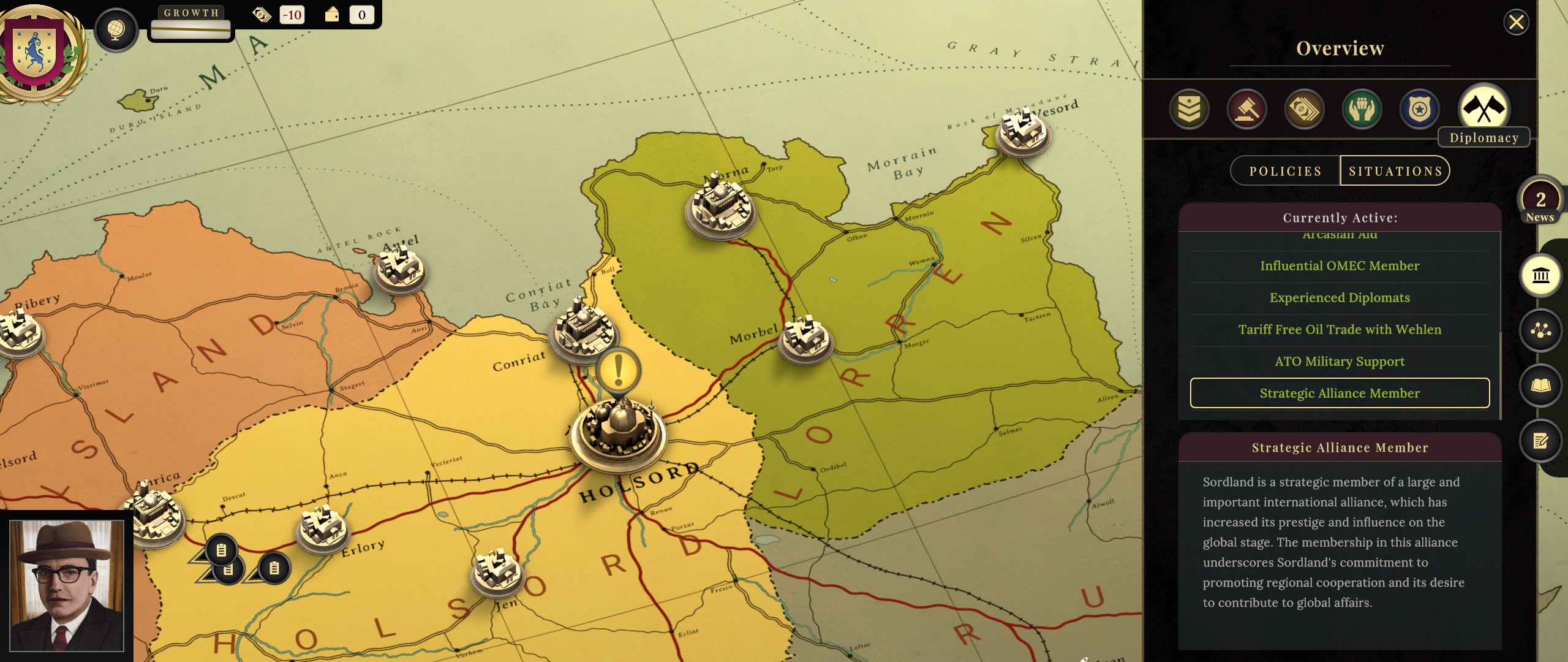
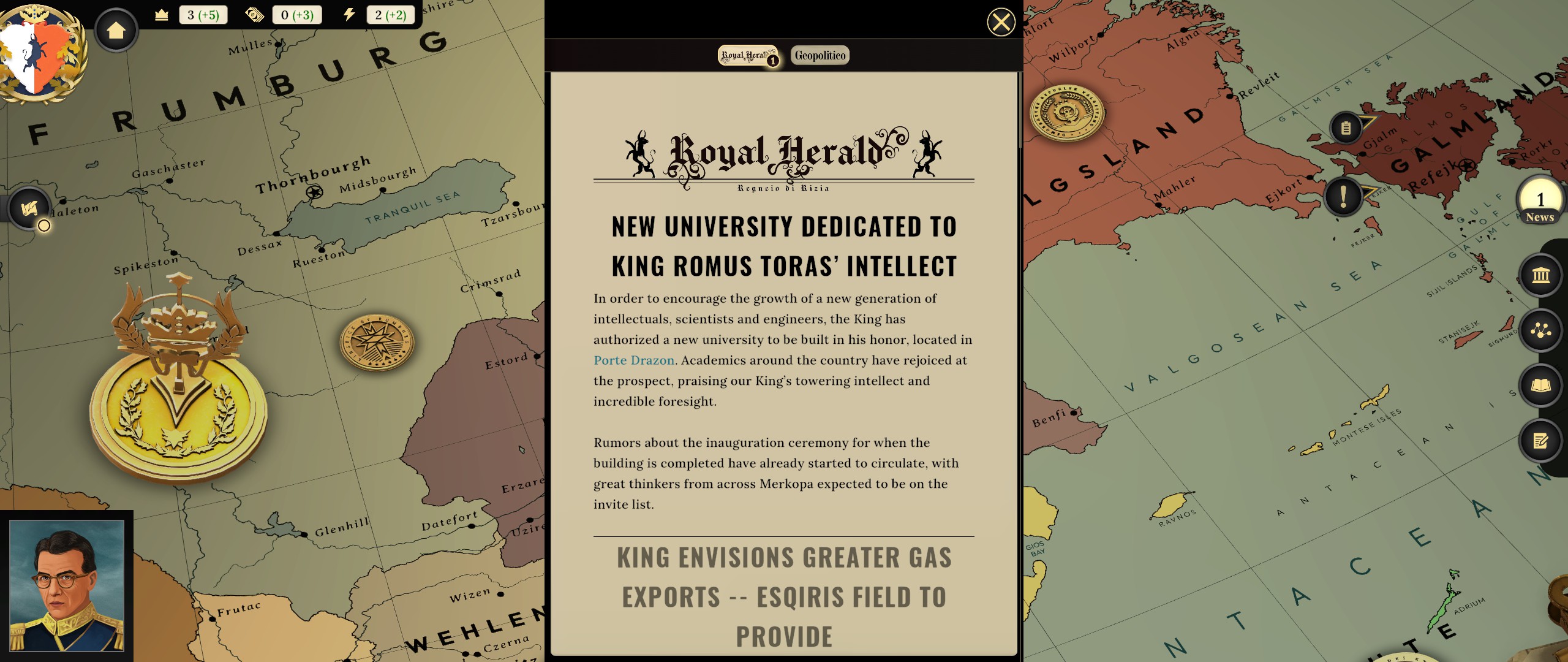
Left: Active modifiers for Sordland in the base game, resulting from my diplomacy. Right: A Rizian decree.
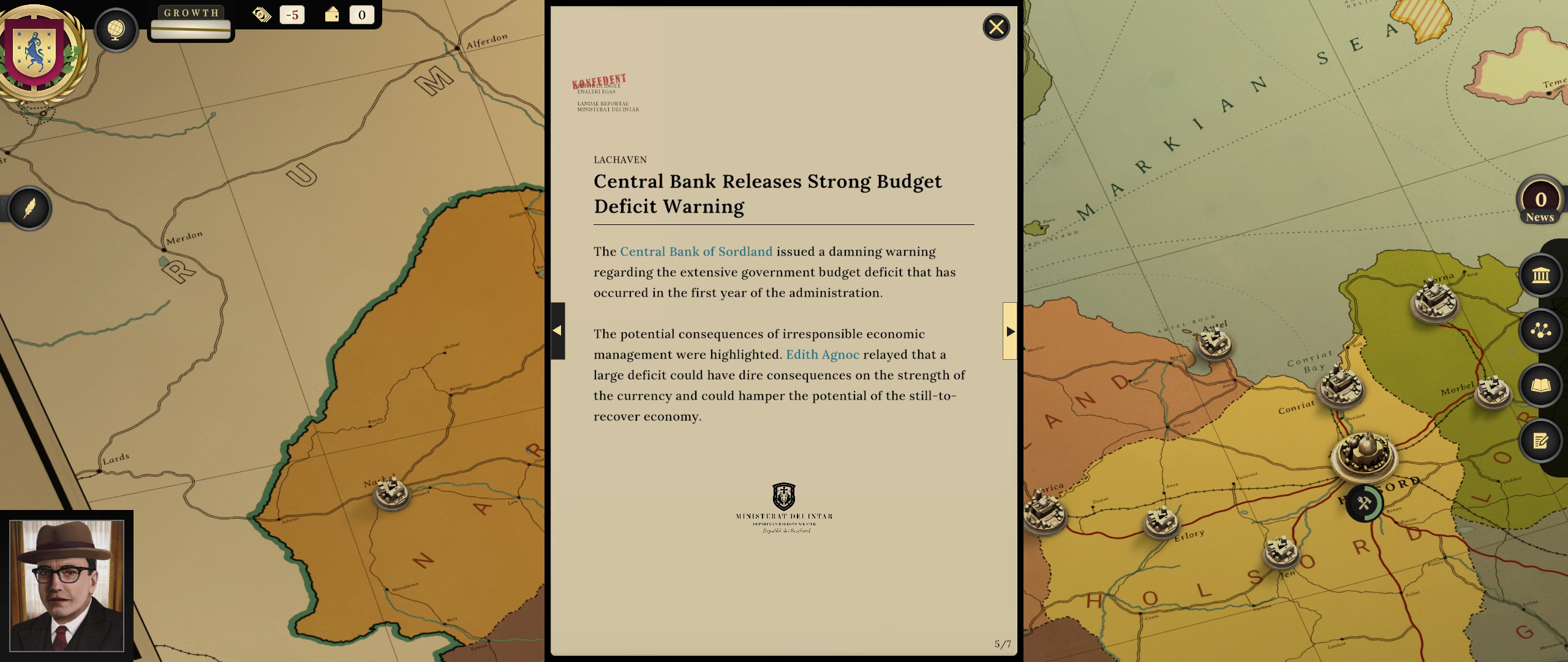
Instead of the numerical resources and stats of a strategy game, Suzerain presents information in a qualitative way. Characters may warn in dialogue that a problem is brewing. Clicking on cities will show modifiers that currently apply to their regions. A sidebar menu keeps track of various indicators, ranging from school quality to the strength of the air force. Finally, the many newspapers of Suzerain’s world will comment on current events from their different perspectives — some more neutral than others.
Rizia lacks a free press at the start of the game. As such, its Royal Herald can be sycophantic.
Throughout, the writing is effective. The characters feel like people rather than strawmen, and events can be gripping — or downright stressful. The prose can be slightly formal, wordy, or stilted, although I can forgive it in the case of dialogue explaining policy options — that can be justified by the game’s need to explain information.
Uneasy lies the head that wears the crown
Whether in Sordland or in Rizia, the player’s nemesis is “events, dear boy, events”. Plot twists come thick and fast, presenting a constant stream of crises. And on a first game, it’s necessary to work out characters’ loyalties on the fly. Who supports which cause, who can be a useful ally, who is out for themselves, and who are the idealists and the patriots?
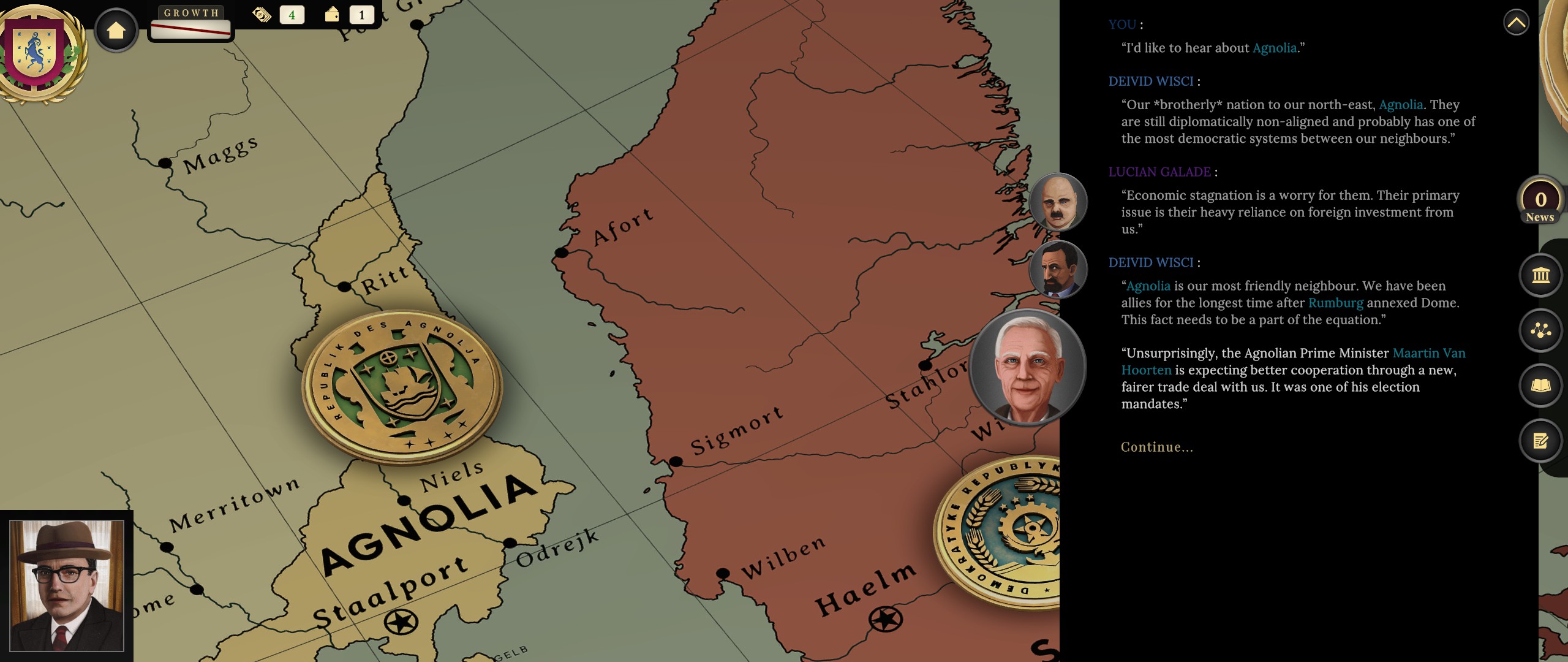
Left: Deivid Wisci, Rayne’s mentor, is one of the good ones. Right: Duchess Lucita Azaro is one of the more memorable characters in “Kingdom of Rizia”.
Compounding this is the messy situation in which both countries begin the game:
Sordland, in particular, rests on a knife’s edge: the economy is both statist and riddled with cronyism, the recently retired strongman still commands an influential “old guard” of loyalists, there is significant tension between the majority Sords and the minority Bluds, and an expansionist neighbour is watching with hungry eyes.
Rizia is better placed, but faces its own challenges. While the Rizians may dream of regaining lost lands, the current rulers of those lands have ideas — and allies — of their own. Domestically, while King Romus is an absolute monarch in theory, in practice his power is checked by the aristocratic families who rule Rizia’s component duchies.
My base game run was a disaster. I set out to be a reforming liberal while trying to make everyone happy. I learned the hard way that this made no-one happy instead. My signature reform, updating Sordland’s authoritarian-era constitution, failed to pass. Saying yes to everyone’s policy wishlist led the country into a debt crisis. The economy cratered. Next to that, my achievements (increasing access to healthcare and education, strengthening opportunities for women, befriending a Great Power, and deterring a would-be invader) paled: I lost re-election by a landslide. The conservatives hated my economic reforms; the liberals liked me but not enough to vote for me over their own candidate; and the far left, far right, and minorities hated me, period. Looking at the list of possible endings, I was probably lucky not to be overthrown or assassinated.
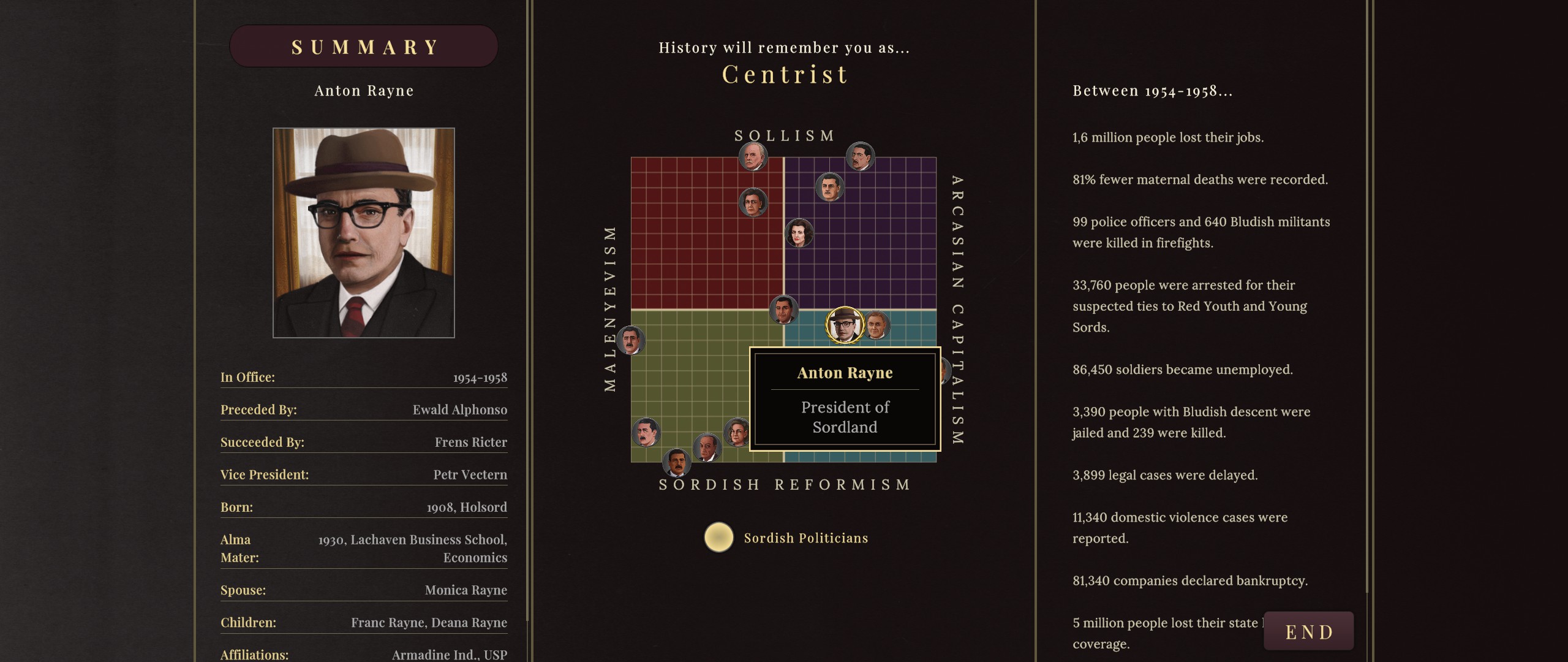
The ending of my first game. Don’t ask what happened to Sordland’s GDP.
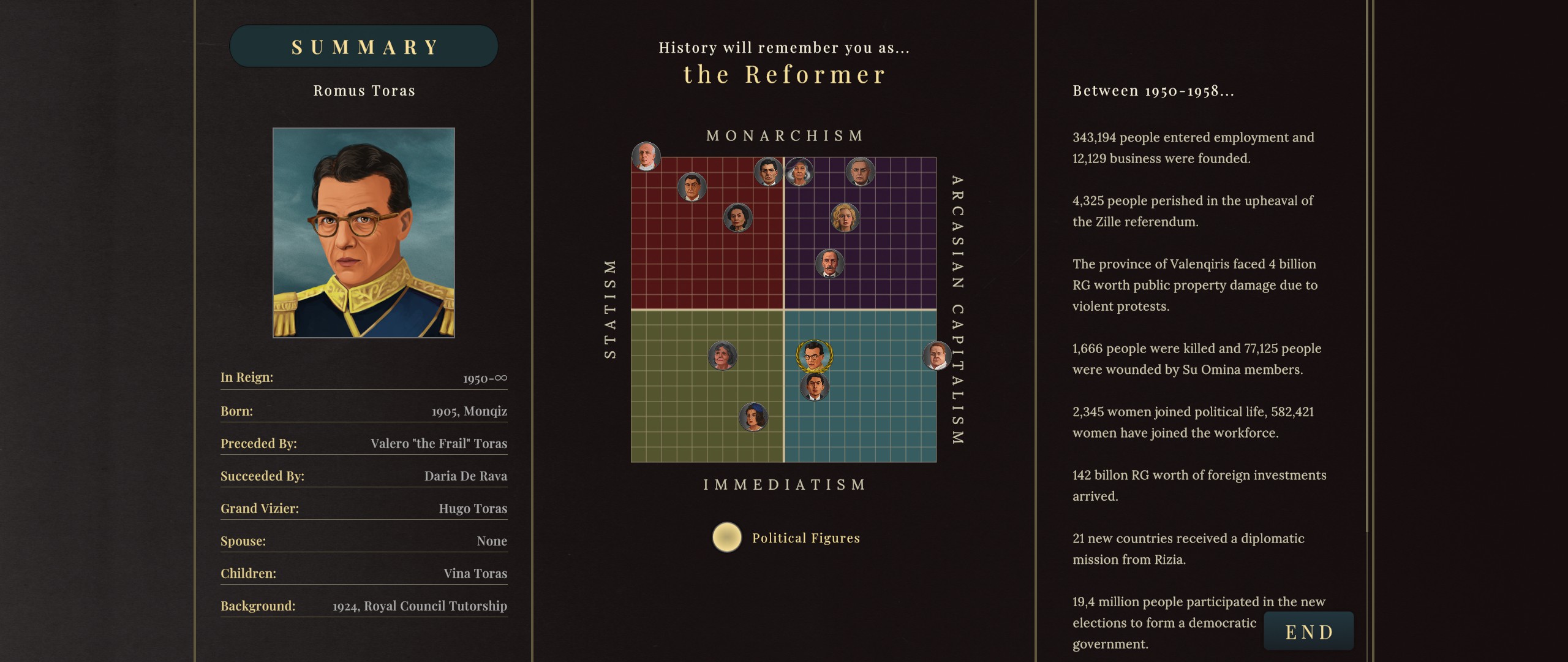
I did much better in Rizia. This time, I played more cautiously, focused on establishing strong economic foundations, and gradually and incrementally advanced my reforms. I turned the country into an energy-exporting powerhouse, then used trade and energy deals as carrots to peacefully reconcile with Rizia’s estranged neighbours. At home, I reformed Rizia into a constitutional monarchy with power held by an elected prime minister; and saw Romus’s heir, Crown Princess Vina, grow into a wise, confident, and compassionate woman. Compared to the shambles I made of Sordland, this was night and day. But perfection eluded me; I failed to recover lost Rizian land from the neighbouring dictator.
The rather better ending I secured for Rizia. Long live Romus the Reformer!
Less predictable than a strategy game — but also scripted and finite
While Suzerain is not a strategy game, it does share similar themes. In some ways, I find Suzerain more convincing:
Strategy games are mechanically-driven, so they require transparent rules and predictable outcomes.
Suzerain can be more opaque, and throw more unexpected events at the player, because it is narratively-driven. Nasty events are part and parcel of the story.
The flip side is that strategy games are unscripted and replayable: new events unfold each time. Suzerain has a wealth of content, but it is scripted and finite. Yes, there is a lot I haven’t seen. Yes, there are many paths I could take on a replay — I could follow different ideologies1, befriend different characters, or execute better on my original goal. But I still know what happens next. As someone who incessantly replays strategy games but plays narrative games once, so far I’ve yet to replay either story in Suzerain.
Maybe I can avoid this mess next time?
Conclusions
For anyone interested in their subject, and who enjoys this kind of narrative game, Suzerain and “Kingdom of Rizia” are easy recommendations. There is something authentic in how the base game and “Rizia” bring their messy, complicated countries to life — and while I’ve focused on the turmoil, my experience in “Rizia” showed how the game depicts hope as well. I’d love to see more content in this universe.
But not become a murderous authoritarian. Some of the content I’ve seen is pretty disturbing. ↩